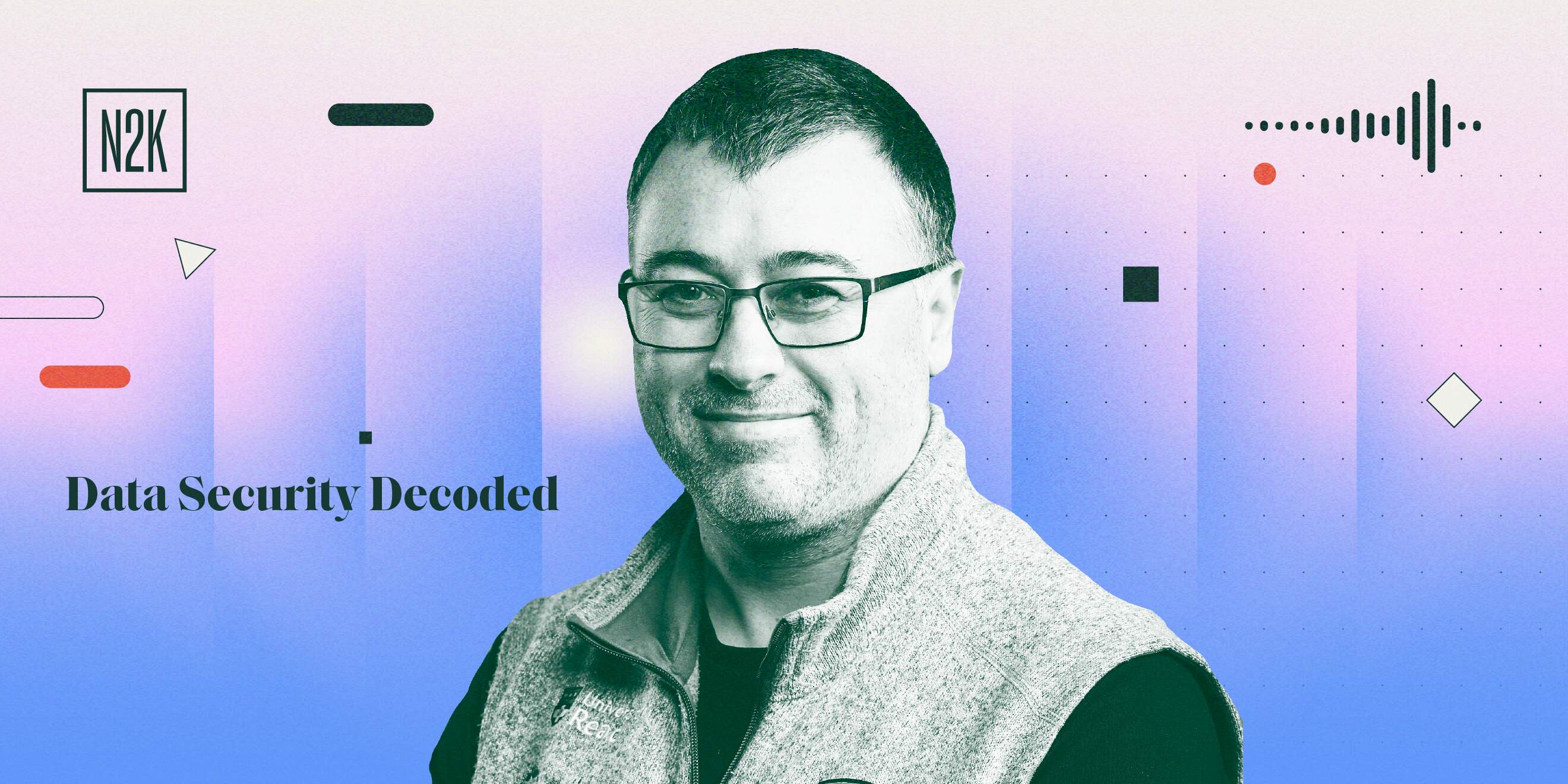


Securing Research Infrastructure and Managing Shadow AI with Kevin Mortimer







Kevin Mortimer: There's pros and cons to supporting a vibe coding world. I mean, ultimately, the direction of travel is that everyone's going to be a system developer. I don't think we're going to be able to avoid that. If you're involved in technology, at some point in the near future, you will become an AI developer. [ Music ]
Caleb Tolin: Hello, and welcome to "Data Security Decoded". I'm your host, Caleb Tolin. And in this episode, I sat down with Kevin Mortimer from the University of Reading to discuss the importance of community tied to his work, the threat landscape as it relates to higher education and research universities, and the AI realities for education. Let's get into it. [ Music ] Well, welcome to the podcast. I'm really excited to have you on. And I know you've spent your entire career in technical roles. And I'd really love to hear more about that journey and what led you to leading a technology team at a university.
Kevin Mortimer: Yeah, cool. Well, first off, thanks for having me. So I've been in technical calls now for around 25 years. Most of that is leadership kind of positions as well. When I first left uni, I actually went to a local ISP. That's still a quite big thing because broadband hadn't really kicked off at this point. And, but I learned a lot of the raw skills around it. I learned how to support teams and how to work with teams, but also the actual ISP had a payment gateway platform, and they were one of the few payments gateways, apart from something of like Wellpay and some of the few others. So I learned a lot about infrastructure and security in that point and that really kind of sort of set the scene for me. So I joined in 2017 and we were one of the first enhanced customers, one of the first Rubrik customers, one of the first missed customers. So we've got quite a few firsts across the infrastructure space, and I'm always looking for new technologies coming and be disruptive and see how we can get that value from that, those early days of interactions where we can really help shape the product to what you need that way. And all those companies I've mentioned that we have done some really good stuff with. And that's for me what really excites me too and that's why I go to work every day. It's not about, you know, it's how can we be better, what we're going to do, and my team of 25 always trying to do things better.
Caleb Tolin: Right, right. I love that. I love that and I know you do a lot of volunteering outside of your technical roles and your traditional, you know, 9-to-5 job. Leading Cub Scouts on Tuesday nights, serving as Chair of Governors at your local school board. You know, these are some of the things that you mentioned to me. What draws you to that kind of community investment and how does it shape your role at the university?
Kevin Mortimer: I think for me it's about, you know, being better at something or helping others be better. And by me giving, so, a lot of it is based around, like, my children and I want to kind of give them some really good morals in terms of life's bigger than them, and I want them to really focus on how they're going to help people, and, but by helping them by not doing things for people, but actually being better and helping guide and bringing in different levels of expertise and supporting people through that. So those are the sort of things that I really enjoy through doing the volunteering pieces.
Caleb Tolin: Right, right. I love that mindset. Well, let's dive into some of the nitty gritty of the cybersecurity aspects of your job. And so I believe it was about seven or eight months ago at the end of 2025, PwC put out a report that labeled higher education, obviously the sector that you work in, as a prime target for espionage and cybercrime, cyber events in particular. From your seat, what does that threat reality actually look like day to day?
Kevin Mortimer: The main difference for me is the diversity of the type of customers or the staff or students that we have, the levels of tech savviness that they have. Some people are really good at spotting things like phishing campaigns, some really aren't. So it's about building the tools out to try and stop them getting through in the first place. But also trying to ensure that our customers actually have the right tools themselves to be able to identify things. So at the moment they know they can report things to us if they believe they've got a suspicious email. Those suspicious emails sometimes are genuinely suspicious. Often they're just not expecting it, but they feel their confidence, that they can ask the question. And I think that's for me the value piece that we're trying to add there. But because it's such a vast level of experience we have across the people using our technology, we've got to kind of sort of allow for the lowest common denominator, but not hold bad people back there, let them grow if they want to grow as well. I mean, a lot of research is pushing boundaries with AI and some of the research. So we need to make sure that we're supporting them, but also keeping everyone safe underneath that.
Caleb Tolin: Right. Right. Absolutely. And you've been in your role for nearly 10 years now. We're approaching that. And over the time, we've seen a lot of shifts in geopolitics. We've seen a worldwide pandemic happen. And you're at a university that has a lot of valuable research data. So what did that period of time where, like during COVID you had, like I said, some of the most valuable research data out there. Was there a spike in espionage activity? Was there, like, what was the cyber landscape like for you and how did you respond?
Kevin Mortimer: So one of the things that I've always been really fortunate about is our CDIO, Shebra, has always been very supportive of me and what I've been trying to do and bringing things in. The day of lockdown when everyone went home, we had a conversation and said we need to turn on LFA for everyone and make it mandatory. There's no option. This was a Saturday morning call we had, and we jumped straight onto the call with the exec board and had, you know, just got their approval too, because it's quite a big change to people as well.
Caleb Tolin: What was that conversation like? Was it a difficult one? With the board?
Kevin Mortimer: It was, yeah, absolutely, just get it done. The university are very supportive of what we're trying to do to keep things safe. I think most organizations have cyber risk at the top of the risk register. Now, what that means will vary across organizations, but it's really about how we then kind of use the situation that we're in to kind of highlight that and then use those to make decisions. We're not being too reactive to a situation. We're trying to be actually, we're more thinking forward to about how can we mitigate a risk rather than wait till something happens. But no, but during COVID generally there was an opportunity for us to bring in some better measures. We rolled out our protection, how we managed our protection within Rubrik change as well. So rather than doing now it's cloud direct, but I'm putting it into our own Azure tenancy. We actually put our research data into the Rubrik cloud or platform, which meant that we had a limited degree of separation from the data. So if worse, if we were compromised, we knew that even the data would still be protected and be secure. And it's those sort of examples I guess that we, we're always trying to look at how we can improve things and not be happy that if something's working, if something better comes along, let's go for it and give it a go.
Caleb Tolin: Right, right. And as a higher education institution, many organizations were affected by the Canvas attack. And it really kind of shifted how, or it highlighted how attackers' goals have really shifted over the years. It wasn't about locking down systems. It was about extracting student data to fuel targeted spear-phishing campaigns. Are you seeing that pattern more broadly? Is that something that you see in your role regularly now?
Kevin Mortimer: There certainly was and certainly still is, to be fair, a direction of trying to stop the university working. It's not always about the data, sometimes it is, you know, kind of a DDoS style kind of approach, just shut the organization down. But I think one thing that has really shifted in recent months is actually the move to the supply chain for education. Some of those providers that provide student data records, they've now been targeted more than actually the universities themselves. Once that data has then been distracted from that, that's then been turned to attack the university itself. So there have been examples where data from a third-party compromise has then been used to actually target students to try and get some money out of that way. So it's a secondary attack that they're looking to now go for. So it's getting more and more complicated and more convoluted. And, you know, we are fortunate in the UK that we know we have some great partners with Jisc and Microsoft remote supporting us through that piece across the whole sector as well to give us that visibility.
Caleb Tolin: Wonderful, wonderful. And we have to talk about AI. I have to know what your AI implementation is looking like. And I know you're looking at building some anomaly detection response playbooks, where you're leveraging some AI agents to detect something suspicious, spin up a live mount, defend the environment. Where are you on that journey and what does building that kind of autonomous response look like in practice?
Kevin Mortimer: So I guess we're at the early stages. For me, it's about looking forward, it's about where you want to go and just have that vision around things. We have an AI policy we haven't adopted too widely across the organization yet. I think there's been a lot of trial work on how the financial and commercials around that looks like, as well as then the data sovereignty question, how are we going to govern that data and what those guardrails look like. These challenges are being worked through. So, the scale part is hard and we have some researchers that we know are actively using AI for example but then there's guardrails around what they can and can't do. The actual agents themselves, this is for me where with Rubrik it's not just a standalone tool. I want to bring in all of the technology across my infrastructure that I'm supporting. So if I get a security detection from our firewall, I can then use that to then interface with Rubrik, and then Rubrik can tell me what, maybe there was a suspicious activity from a couple of days' prior, which can then feed back and give us to, you know, signpost us to where in the firewall logs to maybe go back to. Which then can shut down certain paths if we detect there's certain activity happening, influence our micro segmentation, and how we interface with the hypervisor. So it's the ecosystem that I'm really interested in. As individuals, systems and people, that's, you know, very difficult to actually orchestrate with the introduction of web coding and the MCP platforms. And having something to bring all together and have that agent-to-agent communication, that is where we're going to get the value and the scale to be resilient with our systems and services. Because these systems, they're great at isolation, but as a collective, they're even more powerful. And data very rarely only exists in one place to highlight these security issues.
Caleb Tolin: Right, right. And you already touched on a couple of my next questions, so we'll go ahead and shift into those. So, I'll start with you mentioned MCPs, and we also have talked a little bit about token management and things like that. So in a university where you have researchers, students, staff, tons of different, universities are huge organizations. They all have varying different needs and risk profiles as well. So how are you approaching the governance question of token management and what MCPs you're actually looking to deploy?
Kevin Mortimer: We've got a very limited official AI kind of tool set at the moment that we are supporting as an organization. I think a lot of that comes down to kind of the price model and how we're going to manage that licensing, and which tools should we or shouldn't we be using. Personally, I want to use a tool that's great for code. So, looking at Claude and Codex, they're the ones that I, my teams are going to get a value from because those tools are geared up for that sort of capability. Whereas if you look at Copilot, that's great for managing your productivity, you know, data. So you're trying to find the right tool for the job, but then putting the governance around it and educating those in those governance roles about how AI works and what that means. It's very easy to read the horror stories and some of the sort of the, you know, some of the fake news that's out there and there's a lot of AI washing as well to contend with. So how do you know what's true and not? So, these are the things that we're kind of working through at the moment. You know, I'm using Claude to help write just some scripts at the moment to allow me to achieve things. I have a few private instances in my own personal labs of different technologies that I've started to interface with and with the MCP part of it, but that's my own personal data at that point. Just to kind of get a feel so as long as you come for those governance steps, we can then take those concepts and bring them in internally. But like, yeah, it's quite a complex world of trying to, of education, really, about how AI works and what things mean and don't mean.
Caleb Tolin: Right, right. It's not a straightforward question. So.
Kevin Mortimer: It's a very long answer, sorry.
Caleb Tolin: No, no, no, it's very good. And you mentioned vibe coding earlier as well. So now that we have these tools that can help anyone become a coder to some extent, and as somebody who cares so deeply about security, how does this democratization really outweigh new risks? Or does it just move the problem elsewhere?
Kevin Mortimer: There's pros and cons to supporting a vibe coding world. I mean, ultimately the direction of travel was everyone's going to be a system developer. I don't think we're going to be able to avoid that. If your role touches technology, at some point in the near future you will become an AI developer. You want to be an AI creator, not an AI concealer, is definitely the concept that I want to hold myself to. You know, financially, you want to be generating income, not spending. So that's kind of the approach that we're trying to think about things with. But it's just bringing all those bits together and the vibe coding itself. So the examples I'm using with vibe coding, it's these proof-of-concepts, and do some scaffolding on projects. So I've been looking at a mobile application for university. It's not just a student one, but an overall one. But building into it things that can interface with our timetabling system, with networking tools. Not doing those integrations directly, but, you know, just building the capability that by plumbing in some variables, it would allow us to connect and do the bits. For me, that's, it's those proof-of-concept pieces where I think vibe coding great at. As soon as you want to take that into a product that you're managing, that's when you need to put the better controls around it. You need to have quality assurance around things. But yeah, so I think vibe coding is great for proof-of-concepts, you know, hone the pet projects. As soon as you go on to scale, that's when you just need to have more eyes on things and have a lot of validation.
Caleb Tolin: And who even knows, between the time when we're recording this and when the episode goes out, at the time of recording this, Fable was just released and then retracted. Mythos, we've been hearing about it for weeks now and its capabilities. So when Anthropic releases even more sophisticated models, when OpenAI releases these, like, more frontier models, then more of that's just going to become easier and more accessible for that vulnerability scanning and all of that as well.
Kevin Mortimer: So, I just, so I think shadow IT has been around ever since there were IT teams, right? And I think with shadow AI as well now coming in, the accessibility of it, though, is what is quite dangerous. I think around that data governance and with Mythos and Fable, and we always seem to be talking very much around the US-based organizations that are creating AI tools. If we look the other direction around the world, you know, there's less guardrails in place, there's less of those controls. The intentions around removing Fable from the marketplace might have been different to the outcome it was trying to achieve, but you won't get that from a Chinese product. They'll, it'll just be opened up and I think the more we try to control these AI tools, the more people that have lesser intentions will just find a way around them and it'll be consuming. We shouldn't say they open the floodgates and let people fill the boots, but how to find a happy medium is definitely a challenge there.
Caleb Tolin: Right, right, right. A little hot take sprinkled in there. I appreciate it. So as we're kind of rounding out, what are three actionable steps that you want every IT and security leader that's focusing in higher education to take right now before the next attack hits?
Kevin Mortimer: I think there's a couple of key points people can do. I mean, first and foremost, make sure your permissions are right, your data. So look across your data sets, understand what, who's got permissions to that. Then, start monitoring those permissions as well. If you're not, if you don't know who's got access to things and how they're being accessed, you don't know what anomalies look like. Those two things themselves are massive. I think, and I think the final thing really is just looking at about how those attack services are going to come in. And there are already some really good AI tools out there that can look at public recordings of people's videos and voice, particularly those senior leaders who often have those sort of public presentation and kind of roles, and are then being turned into ways to attack an organization to try and extricate money and other things. So I think educating people around how to identify, spot some of the deepfakes and having those, maybe some tells and some secrets that only you know with people is the way forward. How you then manage that and govern that, that's a whole different challenge. But there's some, so the basics around data management essentially I think is where people need to be investing in first.
Caleb Tolin: Right, absolutely. The fundamentals are always important. It's going to be true time and time again. I want to ask you two inconvenient truths about AI in higher education where you sit as a technologist. So one that universities need to accept about how their actually deploying and governing AI today, and one that AI vendors and tool builders need to hear about whether their products are truly built for the higher ed environment.
Kevin Mortimer: So I think from a education lens, every student is using AI tools. Students generally are very switched on with technology. They are also not a, they don't seem to care too much about privacy, either. If you look at how they interface with social media, you know, they're very open to using those tools, where the older generations can sometimes be a little bit more reserved. So it's how do we then, the bit that I think everyone's struggling with is how do we kind of manage that in the education space? How do we accept that students are using AI but not hold it against them as part of their learning? And there's ways around that in terms of do you allow them to cite AI in their papers? Say, well, actually, AI wrote these bits for me. I mean, if they're submitting it, they're submitting it as themselves. If they can put some AI references into those papers, then actually that they're recognizing that they're using it, and they're saying it's what they believe, and they validated it. It's a bit like if they go and pick up an encyclopedia and they go to a certain page and they quote something from there. They're trusting what the encyclopedia has said is true, and they're using it as part of their own work. How that then turns itself in, so I think this can really transform how education works. If I look even further back from higher ed into the more younger children, this is all going to become normal for them. They're not going to know anything before AI, and it's going to be how, so they're going to have, like, everyone did wherever part of technology generation you are, you always had a way around things. And so they're going to find their ways around things as they get older, and the technology and educators needs to be ahead of their game and identifying things and ensuring what they're producing, you know, falls within those governance guardrails.
Caleb Tolin: Right, that's a great one. I love that. And then what is your inconvenient truth that you want the AI vendors and tool builders themselves, what's the message you want them to hear that they maybe don't necessarily want to hear about whether their products are truly built and favor higher education in terms of the use case?
Kevin Mortimer: I think more generally, I want to see vendors explaining how their technology works. So they can't just go tell and say, oh, we're using this LLM. Okay, great. But how are you doing that? What math model essentially are you using behind that? And there are different, you know, everything around AI is essentially just using a different mathematical model to get the outcome. So how are they using that data? And when I go to conferences, I'm always asking the vendors, so how does your AI work? And what math model sits behind that? What do you mean by that? And if they can't tell me, it's probably because they're in a sales role. Yeah, okay. But often, I think for me that's a credibility piece. If the vendor can tell you not exactly how it works but some of the ways and how they think about it, and how they bring data efficacy in, and how they manage that, it kind of gives you that reassurance. They actually know what they're doing, and it's proper AI. It's not just a badge they've stuck on. There's so much AI washing out at the moment and it's really hard to unpick. And so whenever I say, oh I told AI, the first question I say, okay tell me what math model you used to. Just pick one, doesn't have any doesn't have to be, it won't be just one they use, but just pick one. And they often can't. And I think that for me is a credibility piece. There are some vendors that are very good at being open about this as well, by the way. So, you know, it's fine. For me, that gives you the reassurance that they actually understand what they're doing. And by investing in their product, it's not the kind of, going to be a proper kind of stream.
Caleb Tolin: Right. You've got to filter through the AI tool slop. AI slop, it's happening across content, it's happening across tools, it's happening everywhere. So that's a great piece.
Kevin Mortimer: For me, it reminds me of the cloud-era days. The answer was public cloud. Maybe what's the question? And we've seen a reversal from some public cloud, where it's not always appropriate to store things there, usually from a cost basis, to be honest. And I think the same thing is going to happen with AI. At the moment, the answer is AI to everything. It will come to a point where, actually, AI is great for these sort of things, but we don't need it to do these bits and pieces. We can do that in more traditional ways, but at the moment we haven't worked out what those different ways and rules are around things. And, but the difference between the cloud piece is acceleration is, to get to that point, is so much faster. It's going to be really interesting. I think that's where it goes to our tokenization. And originally you had a flat fee for using AI tools. Now a few vendors are bringing in tokenization costs and different charge models, because frankly it's not affordable to keep doing it as they have been.
Caleb Tolin: Right.
Kevin Mortimer: But then those, but once you're sucked into that kind of way of working, it's really hard to then go back to what you used to do. And I think it's being open to the fact that tokenization is a problem and managing your way of using technology to get the best outcomes, whilst also being smart of how you're using the tools as well.
Caleb Tolin: Right, right. Talk about mathematical models you have to do.
Kevin Mortimer: Yeah.
Caleb Tolin: Absolutely. Well, wonderful. What is the most important message you want to leave with our listeners today?
Kevin Mortimer: I think the biggest message is to embrace technology change, but understand the value outputs you're getting from that, rather than just being a free fool. To me, that's the tricky part. Getting people to articulate what they're trying to actually achieve and why is often the most difficult thing for people to articulate. Some people might use AI tools. I don't know. But, yeah, I think that then leads into then how you're going to achieve those outcomes? What tool are you going to use? How are you going to make sure it's secure and appropriate? And that essentially is educating people to get the best outcome they can from their technology stack.
Caleb Tolin: Yeah, I love that. I love, I was kind of forecasting what you were going to say in my head, and I thought you were going to say, embrace the technology, don't fear it. But you said embrace the technology, but understand the value. And I think that's a really, really critical framing, especially as these AI, like, cost models are changing. It's definitely something that I know more businesses are starting to understand, but even other businesses need to start having that realization as well.
Kevin Mortimer: Well, certainly organizations are still struggling with the OpEx, CapEx models with public cloud particularly. How are they going to cope with tokenization and changing pricing models in AI? And I think that's going to, that whole financial world, if you like, is going to be hard enough to unpick, let alone what are people using the tools for.
Caleb Tolin: Right, right. Well, thank you so much. I appreciate it. And until next time.
Kevin Mortimer: Thank you. [ Music ] That's a wrap on today's episode of "Data Security Decoded". If you like what you heard today, please subscribe wherever you listen and leave us a review on either Apple Podcasts or Spotify. Your feedback really helps me understand what you want to hear more about. And if you want to reach out to me directly about the show, email me at data-security-decoded@n2k.com. Thank you to Rubrik for sponsoring this podcast. The team at N2K includes producer Liz Stokes and executive producer Jennifer Eiben. Content strategy by Ma'ayan Plaut, sound design by Elliott Peltzman, audio mixing by Elliott Peltzman and Tre Hester, video production support by Brigitte Criqui Wild and Sarelle Joppy. Until next time, stay resilient. [ Music ]