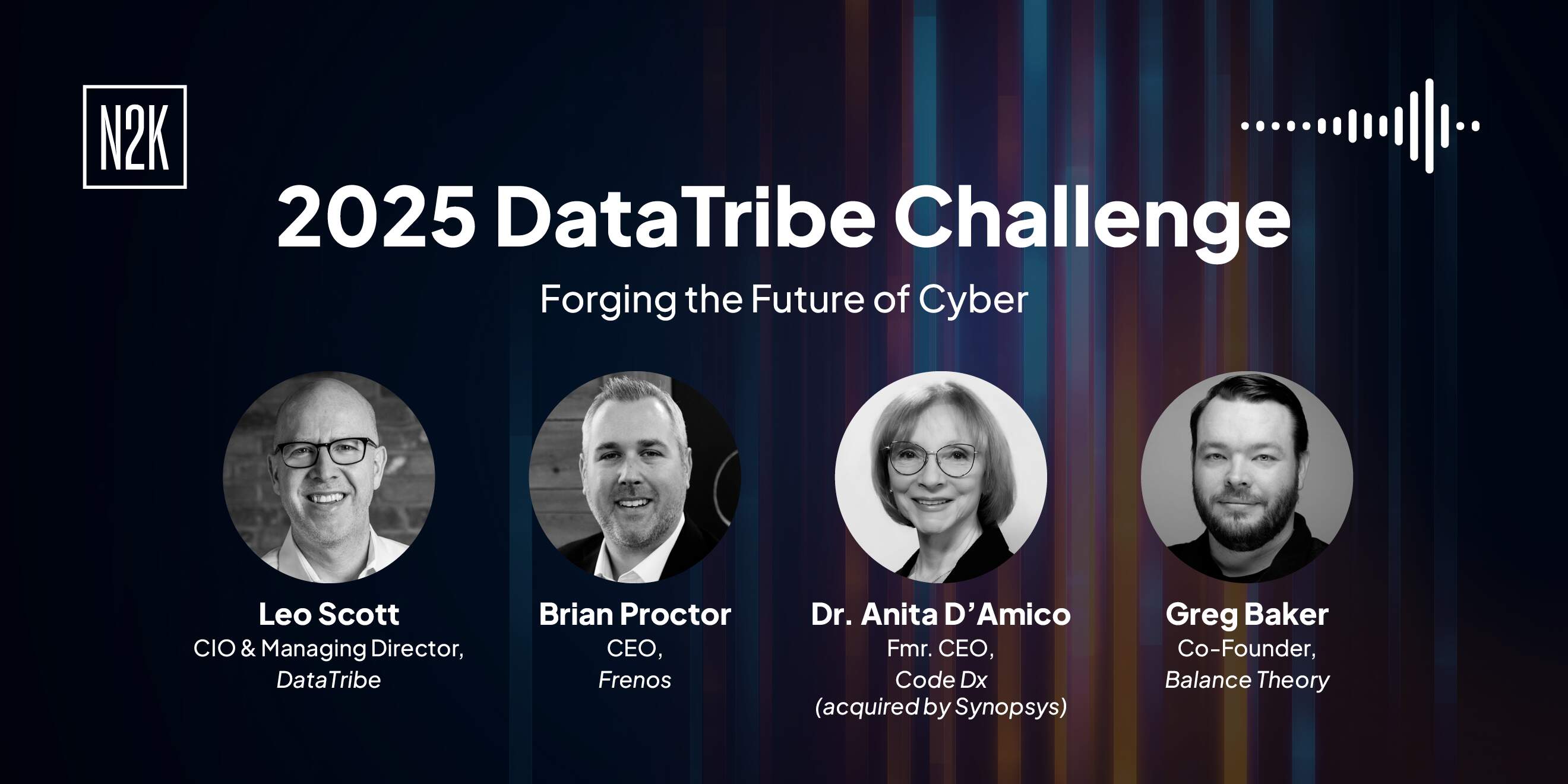


2025 DataTribe Challenge: Forging the future of cyber.





Dave Bittner: Hello everyone, and welcome to a CyberWire Special Edition. I'm Dave Bittner. Now, full disclosure up front, the CyberWire is a DataTribe company, so yes, we'll admit, we're tooting our own horn a bit in this episode, but with good reason. The DataTribe Challenge has become one of the most important stages for cybersecurity startups, helping bright ideas grow into industry leaders. In this CyberWire Special Edition, we're taking a closer look at the DataTribe Challenge, a competition that's launched some of cybersecurity's most promising startups. We'll hear from Brian Proctor of Frenos, last year's winner, about what it takes to capture the top prize. Greg Baker from Balance Theory shares his experience inside the DataTribe Foundry and what it means to prepare for the next big leap. And Anita D'Amico of Code DX reflects on the full journey from Challenge winner to a successful acquisition by Synopsys. And since the DataTribe Challenge is the reason we're here, it's only fitting we hear from Leo Scott, Chief Innovation Officer at DataTribe. He's at the center of this program, guiding founders through the highs, the hurdles and the big wins. [ Music ] Well Leo, let's start with some high-level stuff here. I mean, can you give us a little bit of the history of the DataTribe Challenge, how it began and what led you to where we are today?
Leo Scott: Yes. So, the DataTribe Challenge we've been running for now, this will be the eighth year. We started eight years ago in building an event that would -- took place here in the DataTribe office. In many of the years after that we've run the DataTribe Challenge in the office, in our Maple Lawn office. And this year, we've decided to go much larger and have moved down to a much larger venue, down in the Washington D.C. area in the Navy Yard area and have expanded to have an all-day event. Historically, the event was an afternoon event. Mostly local and a few people would come in from out of town, but this year, we've expanded to have an all-day event, pushing to have a lot more people come in from out of town. And the event, it's not just the event, but it's -- it's become almost a -- a whole program at this point where we will boil down to now, five finalists and we'll then work with the finalists. We'll assign a coach from DataTribe, a DataTribe member for each of the five finalists. We'll coach them over a two-to-three-week period, working on helping them to build out their messaging, refine their messaging. All that goes into their pitch. And then they present live at -- at the actual DataTribe Challenge pitch competition.
Dave Bittner: And why a competition? Why that format for this?
Leo Scott: Well, it's twofold. It gives opportunity for the actual startups to be able to get in front of a -- a relatively large audience in a live situation. They're all out working on -- on raising money. And so, it's very important in that process for them to build relationships and get in front of as -- as many venture firms as possible. The competition format will add excitement to the actual event and makes it an interesting event and can be a -- a fun time for all to participate when -- when they're actually watching the event.
Dave Bittner: Tell me about the judges. It's quite an esteemed panel that I've seen you assemble year after year.
Leo Scott: Yes, yes. Each year we have a panel of five esteemed judges who are generally very senior cyber executive, cyber visionaries. This year is -- is no exception. We have five great judges this year. The -- the judges are Bob Ackerman who's a co-founder at DataTribe, Jason Clinton who is the CISO at Anthropic. It's a -- you can't really go a day without talking about AI and Jason is -- is right in -- in the -- the thick of things there at Anthropic and worrying about the -- the -- the security aspects of -- of AI. We have Marty Roesch, who's based in the area, a founder at Sourcefire and -- and now a -- a founder and CEO at Netography. We have Harry Coker who was previously a -- a National Cyber Director and -- and is now the -- at the Maryland Commerce -- Commerce Secretary at the State of Maryland. And then finally, we have John Bruns who has been CISO in many different positions that started at actually this Howard county, moved to be the CISO at State of Maryland and then CISO at Anomali, and is now working on a -- a very interesting startup helping smaller organizations with cyber needs with the Cyber Ready Clinic that he's working on.
Dave Bittner: So, what can we expect from the day itself? What sort of -- what -- what's the flow of that day?
Leo Scott: Yes, so this -- this year we will -- the -- the all-day agenda will start in the morning with networking breakfast, going into a keynote and a number of interesting panels in the morning, talking about how innovation that is happening in a digital world impacts cybersecurity. So, cybersecurity is very interesting in that it's kind of the tail of the dog or the wake of a boat. And that as -- as you have the -- all the innovation going on in the digital world being the boat and then cybersecurity is everybody running around trying to figure out how to deal with the wake. And so, that's kind of a theme this year. And we will cover that type of theme in these panels. Then we then have a -- a lunch, and then in the afternoon, we have another very interesting panel, the Tech Podcast Host Showdown, which Dave, you are -- you are going to be moderating that one. That should be an excellent time. And we'll go into really the main attraction of the afternoon is the DataTribe Challenge pitch competition. And then we'll finish it off with -- with cocktails, bourbon tasting and -- and -- and a -- a reception dinner. So.
Dave Bittner: In terms of the companies who are applying for the competition, what is the sweet spot there? Who are you looking to attract?
Leo Scott: Yes, we are looking for companies at the pre-seed/seed stage, where they're looking to raise money, their really first institutional money. They'll generally have a product. They may or may not have their first customers. That's the type of company we're looking for. So, really kind of just getting started in their journey. And then they're looking to solve really over-the-horizon, interesting, really big problems. And if -- if you're, you know, at that stage and really working on big, interesting over the horizon problems in the -- the area of cybersecurity, online trust, digital privacy, anything in the general cyber arena.
Dave Bittner: Tell me about some of the winners. I mean they've gone on to success.
Leo Scott: Yes. So, every year DataTribe has ended up investing in at least one of the finalists, mostly the -- all the winners. And they have done very interesting things. So, we've had nine of our portfolio companies are -- are from the DataTribe Challenge. We've had one of the DataTribe Challenge winners from 2019 Anita, D'Amico from Code DX. They had the full experience. They joined DataTribe in the DataTribe Foundry. They built the company and ended up selling the company to Synopsys, for a great outcome for -- for that company.
Dave Bittner: What are the actual prizes here? What's at stake?
Leo Scott: Each year we offer 25,000 in prize money to the finalists. And the way that that is allocated is each finalist will get $5,000. And then in terms of the winner, really, the winner gets bragging rights of the -- the -- the -- winning the challenge, not 100% guaranteed. We have historically invested in -- in the winner each -- each year. And so, it's a -- a very likely chance that we will end up investing in the winner. This year, one of the really great aspects about really expanding the DataTribe Challenge and the -- the overall all-day event is the number of very high-quality, cyber-oriented venture firms that are -- are joining us this year. We've always had some venture firms, but we have a list that is really a who's who of -- of cyber venture firms and they will all be at the event, listening intently to the -- the -- the pitches. And so, if it's not DataTribe, it could be one of -- of many, many other venture firms that could find what the -- the winner or the finalist is -- is doing and -- and could end up investing.
Dave Bittner: Yes, I think it's a really good point that, you know, beyond what's at stake here with the prizes, this is really an opportunity for an up-and-coming cyber company to be seen.
Leo Scott: Exactly, yes. And I think that's one of the -- the biggest opportunities. There's -- there's some of the -- the value add of coaching, but also just being able to -- to get in front of all of these great venture firms at a time where most all of these companies are looking to raise is super valuable for them.
Dave Bittner: Who do you want to come to the event itself? Who -- who are you looking for the attendees?
Leo Scott: Yes, so we have a -- four types really of attendees. It is -- the event overall is an invite only event, but -- and we keep somewhat of a control of -- of who's coming. But the main set of attendees includes obviously all the early-stage cyber startups. And really any stage cyber startup we are inviting and is more than welcome to join us. There's the cyber-oriented venture firms, or if it's not 100% cyber-oriented venture, cyber-curious, at the -- at least venture firms. We also have cyber executives, tech execs, tech and cyber visionaries. That's a -- a third group. And then the final group, this year we're really pushing on that early over-the-horizon view and so, we're -- we're inviting university researchers as well. And so, we'll even have some of the university researchers participating in -- in the event as -- as well.
Dave Bittner: Leo Scott is chief innovation officer at DataTribe. [ Music ] Anita D'Amico led Code DX from Challenge winner to Foundry participant through successful acquisition by Synopsys. Anita has seen the full arc of what this program can deliver, and she shares her perspective on how the challenge shaped that journey. So, today we're talking about the journey that you had with Code DX, and specifically how that interacted with the DataTribe Challenge. I'd love to start off with a little bit of the background here. What led you to the position where you were part of Code DX?
Anita D'Amico: Code DX was a spinoff from another company that I was at, where I was the director of a division. That division was specifically focused on cybersecurity R and D. And for about 15 years, I had been pursuing mostly government-funded cybersecurity R and D. We would look at a hard problem in cybersecurity and do analyses and build prototypes of potentially groundbreaking technologies. So, I decided that it was important to take some of that research and apply it, turn it into operational solutions. And so, I went on several efforts of trying to commercialize the results of various research projects. And each time I did it, and -- and failed or became a little bit more successful, I learned something through the process. And finally, when I had a research project that led to the Code DX technology, I realized that we could no longer be part of a services company. We were doing software services and research services, and instead I needed a product company that would stand on its own. So, we spun out a separate company, Code DX Incorporated, which was designed to commercialize the results of our DHS funded R and D. After that, I became the CEO of Code DX and started commercializing the results. We already had the technology developed. We were fortunate to have that technology funded by a combination of DHS R and D funding, as well as an investment from the owner of the company from which we were spun out of, which was Applied Visions Incorporated. So, we had a technology, we had about a dozen customers, and we needed more funding. With Code DX, I was in an unusual position because we had about a dozen customers and a little less than a million dollars in ARR and a renewal rate, a very nice 90% renewal rate. And so, we weren't exactly positioned for early seed funding, but we were not big enough for Series A. And I went on a quest to find a -- an investor that could see the value of what we were doing and put some money into it. And that wound up being DataTribe.
Dave Bittner: Yes. What led you to finding DataTribe and ultimately the DataTribe Challenge?
Anita D'Amico: DataTribe found me. I -- I had been looking at various VCs and wasn't having a lot of luck. And then I ran into John Funge at a Wall Street conference. I was actually pitching somebody else at the table, further down. And John kind of sidled up and said, "Hey, you know anything about DataTribe?" And I said, "No." And he had heard the story about how we had worked on various government-funded R and D, and he said, "Well, we're situated right outside of Washington D.C., and we're very interested in the kinds of technology that companies like you develop." And it turned out that the following week I was going to be at NSA for another reason. And you know that DataTribe sits not very far from NSA, so I wound up going down there and talking to John.
Dave Bittner: And -- and what ultimately led you to participating in the DataTribe Challenge?
Anita D'Amico: A great opportunity to put CODE DX in front of a lot of people. Not only DataTribe, but other investors and -- and other consultants and to actually tell our story. I was also really interested in participating because I thought the process of doing the challenge itself, even if we didn't win, would be very valuable. The kind of structure that the DataTribe Challenge imposes on a startup requires you to be able to tell your story succinctly and to really, in a very short period of time, show the value of not only the technology, but the business. So, that's what I thought would be very beneficial for us.
Dave Bittner: Can you take us through that experience? I mean, from -- from heading up to -- to get up on that stage and -- and presenting your story, what was that like for you?
Anita D'Amico: I think that doing the actual presentation was probably the least nerve-wracking experience. It was the two days prior to that, that was very difficult and challenging. That was the real DataTribe Challenge was to have what I thought was a really good pitch, basically get taken apart by the DataTribe Challenge team. And they said, you know, "It's not making the point here, it's not making the point there. This is good, that's not good." And just doing this constant iteration of the -- of the pitch. So, doing all that before I actually got on the stage was, I think, the most difficult part. I'm -- I'm one of those people that I'm very nervous before I present, but once I'm in there for about 60 seconds, I just roll with it. And so, the experience of presenting our story to the -- the esteemed panel of judges, I couldn't believe the quality of the judges that I -- I was briefing, as well as the audience. It was really exciting and -- and invigorating and just gave me an incredible amount of energy. I was, as I said, initially nervous, but once the judges started asking questions, I just got really excited and felt like, "Bring it on, you know? This is -- this is good."
Dave Bittner: Now, you weren't the only one presenting that day. This is a -- a competition for -- for funding. After all the groups had presented and -- and you were waiting to see who ultimately was going to be the winner, what was that moment like?
Anita D'Amico: Once I got off the stage, quite honestly, what I really wanted to do was get something to eat. I listened a bit to the other pitches, but once you have that level of excitement and you get all -- I was all revved up and now I was hungry. And -- and I just wanted to sit back and whatever happened, happened. It was like -- it was just like a -- a lot of relaxation afterwards. And -- and -- and I had to get something to eat. I know that's not the example, the response you probably were thinking about.
Dave Bittner: No, but it's -- it's authentic. Well, let's go to the actual moment. What was the announcement like for you?
Anita D'Amico: It was very exciting to have the announcement made. All of the judges agreed. It was a consensus. There was no -- no judge that didn't -- that didn't agree with the other ones. And so, it was very exciting that it was a unanimous decision. That, I think was one of the most exciting things. It was a unanimous decision, and it didn't take them too long to make that decision. And then when I got up there, I was just so happy for my team. I wanted the -- the Director of Sales to come up, Curtis Bragdon. And I wanted our CTO up there, Ken Prole, and -- and the person who helped invest in the -- in it initially, Frank Zinghini, who was the CEO of the company from which we were spun out. It just seemed like this shared dream come true. And it also felt like the beginning of another chapter. It -- there was both the excitement of winning, but then the excitement of knowing that we were about to get involved in something even bigger.
Dave Bittner: Well, let's continue the journey. I mean, you -- you take on this funding from DataTribe, and ultimately, that led to an -- an exit, an acquisition. Take us through what happened next. You -- you win the money. What -- what's day two look like?
Anita D'Amico: So, we win the money. I remember looking at the screen of the bank account and having the bank account go from like 100,000 to 2,100,000. Taking screenshots of it. It was very exciting. But here's the thing. After you win the DataTribe Challenge, for us, there was a lot more work to do, and that had to do with really building out the company. Now, I was already somewhat more mature than some of the other companies that -- that -- that win the DataTribe Challenge. Code DX was spun out from another business. We already had customers. We already had ARR. We already had technical staff. And we had -- we were buying services for HR and for accounting and bookkeeping, those types of things. So, we had that built out. But what we didn't have, which DataTribe held us -- helped us with incredibly, was the structure for a product company that was going to grow rapidly. And we needed help with our financials. Setting up the financials for a subscription business, for setting up financials that would appeal to Series A investors or as it turned out, to acquirers. We needed help in recruiting the next level of staff. We needed somebody who was a director of marketing, a vice president of sales. All those things that make a product company successful, far away, above and beyond what the technology is, because the technology could be great, but if you don't have all those other things in place, your company's not going to grow. And that's what happened in the first two to three months of -- after winning the DataTribe Challenge was filling out those pieces of the company's structure and the talent pool.
Dave Bittner: What was it like for you on -- on the day when you signed things over, when ultimately the company got sold?
Anita D'Amico: The months leading up to the sale of the company were very exciting. They were anxiety provoking, but very exciting. We were in the hunt for a Series A and it was still during COVID, so it was a little bit tough. I had had two prior Series A offers in -- tentative offers, verbals, which I didn't like and turned down. And so, I was -- really thought that we were -- our valuation should be higher. And so, we went back, retooled and we're really looking for a good Series A. So, that was in about January of 2021. I retooled my deck for Series A and started going after other Series A investors. And we got a call from Synopsys Software Integrity Group actually at LinkedIn, a LinkedIn message from Synopsys Software Integrity Group that said, "Hey, we're kind of interested in your technology." And I actually knew the general manager there from prior business relationships for years before. And so, I said, "Well, sure, we can show you the technology, but just so you know, we are on the hunt for Series A and that train has left the station. So, I'm not exactly sure what your intentions are, but if you're thinking --." And he said, "Are you interested in acquisition?" I said, "Well, it wasn't on my radar. We're pursuing Series A, but if you want to put it on my radar, well, fine. You should just know that as soon as I get a good Series A valuation, I'm going to take it." And -- and so, what happened was that there actually became a race. It was from about February and March, February and March was, "Who was going to come in first?" Was it going to be an acquirer or a Series A investor? And there was about one week in March of 2021, when I had three verbal offers on the table: two Series A and one acquisition. Now, probably the most anxiety-provoking part of all this was to turn down two Series A verbals in order to go with an acquisition with the risk that if we did not pass the due diligence, I was right back at square one. So, the due diligence was really critical. By the time we got to the day of acquisition, which was in June of 2021, we were exhausted from the due diligence.
Dave Bittner: But -- but I would imagine that that was something that -- that the folks at DataTribe had helped you prepare for along the way. Like you were saying, all that financial stuff probably put you in a much better position than you would have been on your own. Is -- is -- is it fair to say that?
Anita D'Amico: Absolutely. Being part of the DataTribe Foundry really helped prepare us for the due diligence. Because as -- as Bob Ackerman and Mike Janke had told me a long time before, whatever you do for a Series A is going to prepare you for an acquisition. So, don't think that it's a different path. You still have to show the same type of financials, the same value prop, the same customer stickiness, those types of things. And so, the kinds of preparations that DataTribe helped us with in preparing our financials was really key to due diligence. I'd say there were two big things that helped us in due diligence. Number one was DataTribe's advice. Number two was the history of having prepared countless number of government proposals in response to a government RFP. If you've worked government RFPs for a decade, you know that whatever they ask you for, you give them. You don't ask why. You put it in the most clear and succinct form possible and in exactly in the format that they wanted. And that's what due diligence requires.
Dave Bittner: It's not a time for creativity.
Anita D'Amico: No. And in fact, the -- the acquirer, Synopsys, said to us that we had done our due diligence, the first stage of our due diligence, faster than any company they had ever acquired. I -- I remember receiving on a Friday night something like 1700 data items and -- and having a majority of them fulfilled within two weeks.
Dave Bittner: It's quite a success story. Did you ever pinch yourself?
Anita D'Amico: Yes, it's like a Cinderella story. It is. I tell people that this is a Cinderella story. This is the story that to me, almost every cybersecurity researcher wishes that they could live, the journey that they wish that they could do. That you start with a -- a research idea, some concept, and you think, "I wonder what that would be like when it grows up," and you actually go through the whole growth of that research idea into a business idea and then into a -- and then to funding it and then growing it and then seeing it get incorporated into another company and become something bigger and then see all of the staff on your team grow and blossom into other roles. It's just like the perfect arc for anybody who is doing research and wants to see their research eventually get into operations.
Dave Bittner: And DataTribe was a -- a key component of that.
Anita D'Amico: And DataTribe was absolutely essential to that journey.
Dave Bittner: That's Anita D'Amico from Code DX. We'll be right back. [ Music ] Next up is Greg Baker, co-founder of Balance Theory. His team came through the challenge and joined the DataTribe Foundry where they've been building momentum toward their next stage of growth. Greg walks us through that experience and what it means to prepare for the leap into a Series A. So, before we dig into some of the details about the DataTribe Challenge and -- and your involvement with that, can you give us a -- a little description about Balance Theory and your part in that organization?
Greg Baker: Absolutely. Balance Theory, so we're a seed stage startup, part of the DataTribe investment portfolio. It's myself and my two co-founders, Lisa and Nate, and we're part of the Foundry. We actually were one of the past Challenge winners. And a little bit about what Balance Theory does is we sit at the intersection of a security program's strategy and spend management. So, we're really like fin ops for cybersecurity where we go in and help CISOs align the components of their overall strategy when it comes to what controls do they need, how are they thinking about the forward-looking components of their work -- roadmap, and then we rationalize their spend across achieving those areas, from what products they're investing in to what services they're consuming. And what we do is we go help optimize that spend and allow CISOs to -- to really extend what they're doing with their budget to -- to drive better coverage for their cybersecurity program and maybe achieve things a little bit ahead of schedule on their cybersecurity strategy that they otherwise might not be able to. So, it's a fully agentic approach, leveraging best of breed technology to really give time back to CISOs and not just time, but real dollars associated with it.
Dave Bittner: Well, let's go back in time together here. What's your recollection of when you first heard about the DataTribe Challenge and it caught your interest?
Greg Baker: Well, we've -- we've known about DataTribe for a while. So, myself and my co-founders, we actually come out of the intelligence community. And one of DataTribe's big value propositions is they help folks transition out of intelligence into the commercial world and build scalable businesses around some of that technology. This is actually our second startup, and the first one we bootstrapped without venture capital. But the second one, when we went to the table for venture capital, DataTribe was top of our list. So, myself and the co-founders, we sit here in Maryland. DataTribe's Foundry is right here. We've known about them for a long time and had other friends and associates that had built companies as part of the -- the DataTribe. So, kind of was all just serendipitous timing. When we were going to launch this new company, it was getting -- it was really leading right up to when the challenge was going to run. So, we decided to apply and I -- I guess the rest is history.
Dave Bittner: Well, let's walk through that process together. I mean, once you applied and you found out you were accepted, what was it like building your pitch?
Greg Baker: Well, you know, times have probably changed from back then to now in terms of what it looks like to build a pitch. But we had a core concept and a kind of band back together team, understanding that really the space we wanted to go in was a space that we had a lot of experience with and understood the pain points we were trying to -- to go after. So, for us, it was taking something that is -- is kind of really a niche -- a niche part of cybersecurity, which is where -- how the channel plays into it, how folks leverage VARs and SIs to help with spend management, with strategy management and kind of bringing those things together. So, you know, I'm -- I'm a rather verbose person, Dave, so being able to simplify that message and bring it down into a couple of key bullet points, why we think this was going to work, and really being able to demonstrate the technology was kind of step one. DataTribe always really says, "Hey, pass the mom test," which is, "Can you explain this like you would, what you're working on to your mom?" And we -- they didn't just help us after we applied, you know, get into the Challenge and be evaluated, but they give you really a set of expert coaches that partner with you in preparing that pitch. And I would say it's really an invaluable experience because you know, ultimately, that pitch we reused, you know, for a year after even entering into the challenge in terms of how we drove go to market, how we talked to investors, how we talked to clients, and informed a lot about it. But it really just comes through iteration and simplification. So, being able to take all the things you want to say and have, you know, most founders have a lot of things they want to say about their company and -- and simplifying it into -- to really just a couple of key points.
Dave Bittner: How about the day itself? As you were walking up there in that competitive environment to take the stage, what sort of things were going through your mind?
Greg Baker: Well, other than, you know, did I -- did I wear the right stuff where I'm not going to be sweating through my shirt up there on stage, you know, it was really just excite -- excitement to get out there and tell our story. I think that there's so much innovation happening in this space today. My experience so far is that -- has been less of a cutthroat mentality between companies. It's more kind of, you know, that tribe mentality of everybody's there to help each other do better, to -- to bring their products to market, to think about what's happening in the industry. And that -- that was really the vibe of -- of the challenge. Getting to meet and build lasting relationships with some of the other folks that had entered, doing that in the spirit of, you know, everybody wants to win, but you're kind of rooting for each other through that -- through that process. And then ultimately, when we ended up winning, being able to -- to really help on the back of that kind of publicity, promote others as well. So, there was probably a lot more going through my head at the time. This was two years ago, but, you know, making sure that I hit the high points. I will tell you that we -- we do a dry run rehearsal the night before, and I think my dry run rehearsal, I, like, completely bombed my talking points. So, while my co-founders went and took some of the CISOs we had invited into town out to dinner, I -- I think I stayed back in the -- in our office at the time, which was a very small little startup office, just rehearsing and rehearsing to make sure that I got it right the next day, and I think it turned out pretty well.
Dave Bittner: Yes. Well, ultimately, you won the day. So that, in a way, is just the beginning. So, what -- what can a company expect after they win? What happens next?
Greg Baker: We really like DataTribe. We won. We weren't 100% sure what -- what -- which way that would go in terms of investment. I mean you ultimately, you know, obviously on the back of winning, they were very interested in -- in the team and what we were working on. So, from there it was okay, well, what does this look like to -- to get married to a set of investors? Because that's really what it's like. And DataTribe was, you know, DataTribe and TEDCO were the first money into Balance Theory. So, we went through the whole process of what it would look like, how would we form the board, you know, how do share options work and, you know, what's the valuation, all those types of things. But we moved through that pretty quickly as a team. And then it -- it really transitioned into outside in judgment to inside-out co-building. So, I -- I can't recommend, you know, the DataTribe it -- itself more than -- than really any other VC out there. And again, our experience is somewhat limited, but they don't just focus on, you know, "We gave you money, are you hitting performance goals?" They really do take an invested approach and helping round out the -- the rough edges of the team, think through what should be being built. Even today, two years later, it's not just in board meetings that we're talking. It's on a weekly basis. They're helping us across product, across go to market, across positioning, fundraising, really kind of across the board. So, it's really like having another co-founder but with extensive reach and experience being involved in the company. So, you know, for those that are at seed stage in a fast moving environment, I couldn't recommend it more.
Dave Bittner: Yes, it's sort of my next question is for those folks who are considering entering the challenge, what would your words of wisdom be?
Greg Baker: Simplify that pitch. Make sure that you -- you feel really confident. Definitely don't -- don't do it live for the first time. Practice and -- and make sure that -- that you go through and kind of round out the rough edges. But also, be bullish on what your concept is. You know, be open. Everybody's going to have an opinion on what your business could look like and where it should go. So, you get a lot of noise and a lot of signal, but you're starting your business for a reason and you're trying to go solve a problem. So, be bullish on the problem, be bullish on the solution and apply with that level of confidence that you're the team and -- that can go execute on -- on bringing it to market. So, I will say that confidence above all is probably the best thing to try to lead with. And then from there, be open to that -- to that feedback and criticism and -- and the ability to fail fast and test ideas and, you know, refine and make sure the things that you're -- you're bullish on are proven and -- and work. But, yes, just -- you don't know unless you put yourself out there. So, you can -- you can definitely spend a lot of time on whiteboards with the team thinking through all the ways to be successful. The best way to -- to really test that is to put it out there into the world, get that feedback, see how it resonates, and then move toward that -- move really quickly towards where the value is going to be. And the challenge is a great way to take founders that have either not done it before or want to go test that market and put them right in the center stage where you can get that feedback. So, even if you're not raising money, but you're thinking about raising money in the future, or you even just want the opportunity to get in front of some of the smartest minds out there in cybersecurity, you should definitely apply.
Dave Bittner: What about the event itself for folks who just want to come and -- and check out the competition to see what it's all about? Can you describe what that day is like?
Greg Baker: Oh, it's great. It's, you know, I think DataTribe does a great job at making it, you know, that right hybrid of learning, but also networking and building connections. So, you know, the day's broken up very well where you have the opportunity to meet other founders or investors or potential clients, kind of in -- all in this mixing bowl type of environment where everybody's there to learn and everybody's there to have a conversation and talk about what they're doing. And then you huddle up and -- and you get a session, whether or not that's a pitch or an update on what's happening in the market or what the market's doing in terms of trends. You know, it's kind of like a -- a fire hose of information and networking all kind of condensed into one event. But I do think this year, it's actually spread out with a bit more time. It's more of an all-day type of event than it is a kind of condensed way that it was previously. So, I'm really looking forward to -- to the format kind of update this year, because, you know, I -- I joke with the DataTribe team that it would be great if we -- we had the ability to do one of these challenges like every quarter versus once a year, because myself as a founder and -- and part of the DataTribe, actually take so much away from these events when they do happen.
Dave Bittner: Yes. And hold them in Hawaii.
Greg Baker: Yes, Hawaii. And all expenses paid, right? Well, there's a lot we can add to that list.
Dave Bittner: Right? All right, well Greg, I think I have everything I need for our story here. Is there anything I missed? Anything I haven't asked you that you think it's important to share?
Greg Baker: You know, probably not much. I think that great and perfect is the enemy of good. And, you know, make sure that even if you're thinking, "Is this a good idea to submit or not?" you should err on the side of submitting because you know, I will tell you if you go back and looked at what we talked about we were going to be doing as a company, even when we won the DataTribe event, to where our product and you know, what our client base looks like now, it just evolves. The market evolves. What you're working on evolves. So, you know, it's really just -- it's not going to be perfect. Just put it out there, get the feedback, see how it resonates with the market and with these thought leaders that you only get an opportunity, you know, so many times in your life to get in front of and -- and seize the day.
Dave Bittner: That's Greg Baker, co-founder of Balance Theory. [ Music ] Brian Proctor is co-founder of Frenos, last year's winner of the DataTribe Challenge. Frenos is building solutions to help defenders get ahead of fast-moving threats. And Brian joins us to share what it was like to take home the top prize and what comes next for his company.
Brian Proctor: So, we started Frenos in January of 2024, and like many startups, we went out and tried to identify kind of seed investors to really fund our seed investment and really start growing our company. So Frenos, what we are, we are the first AI OT cybersecurity company, out there really trying to help people understand their OT security posture and proactively defend against today's threats. So -- so, we were an early stage company just coming out of stealth and obviously talking to a variety of venture capitalist firms and angel investors, to see who -- who wanted to kind of be part of our company and -- and -- and fund the first step in our journey. And after talking to a variety of people and investors all across the country and world actually, we ran to the DataTribe Challenge. Actually, someone in the community, in the OT cybersecurity community, Rob M. Lee, CEO of Dragos, who's also an advisor for us, actually his company -- company Dragos was funded by DataTribe. Their seed investment was also funded by DataTribe. And he said, "Hey, DataTribe has an annual challenge. This might be something you want to participate in." And he connected us with the folks over at DataTribe and got to meet Leo and John and Mike Janke over there and kind of talked about it and yes. So, obviously challenges, pitch challenges and these kind of startup challenges is -- is -- is kind of a common thing. There's a variety of VCs who do it and obviously DataTribe's background and experience in cyber security as well as in operational technology or OT, yes, it was just kind of a perfect fit for us and made sense for us to -- to apply and we were a finalist and had -- had a -- got lucky enough to actually win. So.
Dave Bittner: Yes. Well, I mean, tell us about that experience. As you were, you know, once you made the decision that this was something you were going to go for, what sort of ball gets rolling after that?
Brian Proctor: Yes, so like many challenges, there's certain criteria. Normally it's -- it's a pitch. You get a certain amount of time on stage in front of the audience and -- and in front of the judges. So, kind of what happens next is you kind of really kind of understand what the -- what the various constraints are. I think the -- the DataTribe challenge, I think it was maybe ten minutes if my memory serves me correctly. So, it's really about putting together the best pitch. And part of that pitch obviously is a deck and a PowerPoint. And so, yes, we worked tirelessly with graphic artists and our team to really put together the most compelling pitch that really hits a variety of topics. Not just what our technology is, but who we are, what our backgrounds are, because obviously, the founders and the initial team play a huge role, especially in early stages because investors are investing in the team, mostly. And then what our vision is and -- and what our progress has been over time. So, we refined that pitch and that deck for -- for many -- for a couple months, to really, yes, make sure that we go up there and -- and give a impactful speech and -- and talk and then of course, really hit those various areas that we thought the judges and the audience members would like to hear. And so, yes, just preparation of the presentation, refining it, how we rehearsed the pitch, I can't tell you probably a hundred times. And my other co-founders and -- and -- and other team members critiqued it and a lot of late nights and don't say this word and say that word. So, yes, fun -- fun at times, stressful process because you want to go up there and make sure you give your best performance because that's what it is, right? It's a -- it's you are on stage, all eyes on you and yes, you want to make sure you knock it out of the park. So.
Dave Bittner: Yes. Well, set the stage for us here. I mean it's, you know, it's the day of the challenge. You know you're going to be going on stage any moment now. The room is full of people. What sort of thoughts are going through your head?
Brian Proctor: Great, great question. Yes, there's so -- what's great about the challenge is -- is there's kind of a -- a -- some talks before and you get to meet people before. It's an audience of LPs in DataTribe, as well as other investors in the community, cybersecurity community, as well as representatives from the cybersecurity community as well. Knowing that, yes, it's -- so there's talks and then kind of the -- the highlight of the night is -- is the pitch challenge. So, we had four finalists, and we were lucky enough to be the last one to go. So, we had an opportunity to kind of see the first three. But we wanted to kind of spice it up a little bit and instead of just walking on stage, we actually wanted -- we -- we're fans of Morgan Wallen if you're into country music actually, and what he's known for B, for coming on stage is -- is kind of walking up to a certain song and kind of having a camera follow him backstage as he walks up to the stage. So, we, Dave, actually we reenacted a Morgan Wallen walkout as part of our presentation to try to just kind of build some hype and build some energy and walked right on stage and gave our talk. So yes, it's -- and -- and then the talk consisted of -- of me, my co-founder and CTO Harry and yes, in front of the five judges. And after we gave our -- our ten-minute pitch, the judges asked a variety of questions and on a variety of topics. And so, you kind of -- you kind of get grilled for a little bit. And then, yes, you sit and wait. The judges debate who wins. And yes, we were popping bottles of champagne once we heard our name. So, it was a great, great, great day for us at Frenos.
Dave Bittner: And what is the day after like when you realize, you know, you have won. You're going to get this investment. It's -- it's got to be a -- a feeling of excitement. But I would imagine also you got a lot of work to do now.
Brian Proctor: Well -- well, Dave, actually to correct you a little bit, there's not a guarantee investment if you are a winner, actually. So, we didn't have a term sheet, obviously at that time we were talking with investors. We actually formally started officially raising probably about 30 days before the DataTribe Challenge happened. To answer your question, we won the challenge and obviously we got a lot of great video shots and social media posts announcing that we won, which was fantastic. And that -- that really quite honestly, was a rocket ship for us to really gain awareness, not -- not just within like social media and our connections in the community, but because a lot of investors, investors outside of DataTribe were there. It really validated kind of our vision and -- and thoughts. So, winning really helped us get some term sheets, one from DataTribe. As everyone knows, they are our lead seed investor, but we actually got other term sheets from other investors as well outside of DataTribe. So, it really catapulted our -- and -- and launched us and -- and sped up kind of the fundraising process which is obviously as an early-stage startup who's looking to raise money, that's the overall goal. So, it was a great catalyst for us to really close our round and really get to work and really start building our company.
Dave Bittner: And what's the last year or so been like for you and your colleagues there?
Brian Proctor: Yes, rapid growth. Absolutely rapid growth. So, Frenos was three of us. There's three founders: myself, Harry and Eric. And so, after we raised the money, we -- we formally became employees. So, we weren't -- we didn't have any salaries or anything like that. So -- so -- so, we officially became employees, salary employees. And then we started hiring and really building the -- the -- the team. So, your seed -- seed phase of your company is really focused on product market fit and ensuring you build a product and proving that your product is really meeting the needs of -- of the verticals and industries that you're focusing on. So, for us that's operational security or operational technology or industrial control systems. And so, yes, we immediately started building, really focusing on product first, right? So, hiring developers and AI folks to come join our team and build on top of what we already had. And so, yes, now, geez, we're -- we're eight full-time employees. We've probably got seven full-time contractors. So, we're about 15, 16 people currently. Yes, we've got good amount of customers and good revenue. So -- so, things really have -- have taken off since we, yes, closed the round and got the money, which was in late January of this year.
Dave Bittner: Yes. What's your advice for an organization or a founder who's thinking about participating in the DataTribe Challenge?
Brian Proctor: I would say if you're looking to raise a round, get exposure to a variety of venture capitalists and have a platform to really rocket launch you into kind of the later stage of the fundraising process, you 100% absolutely need to be part of the DataTribe Challenge. So, I would say definitely submit your application and get an opportunity to participate. I -- I couldn't recommend it more, just the exposure, and the outcomes, not just for -- for me and Frenos, but I think if you look at the other previous winners of the DataTribe Challenge, there's -- there's been a variety of successful companies and even exits. So, yes, for any founders out there that are looking to raise a round, definitely would recommend participating and applying to be in the challenge.
Dave Bittner: What about the event itself? You know, for people who are not participating in the challenge, but just coming to be in the audience to -- to see what's being presented and you know, there's a social aspect as well. It's -- it's a worthwhile event in itself?
Brian Proctor: Yes, absolutely. As I mentioned and touched upon earlier, not just VCs, but CISOs -- CISOs, as well as folks from the intelligence community, angel investors, a variety of folks who support startups as well, from marketing to PR to design folks. So, it's really an event that brings together, a variety of -- of different folks and it's just not about the challenge as well. As I mentioned, there are pre-sessions and talks from CISOs and CEOs and VCs on a variety of topics. So, it's a fun packed day and normally, it ends in a bourbon -- a bourbon tasting, which is always fun. So, if you have a thing for bourbon, yes, that's always a good way to end the night as well.
Dave Bittner: That's our CyberWire "Special Edition." And yes, as a DataTribe company, we know we've been singing our own praises here. But the track record speaks for itself. The challenge has helped companies like Frenos, Balance Theory and Code DX move from big ideas to real impact. We're excited to see what this year's innovations will bring. Thanks for listening. [ Music ]