
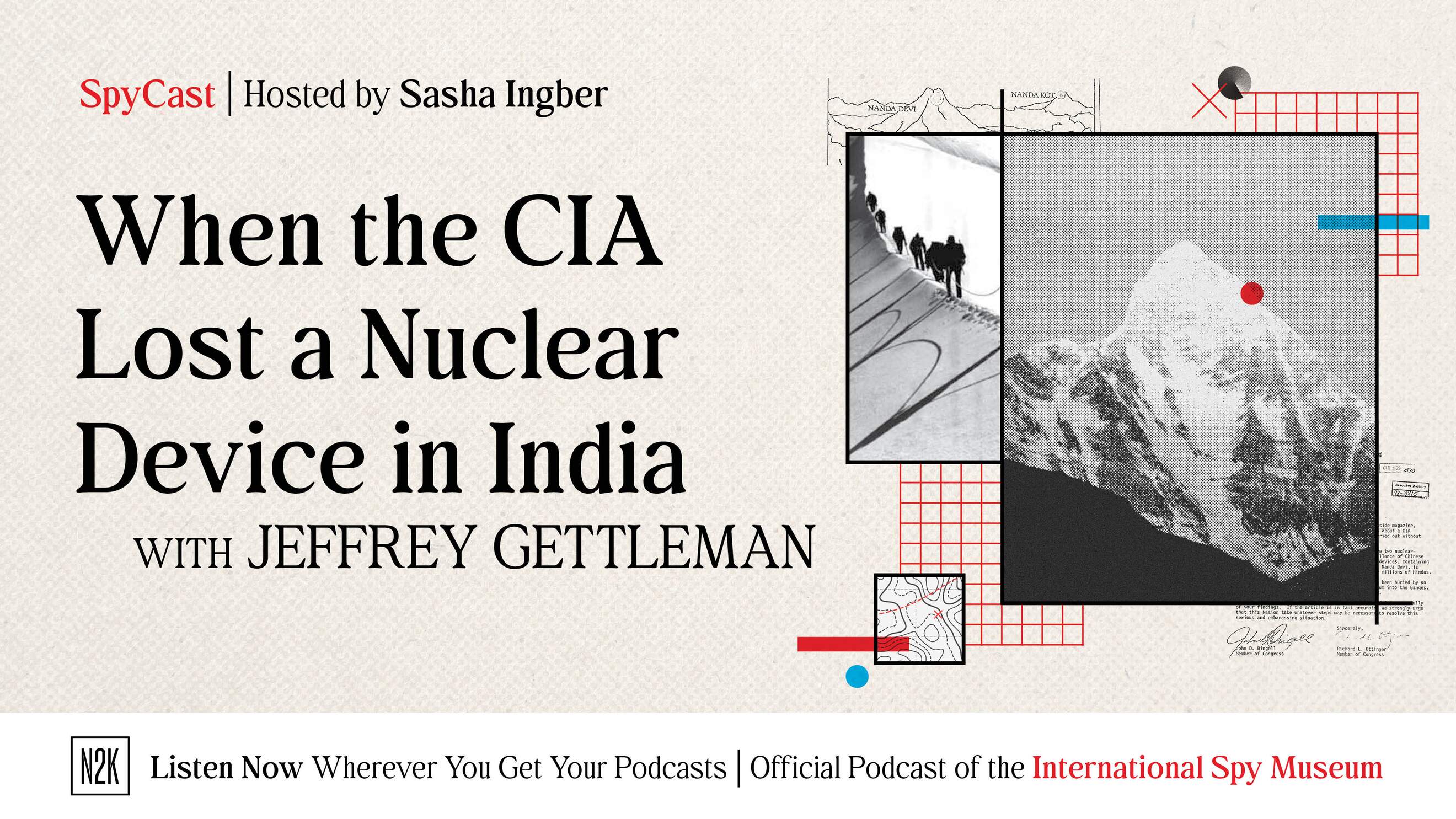


When the CIA Lost a Nuclear Device in India










Sasha Ingber: Welcome to Spycast, the official podcast of the International Spy Museum. I'm your host, Sasha Ingber, and we are in the midst of camouflage month, highlighting our new camo exhibit, an exploration of the world of disguise, deception, distortion, and disappearance. So now let's talk about disappearance. Even if some of it wasn't necessarily intentional, because this plan went awry on a nuclear level. Literally. In the 1960s, the CIA lost a plutonium filled generator on top of a mountain in India. It was supposed to power an unmanned listening station, picking up signals from China's missile tests. But when mountaineers ascended the near 26,000 foot Nanda Devi under the guise of studying the environment, weather got in their way.
They left the nuclear device behind, and months later when they returned, it was gone. New York Times reporter Jeffrey Gettleman reconstructed this event with a team of journalists. It took about seven years, thousands of miles, and earning the trust of many men who had grown old and have since passed away.
Hey Jeff. Thank you so much for joining.
Jeffrey Gettleman: My pleasure.
Sasha Ingber: So before we get into this story, can you tell me about how it came about for you back in 2018?
Jeffrey Gettleman: It started when I was based in New Delhi and early on in my experience there, I came across this small article in a Indian newspaper that mentioned this mystery about a missing nuclear device.
And one of the most remote places on the planet, uh, a mountaintop in the Himalayas called Nanda Devi. And it was just a small article of somebody complaining that this mystery had been unresolved and they wanted some answers. And I looked at my colleague, Hari Kumar, who's worked in Deli bureau for, for decades.
And I was like, Hari, um, what, what's going on with this? You ever heard of this? And he's like, yeah. It's one of these kind of rumors, sort of old stories that's been floating around for years. We've never done it. I, you know, supposedly some nuclear device got lost by the CIA years ago and they still haven't found it.
And I was like, whoa, that's interesting. You know, the, the sort of long story is this was years of the making. We kept putting it down and picking it up, but we got deeper and deeper into the subject and kept finding out a lot of new stuff.
Sasha Ingber: And so we will come back to all of the different ways you uncovered new pieces of this story.
But let's now travel back in time to 1964. China conducts this important test in the Xinjiang province that sends the United States into an absolute whirlwind of worry.
Jeffrey Gettleman: Yeah, exactly. So there's a lot happening at that time. This is like the you know, the height of the Cold War. There had been the Cuban Missile Crisis, the, the, the, the rivalry between the US and the Soviet Union.
The Vietnam War was beginning to heat up, and in the middle of all this, China is becoming a nuclear power. There's only a handful of countries in the early sixties that had nuclear weapons. The US, the Soviet Union, Britain, France, and then China. In 1964, the Chinese detonated their first nuclear weapon.
It took the United States Security Establishment and the CIA by surprise. They were much further along than anybody realized. And so there was this plan that they had to figure out how to monitor the Chinese, and at the time. The US didn't have a lot of human resources inside China that could help.
China was kind of this closed off place that nobody knew a lot about, and so the, the discussion then became how can we figure out what the Chinese are doing? How are they progressing? What kind of technology are they using so we can assess their nuclear capabilities?
Sasha Ingber: And happening parallel to this is the advancement of United States technology meant for space.
At the heart of this mission that you describe is a nuclear generator that is going to ultimately power an unmanned station on top of the mountain, Nanda Devi. Let's talk a bit about what this technology is and why it was so important.
Jeffrey Gettleman: Sure. So in the most top secret labs that the United States runs, scientists figured out how to make portable nuclear generators, and the, the, the need was to power satellites.
The first generation of satellites that went into space in the late fifties, early sixties, and the way this technology worked was using chunks of plutonium, which is highly radioactive. Same material that was used in the Nagasaki and Hiroshima bombs, and a lot of nuclear weapons. So these scientists in the late fifties figured out that there was a way to generate electricity from, from capsules of plutonium, and then they built these generators that went into satellites to power all the equipment in a satellite.
And then somebody figured out if we ever need to have a unmanned piece of equipment in a remote place that we can't service and we can't refuel, we just have to leave it there for a long, long time. These generators would be essential as a power source.
Sasha Ingber: And the idea was that now the United States could catch signals from missile launches that the Chinese were conducting.
Right?
Jeffrey Gettleman: Exactly. So another thing that was happening is at the same time, there was this huge technological breakthrough where scientists figured out how to put up sensors that could detect, uh, radio signals from missiles that were flying hundreds of miles, maybe even a thousand miles away. Once the missile got high enough into the sky and is heading towards space or into the stratosphere, it's sending down radio signals to the controllers of the missile.
And there was a way to intercept that. Most of their effort was concentrated on the Soviet Union. But when they got concerned about China's weapon program, they thought, okay, let's kind of copy and paste what we were doing for the Soviet Union for China, and let's figure it out. A way to intercept signals from Chinese missiles flying high above China from wherever we can.
Sasha Ingber: And wherever we can becomes the top of Nanda Devi, and it's going to take mountaineers to put it all there. Tell us about the cover story that the CIA concocted for this mission.
Jeffrey Gettleman: The CIA planners figured out that the best way to monitor signals coming off Chinese missiles was to establish a sensor antenna station high up in the Himalayas.
The higher the better because the higher you go the greater a range you have. There was a few mountains that they were discussing as the best place to put the sensor. All of these are very hard to climb, very hard to climb. Only a few human beings have climbed the highest mountains in the Himalayas at that point.
In the fifties and early sixties, just a few. And so the whole idea of like, Hey, it would be great to put up a sensor. We just have to figure out how to bring it up to the top of one of these really tall mountains. That was challenging in itself. So what the CIA did was they began to assemble different people that could help 'em pull this off, and they needed a cover story.
They needed some excuse, not the real reason that they were going to spy on China. They needed some excuse that would explain why these top American climbers were disappearing into the Himalayas for months. And what they came up with was this idea that these climbers were going to engage in scientific research.
They created a fake business. Lots of documents, you know, phony business cards, got lots of people involved. I even found a document from President Kennedy's brother-in-law who was writing this, some contact of his and the Indian government saying We would really like your support for this scientific mission.
They knew it wasn't a scientific mission. This was a top secret national security priority to spy on China, but they had to dress it up with this elaborate cover.
Sasha Ingber: And part of the idea of this came from cocktail party chatter you report. Let's talk about Barry Bishop, a man who worked at National Geographic, who was one of the key players in this mission.
Jeffrey Gettleman: I think a lot of good stuff probably happens at cocktail parties.
Sasha Ingber: I wanna be invited to those parties.
Jeffrey Gettleman: Well, I think, and I think in the sixties there was this kind of chummy group of people that spent a lot of time together. And they were from all walks of life. You had people in military and government and journalism, um, just kind of the elite.
And so Barry Bishop was this famous mountain climber. He was, um, a, a, a journalist, a photographer, and a really experienced mountain climber who had summited Mount Everest. He worked for a National Geographic magazine. He was at a cocktail party in Washington and in 1964, and he's telling people about this amazing experience he had at the top of Everest and this, this uninterrupted view he had of hundreds of miles of mountains and the Tibetan plateau that he could see from the top of Everest.
One of the people at this cocktail party was Curtis LeMay. LeMay, was the head of the United States Air Force and in charge of America's nuclear weapons strategy. He's listening to Bishop, LeMay is also on the board of National Geographic. So he probably knew Bishop. And when Bishop starts telling him about this great thing he did by getting to the top of Everest, how far he could see, the wheels in Lemay's mind start turning.
And he thinks, number one, that's how we're gonna spy on China. And number two, I need this guy's help.
Sasha Ingber: Follow up question. What was he drinking when he thought this?
Jeffrey Gettleman: You know, if I knew that I wouldn't be talking to you guys, I'd be writing a book or a screenplay. I don't know.
Sasha Ingber: Yeah, I hear you. So, the CIA creates this very, very ambitious mission.
Um, certainly being called the tip of the spear. This wouldn't be the first time that the CIA decided it was going to do something bold. This is a joint operation with India. They're doing it in India. How much does the CIA share with their Indian counterparts to get them on board, but also to protect this top secret technology that we've just talked about.
Jeffrey Gettleman: So the CIA made the decision that they needed India's help and the reason why they needed India's help is because it would be too difficult getting that many people, all that equipment into India secretly. And getting it to the top of, of Nanda Devi, a a a, a very hard mountain to climb because it's surrounded by other mountains.
They made the decision that they were going to work together with India. India had its own reasons to do this. India and China had fought a border war. India was very frightened of China's dominance, and so the Indians were, were happy to get some help to figure out what was going on in, in China. So the CIA put together some of, some of it's the best climbers they could find. They asked the Indians to do the same. They matched them together. But to your question of like, what exactly did they share? How much did the Indians know? The Indians knew only the basics. They knew that this was a sensor station that would be put at the top of a mountain that would intercept signals from Chinese missiles.
They did not know that much about how this technology worked, and there were some vague references to this nuclear power generator, but the Indians were not, and you know, told much about its design, about the risks, about the technology behind it.
Sasha Ingber: And in uncovering all of these pieces, you tracked down this man, captain Kohli, and interviewed him in 2018, in his eighties before he passed away.
What did he tell you of what he had initially thought of the CIA's task?
Jeffrey Gettleman: I first approached him, he was one of the first interviews we did in 2018. We stayed in touch with him throughout this whole process. He was advancing in age. His memory was beginning to fade. It was harder and harder to talk to him, but we kept trying and he was told what the objective of the mission was.
He was told a little bit about the equipment. But he was not given a lot of detail about the risks that this equipment poses to anybody who comes near it, and the dangers that that could, the dangers that could be created by losing this equipment or misplacing this equipment or mishandling this equipment.
He was totally kept in the dark.
Sasha Ingber: Did he express any concern about when this expedition would take place in the fall? Bumping up into some pretty nasty weather as opposed to the spring because you've painted this picture whereby the United States has a sense of urgency. China has done this test.
Everybody's really surprised. They wanna know what's going on there. They're rushing.
Jeffrey Gettleman: They, the, the test for China happened. In October 64, and then there was this scramble to get this mission going, and this takes time. They had to, I found documents that showed that the nuclear generator that they used on this mission wasn't completed until July 65.
Just getting all these climbers together took a lot of time, the planning, the logistics, the permission from India, the cooperation, so they didn't start until September, 1965. September is a bad time to start an ambitious climbing mission in the Himalayas. Winter is coming, the winds are increasing, it's getting colder.
Your visibility is decreasing, it's dangerous, and if you were gonna set out the ideal mission to go to the top of one of the highest mountains in the world, you wouldn't start in September. And that's exactly what they did.
Sasha Ingber: Did anybody voice any concern about that? Or was it really just, let's just do this as quick as we can.
Let's get it done?
Jeffrey Gettleman: I think there was this excitement by the boldness of the idea, and that's, that's what Kohli and some of the other people involved conveyed to us. So they knew it was late in the season, but from what I gather, nobody said, this is impossible. Let's not do it. Let's wait until next year.
And that's also a huge time gap. The nuclear test was in October 64. They're trying to get this, this equipment up there in the fall of 65. If they waited until the spring of 66, you know, you're talking a year and a half from when that nuclear test happened. So that would defeat the purpose of this whole expedition.
Sasha Ingber: And we're talking about men who were professional climbers and people who may have had a military background, but they weren't, say from the CIA's Special Activities Center. They weren't Delta Force or Navy Seals. Can you describe what these men told you about the journey climbing up this mountain now in September?
Jeffrey Gettleman: So what they decided was they could trust Bishop Barry Bishop, the photographer. He had a good cover. He, um, was an experienced climber who had climbed Everest before they could trust him. And then he recruited this team of very experienced mountain climbers, some of the best in the country at that time.
They made the decision that they were gonna fly the climbers in to a kind of base camp at 18,000 feet. 18,000 feet is still very high, and the climbers got off this helicopter. They set up their camp and everybody got altitude sickness. Within hours. You can't go from sea level to 18,000 feet that quickly without feeling the effects of the, the less oxygen in the atmosphere.
So everybody got sick and then they have to sort of fight their way up the mountain. And it was, it was, you know, I'm reading these notes and they talk about immense snowfall, people getting headaches, nausea tents being swept off the mountainside because the winds are so high. It, it went from bad to worse.
And the, the, the climbers realize, and the relaying this back to the, to the CIA handlers on this, that time is running out that if you can't get this device up there by mid-October, then it's, it's done for the year because the weather is only gonna get worse and worse and worse. And you're talking the tip of, of, of Nanda Devi is 26,000 feet.
It's, uh, like it's totally lifeless, inhospitable, dangerous. Um, and, and, and yeah, it's life threatening to just stay up there for a few hours
Sasha Ingber: And then the weather gets worse. You describe these men walking in snow up to their thighs, and some are even using these warm plutonian capsules for heat.
Jeffrey Gettleman: Yeah, that's a really interesting detail and, and when I, after we published this story, I had so many people telling me, God, that detail really killed me because they had some Sherpas and porters on the mission. These were poorly paid locals that live in those mountain villages that they recruited and paid very little few dollars a day to carry their stuff to the top.
And these guys were totally in the dark about everything. Somebody had even told me that they, they, that the, they were told they were gonna look for gold. It was just like they didn't know anything about the true purpose of the mission, but this generator had these capsules. That are, I don't know, kind of like the size of a water glass or something, and they're, they're warm, they're completely radioactive.
They're full of plutonium, and, and so the Sherpas would kind of fight with each other of who got to carry these capsules because that was one way to stay warm at the top of the mountain. That was not a safe thing to do. If they're warm, that's because they're shedding radioactive material, and that could be really dangerous to anybody, um, who, who wasn't protected and none of these guys were.
Sasha Ingber: And meanwhile, the weather gets so bad that now there is this decision to make on whether or not these men should turn around and whether or not they should leave the generator. And now this causes some clashes. Can you take us into that moment?
Jeffrey Gettleman: So. A blizzard hits the climbers are at the top of the mountain, spread out between different camps, very close to the summit. They have succeeded in bringing up all the equipment, including the nuclear generator to nearly the top of the mountain. All of a sudden it's, it's, it's, it's super dangerous to be on that mountain.
There's no visibility. The snow is building up, the winds are increasing, and so this moment comes where they have to make a decision. What do we do? Captain Kohli was in charge of the climbing logistics. The CIA had basically deputized him to figure out how to get that equipment up there. And he's communicating on, on a, a radio to the people at the top and they're telling him they can't move.
It's dangerous as hell up there. Like they're, they don't know what to do. And so Kohli makes the call that the climber should come down and they should leave the equipment up there. And while he's communicating and telling these guys over the radio, that's his decision. An an American climber, Jim McCarthy, who's this ignatious, aggressive, combative guy, kind of really intense.
Here's Kohli having this conversation and he just blows up and he starts screaming at Kohli, what are you doing? You've gotta bring that generator down. There's no way we can leave that thing up there. And Kohli's basically saying like, quiet down, you know, this is my, my call to make. And McCarthy told me that he had this premonition that if they didn't bring the generator down, they would lose it, and that there could be enormous consequences of losing this device packed with plutonium, actually a third of the plutonium that was in the Nagasaki bomb and, and how dangerous that could be for, for everybody in that area if they lost that device.
And McCarthy's argument is this thing weighed 50 pounds. Like if the guys could come down the mountain, they could just bring a couple packs and carry this thing down. But Kohli was, was sort of the middle man in this conversation, talking to Kohli about it. I'm talking to McCarthy. And Kohli's like, no, no, we couldn't.
He's like, those guys could barely make it down alive with nothing. And if they tried to carry anything, they could have slipped. And we're talking about, you know, 24,000 feet, a sheer drop of ice and rock, thousands and thousands of feet down. I mean, this is, this is an environment that few people have ever experienced, and these climbers were good.
But Kohli was insistent that if, if these guys were gonna survive, they had to come down at that moment. Empty handed and his, his thinking he said was, we're just gonna leave it up there. It's gonna be secured with some ice screws and ropes. Tie the stuff down and we'll come back next year and bring it to the tippy top.
Sasha Ingber: When we come back, we discuss why even decades later, the CIA refuses to acknowledge this failed operation.
What you're describing is a moment of having to choose between the men versus the mission. But I also wonder if this is a cautionary tale in compartmentalizing information on a need to know basis. Because you described that Kohli didn't really know a key piece of information about what was really at stake here, and maybe McCarthy did.
Jeffrey Gettleman: No, that's a good point. Kohli said in one of the interviews I did with him at the end of his life that if he knew then what he knows now, he would not have left that device up there, and that's like a pretty heavy thing to kind of carry around. And so he feels this resentment that he didn't know then what he knows now.
Sasha Ingber: Absolutely. And I, I really wanna understand what these men felt in looking back, but before we get there, what literally on earth happened to this device in, in the reporting that you've done. Where do you think it is right now?
Jeffrey Gettleman: Okay, so this is what happened. These guys made the decision to leave it up there.
They then came down the mountain. This is October, 1965. They tell the CIA and the Indian Intelligence Services. It, it, the blizzard hit. We could not install. The device equipment's up there. We'll come back first thing as soon as winter lifts, and we will install the equipment as planned. They gotta wait because the winter's long.
It's the top of the Himalaya, so they go back up there in May, 1966. They're totally shocked by what they find. They go to the exact spot where they had left this nuclear device and the other equipment and everything is gone. Even the mountaintop is a little different, as if like a whole piece of the mountain had collapsed and slid to the to the bottom.
So what they conclude is that some avalanche happened. And this happens in the Himalayas. They're constantly moving. There's these glaciers that are moving. There's an, you know, incredibly intense weather. There's snowfall, there's high winds, and so they think some event happened at the top of the mountain in avalanche or an immense snowfall, and it just sheared away that spot and the equipment tumbled down.
But we're talking about thousands of feet down and nobody knows where this stuff is. And the best guesses are that it fell into, uh, a gully or a glacier, and it just got kind of stuck there. But, but then it's buried by more and more snow every year. It could be under 20 feet of snow and ice, nobody knows, or more.
And then there's another complicating factor. The generator was warm. Because of this radioactive energy source. And so the generator is not just gonna sit on the snow getting dusted over like some other object. It's actually gonna sink. It's gonna melt the snow beneath it. And so people believe that this generator has been slowly sinking deeper and deeper into the Himalayan glaciers, which means it's very hard to find.
And it could be almost anywhere in that area if it's on the move.
Sasha Ingber: Unbelievable. And there are also multiple attempts to search for it. You described, uh, using technology to detect radiation, infrared sensors, telescopes, and nothing solved this problem. And then come the fears of what this could lead to, uh, potentially plutonium poisoning the Ganges where people are, are relying on this sacred river.
There are scientists who also told you that a terrorist group could access this plutonium and use it to make a dirty bomb. What are your greatest concerns? What seems most realistic from the reporting that you did?
Jeffrey Gettleman: So nobody knows what, what this means. That was the consensus I got that I, I spoke to a number of nuclear scientists.
I spoke to environmentalists, I spoke to the climbers themselves who were on this mission. None are comfortable that this device is, is, is MIA, but the risks are just, are just really mysterious. So some scenarios are, are this, that the device is just kind of sitting at the bottom of a glacier. It's stuck.
Nobody's gonna come near it because that area is very remote, so it's not gonna hurt anybody. That's one, that's one possibility. Another possibility is the device is on the move. It's melting, it's gonna, it's gonna emerge in a, in a river or a water source, and that could be really catastrophic because this area is the, is the headwaters of the Ganges River.
These glaciers in the Himalayas feed these tributaries, they get bigger and bigger and they eventually spill into the ganji. And you're talking about one of the most important river systems in the world that hundreds of millions of people depend on. And then the third scenario, which is kind of the most fantastic one, but not totally beyond the realm of possibility, is that somebody finds this device and then it could go in a few different ways.
If it's a, a local person who has no idea what it is. They could be burned by the capsules. They could harm themselves. They could inhale or ingest the material. They could get sick. And then there's this terrorist scenario where if the device fell into the wrong hands, you could take out the capsules, use that plutonium.
You couldn't build a a nuclear weapon. That would create a mushroom cloud and a chain reaction easily. From that material, there's no trigger. It's not the same kind of plutonium, exact same kind that's best used for nuclear weapons, but you could make a dirty bomb, and that would be packing explosives around those plutonium capsules, blowing them up and spreading radio activity over a large area.
That's one of the fears.
Sasha Ingber: It's extraordinary to think about the implications of this and how much remains unknown. Where the possibilities go. What was it like to find these men who had climbed Nanda Devi to knock on their doors? Did they have hesitation to speak with you? You're describing a series of, of, of levels, of resentment after all of these decades have passed.
Jeffrey Gettleman: First, I think they were not super comfortable talking about this, this operation because they had taken a vow of silence. They were supposed to maintain it for their entire lives. It was a top secret mission run by the CIA and the Indian intelligence equivalent. And the, the, the men involved took that seriously, that responsibility.
Another impulse was they felt burned. They felt burned by the planners of this. They were kept in the dark. It was poorly planned. They started too late. It was rushed. It was dangerous. And so that impulse may have taken over some of the people we spoke to, and even though they knew they shouldn't be sharing everything they wanted to, they wanted to get it off their chest.
They wanted the story to be told. Right.
Sasha Ingber: I imagine that many of these men embarked on this mission with a sense of patriotism. But all of these decades later, did they regret what ultimately happened? Did they regret going on this mission?
Jeffrey Gettleman: So I asked that very question, do you regret being part of this? I got some different answers.
Kohli basically said, yes. If I had known then what I know now, I would've done things very differently. And this whole mission is a sad chapter in my life, which is a pretty devastating thing to hear from somebody at the end of their lives who had been so dedicated to serving this higher purpose.
McCarthy had a little different take. Yeah. Like I said, he's ignatious, he's combative, he's aggressive. Um, and he's like, no, you know, we were called to do this duty. And we did it the best we could, and that's all you can do. The, the other, the last surviving climber, he, he was similar. He just felt like it wasn't for him to question the higher ups.
If they had made this decision that this was an important mission, then you do it. But each of 'em had, had, had a, had a palpable, a palpable sense of bitterness. And, and toward each other. You just, you just got the sense that everybody was trying to blame each other because it had failed.
Sasha Ingber: And I'm wondering about the health ramifications decades later of the people who went on this mission.
Jeffrey Gettleman: So we looked into that and we heard lots of anecdotal, uh, you know, stories that the men who had participated in this mission who would carry those plutonium capsules, got sick, died at a, at an early age. But this happened so long ago, we could not find anybody. With hard information about what really happened to them.
But McCarthy explained to me that he was the one who was trained to load and unload this generator and handle these plutonium capsules. And he was given some warnings about how to do it, and he wore some gloves, but he then got testicular cancer in the early seventies. And he's convinced that that was caused by his exposure to these capsules.
Sasha Ingber: Take your best stab at why the CIA, even now decades later refuses to answer this. And then as a follow up here, by not admitting it publicly, can the agency still learn lessons in the missions that it embarks on as the years go by? If this information is kept to one small group and then another small group, can they still carry on with the lessons when they're not admitting it?
Jeffrey Gettleman: So I think the CIA has a policy that they do not want to discuss covert operations even in the distant past, and that's just their blanket policy to protect their sources and methods. They also don't want to take responsibility for mistakes. Now, does that hinder the ability to evolve and to adjust and to learn from your mistakes?
That's an interesting argument. I think not that many people have gotten into the nitty gritty of this mission where this device is, what may have happened to it. And I think if you're suggesting that maybe a, a kind of more transparent approach would produce better lessons learned. I think that's a really interesting argument.
Sasha Ingber: I mean, I could keep talking to you about this, Jeff. This is a truly fascinating story. Thank you so much for taking us through this extraordinary journey, Jeff, thank you for your time.
Jeffrey Gettleman: My pleasure.
Sasha Ingber: Thanks for listening to this episode of spycast. If you like the episode, give us a follow on Apple, Spotify, or wherever you get your podcasts, and leave us a rating or review. It really helps. If you have any feedback or you wanna hear about a particular topic, you can reach us by email, at spycast@spymuseum.org.
I'm your host, Sasha Ingber, and the show is brought to you by N2K Networks, Goat Rodeo, and the International Spy Museum in Washington DC.



