
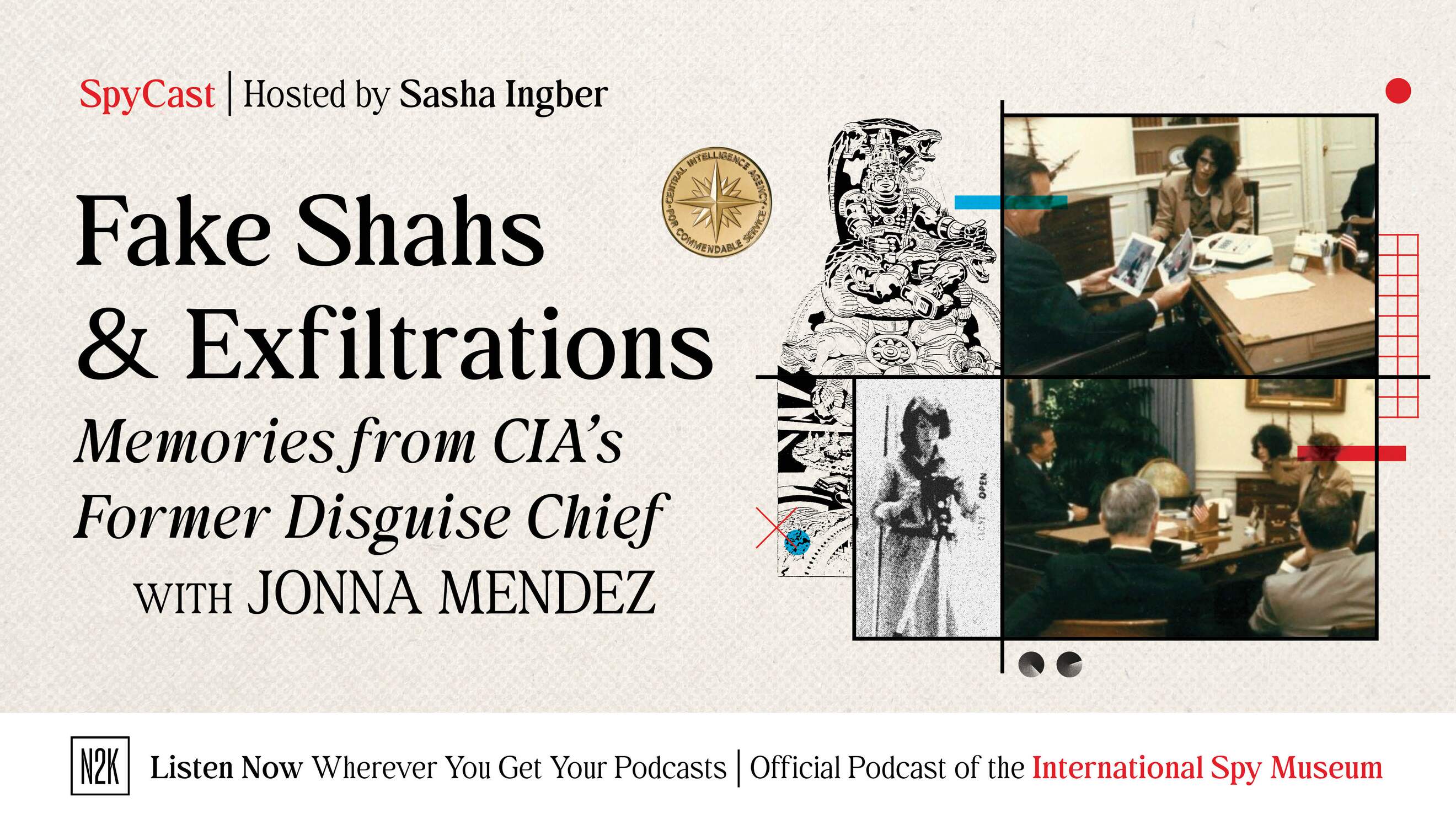


Fake Shahs and Exfiltrations: Memories from CIA's Former Disguise Chief










Sasha Ingber: Welcome to Spycast, the official podcast of the International Spy Museum. I'm your host, Sasha Ingber, and we're wrapping up camouflage month highlighting our new camo exhibit, an exploration of the world of disguise, deception, distortion, and disappearance. So here we are in the last episode of our series.
Jonna Mendez knows how to blend in. She also knows how to make a spectacle. Starting out as a secretary at the CIA, she left as its Chief of Disguise. Her career took her into denied areas where her special abilities assisted in a variety of high stakes operations- collecting on the adversary, recruiting and exfiltrating agents and staying on the cutting edge of technology.
She sat down with me to share stories, many of which she has never shared before. Hey Jonna, welcome to Spycast.
Jonna Mendez: Thanks. It's great to be here.
Sasha Ingber: So let's talk about Iran. All eyes are on Iran right now, and in the early days of the Islamic Republic, right after the Shah was overthrown, you did something that you haven't shared before and that is making two Shahs.
Jonna Mendez: It was an unusual solution to an unusual problem. My office was called Office of Technical Service. We were the technical arm of the CIA to make the gadgets or the tools that our case officers needed to accomplish their jobs. We were basically creative problem solvers and they would come and say, you know, I need a disguise.
And I'd say, sit down. Let's talk a minute. Maybe you don't need a disguise. Maybe you need something else. Um, always trying to find the best answer for a problem. And of course, at the beginning of the Iranian scenario that went on, what, 40 some years ago, the problem was that we had allowed the Shah of Iran to come to America for cancer treatment.
And his citizens were so angry. He had a terrible mean, uh, security service. Uh, there was no protesting in Iran. The revolution began because we let him in for cancer treatment and everyone was trying to find a way to solve that problem. Typically you'd wanna get together with some Iranian people, sit down at a conference table, talk it through, talk it out.
But none of that classic stuff was gonna work. So the idea came up. What if the Shah left the United States? Would that calm them down? If that was the only problem, big problem, then what if he left the United States? Would that resolve the situation? Well, maybe he didn't actually have to leave the United States.
What if we made it appear that he left the United States? And so what we did in OTS using the tools that we had, which were basically from the disguise labs, but using some people that we knew costumers, all kinds of people came into this, going through all the pictures of all the employees at CIA defined, did we have any that had facial features?
That would be a beginning match with the Shah, we found a few. We brought them up to our offices and at the end of the day, we made two fake Shahs of Iran. One looked exactly like the Shah. He was, he was from a Middle Eastern background. He had the bone structure, in other words. I think we had to do something with his nose, something with his hair.
We put him in the Shah's uniform with the big red sash and the epaulettes and the, I mean the Shaw, when he was, when he, when he had all his regalia on, he was a stunning figure.
Sasha Ingber: And he was the right size figure.
Jonna Mendez: Yeah, everything. Everything. Then we made a second one that appeared to be a dead, he was on a gurney.
He was on a stretcher still in his uniform. And that could have been almost anybody, but we had used our mask, uh, capabilities to make his face and still put the uniform on him. Getting the uniform was a little tricky, getting someone who could exactly represent it, and we took those into the White House early on and showed Jimmy Carter and said, this could be a solution.
This could diffuse this revolution, this could calm them down enough that we can get the people that were left behind. And Jimmy Carter said no. He said he thought it was too risky. He wasn't comfortable doing that. He wasn't sure it would work. It was his decision to make and he said no. So we'll never know.
Would that have worked? I mean, in retrospect it like it would've had a good chance of being believable. Carter said later that he wished he'd said yes. So that was one of our great operations that didn't actually do anything. It was just a great idea.
Sasha Ingber: And the first time that you're describing it right here, right now,
Jonna Mendez: I have never really talked publicly about that.
Sasha Ingber: It's amazing to think if Carter had decided to go with one of the fake Shahs, would we be at war with Iran?
Jonna Mendez: You, you can't, you, you can't, you can't go back like that. You know, you, you wanna think that things would've worked out differently and perhaps, perhaps they would've.
Sasha Ingber: Now, I know that you also brought a letter today, and it's sitting in the chair with you.
This is from someone who did not know that he was part of a disguise for an operation that became very famous. During this time of revolution, this was addressed to your husband Tony, who had orchestrated the operation to rescue the American diplomats who were hiding out at the time, and they pretended to be the crew of a fictitious film called Argo, can you show us that letter and, and tell us about it? Maybe read a little bit from it.
Jonna Mendez: Um, I brought a copy of it with me. The letter was sent to my husband right before he died, and it was never opened. He never read it. And then it went into a plastic tub with a whole bunch of other stuff. And just recently I discovered it and I found it to be amazing.
This was the fake movie, Argo. A movie that was never made and they were putting it together in LA and the difficulty is getting a studio. Michael Douglas had just left, he'd done Chinatown and they got that studio. Get the phones working, you know, get some, some advertisements up in the, in the local trades.
Hollywood reporter, variety. You have to get some noise going about your movie. Tony called it Studio Six Studio. Because he was gonna go and rescue six people, and my husband, if he had anything, had a good sense of humor. So this young man wrote a letter to Tony Mendez dated 2012. He said, I saw a trailer for an upcoming film, Argo, a fake movie set up by the CIA involving Chambers.
Sasha Ingber: And that's John Chambers, the filmmaker who was involved in the Argo cover.
Jonna Mendez: Yeah, he said, John Chambers hired me to do idea sketches and character drawings for a film he said he was gonna produce called Argo. He said, I shared a small production office at the Gower Studios corner office, top floor facing the parking lot and Sunset Boulevard Studio six plaque on the door.
Bare white walls, no art that I can remember. And he goes on to describe, uh, John Chambers. Bob Sidell, who was part of it, his wife Andy, who answered the phones. This man named John Bruno did production drawings.
Sasha Ingber: The one who's writing the letter.
Jonna Mendez: Yes, he did character and makeup design sketches. But he noticed while he was there that it was very quiet and that there, there were no, there was, there was no one there really except for these principals he was working with.
And so he asked John Chambers. He said, where is everybody? And Chambers said, oh, they're on a location scout. They're overseas looking for where we're gonna do the filming. And this guy says, okay, that makes sense. Great. So it went on and on, and then eventually John Chambers came in and said, well, it looks like it's not gonna work.
He says, we're gonna shut it down. And they did exactly that. John Chambers never broke a character, never said, son, this whole thing is a CIA operation. Never, never gave it away. They took the sign off the door and they shut it down. This man who had worked doing the sketches, character sketches, went onto uh, it sounds like a very good career. Won some Golden Globes for some of the work he did with, um, Titanic and with, uh, some other major movies.
Sasha Ingber: Not too shabby.
Jonna Mendez: Not too shabby.
Sasha Ingber: He did okay. He didn't know he was an unwitting participant.
Jonna Mendez: He did not.
Sasha Ingber: Not only was he an unwitting participant, he started to wonder if maybe this was even legal at one point.
Right?
Jonna Mendez: Yeah. It's like maybe he thought he smelled a rat. He said one day a man showed up at their door carrying a little suitcase, a man in a coat and a tie, and he spelled that out in the letter, white shirt, coat, and a tie, which in LA back then, and even today is kind of unusual. That's an outta towner, right?
That's not a local. And he came in with his suitcase and he set it on a table and he opened it up and he said it was full of a hundred dollars bills and John Chambers signed something for it, and off the fellow went. And so our, our gentleman, John Bruno, who wrote the letter, came over to John Chambers and said, is what we're doing legal?
And Chambers said, oh, we're legal. We are absolutely yes. Yes, we are. We are obeying the law in every regard,
Sasha Ingber: Keeping on with Iran. But this idea of disguises, it's safe to say that everybody generally knows the CIA is using disguise to gather intelligence, but it's also important in rescue operations. And I don't think that people necessarily know how important it is in exfil trading, uh, people who have spied for the United States.
Can you tell us about another moment in Iran? With the chief of Security for SAVAK, which is Iran's notorious secret intelligence and police service, which was eliminated by the Islamic Republic and who that person was. What happened there?
Jonna Mendez: Well, there was a man inside of SAVAK who was our penetration agent of SAVAK, and he was very well known and he was very high up in SAVAK.
But he was working for us and when the revolution started. I don't know exactly how his name came up, but all of a sudden it became known that he had been working with the evil American government and they were looking for him. The Iranians were looking for him. He went to his grandmother's some building.
She had some attic upstairs, some tin roofed, hot, terrible place, and that's where he was hiding. Tony Mendez said, think of John Wayne, the movie actor. This was their John Wayne. So he's really scared. He's gotta get outta the country. He is so well known in the airports or any of those people know his face, they know him.
He trained half of the security staff of of the country. So Tony disguises this Iranian SAVAK agent of ours as a Jordanian. Now to you and I, those would be small, nuanced differences. But to an Iranian, they would take one look at this new face, and they, he's not one of us. He, he's, he's not part of our tribe.
He doesn't belong here. They disguised him as a Jordanian pipe fitter. They gave him old, some old British tweed jacket and shoes and a passport and a cover story, and it looked like it was gonna work. The Jordanian pipe fitter goes to the airport. The guy that's with him comes outside and said, I've lost him and I don't know where he is.
Tony goes to Swiss Air and says, I just put my uncle on your plane, and we forgot his heart medicine. And they turned Tony loose in the departure lounge, and he went in the men's room and found. This man's code name was Raptor. Found him standing on a toilet stool inside of a, you know, a little
Sasha Ingber: bathroom stall.
Jonna Mendez: Talked him, talked him out. Mr. Curri, I think his name was, walked him over. He went through the guards. He got on the plane, he went home, he got out. And then every year after that, he sent us every Christmas, an invitation to dinner. We could never go.
Sasha Ingber: So you have a lot of secrets that you have to keep for the agency, but there's a secret that you shared with me that you have kept from the agency, or you did for a while.
It has to do with a flower pot and a pair of high heels.
Jonna Mendez: Oh, yeah, yeah, yeah. I did tell you that my most recent book. It's called "In True Face." It's about being a woman in the CIA and it, it was a little bit about how hard it was to be a woman in the CIA. It was difficult. There was a, um, a Washington Post reporter, Tim Weiner, who wrote once years ago.
He said there was no other element of the United States government that treats its women as badly as the clandestine service of the CIA. One of the ways that I stopped being a secretary and started being an operational officer was I, I did. I did fairly well at all of the things I did, but I was chosen to be in this unique training class out of a thousand people.
Eight were picked every year, and they taught us everything, all of the trades that that we knew as technical support for CIA. They taught me morse code. They taught me how to do secret writing. They taught me how to make micro dots. They taught me, that's where disguise came in. They taught me how to use a silent drill and go through a wall and, and put in a pinhole camera and I could do a lot of things.
And so because of that, when I got through the class, they send you out on a, a mission. Uh, and it was three months in a Latin American country where I was to handle everything while I was there. While I was there. This, this thing broke. It was on the roof of a building, a couple of blocks from our embassy, and it was, um, it was like a cutout device.
It was to protect our foreign agents who were calling us in the embassy. The call didn't go directly to the embassy. It went to this thing, which redirected it to the embassy. The thing was a flower pot. It was on top of a building, so it broke. It wasn't working while I was there, uh, with all the training I'd gotten, I I, the last thing I they taught me is if you get in over your head, you always have to know to send for the experts.
Don't hesitate to send for the experts, and this is the first thing I encountered. When I got there, this broken thing, and I thought, I can't just arrive here and then send for the experts.
Sasha Ingber: You're trying to prove yourself.
Jonna Mendez: Trying to prove myself. So I went up to visit the flower pot on top of the, uh, building.
And this was in a big city where lots of traffic and sometimes the, just the slight movement of the traffic in the buildings and these things can get out of alignment. And that's what I thought was wrong was that it was just, it had just, just a fraction of a millimeter and it wasn't gonna work. So I did the only thing I could do.
I kicked it. I mean, I, I knew I couldn't fix it. I had no tools. I, there's nothing, what can I do? So I just, I kicked it almost because I was angry that I couldn't fix it and, and went back to the embassy and I, I thought, okay, I'll, I'll send the message out in the morning and I get a message from the Chief of Station who calls me in, and he says.
Good job. I said, really? He said, just so impressed. So impressed. He said, I sent a report back to your bosses up in Europe. Tell him what a good job. He said, your boss is coming down tomorrow to visit. He wants to come down and congratulate you for fixing that thing. I said thank you very much. I appreciate that.
I never, ever told anyone until I wrote that book, how I fixed it.
Sasha Ingber: It's such a good story.
Jonna Mendez: It was a good story.
Sasha Ingber: When we come back, Jonna shares more memories and reflects on a life defined by disguise.
Now, I know that in the course of your career, you're not only in these high stakes environments, but there are times where you are also injured. There's a moment when you're in a closet in India, concealed from a case officer and an Indian man who has just come with schematics for a Russian weapon system.
Take us into that moment of what you were doing and, and what happened.
Jonna Mendez: That's just an example of what a workday might look like because you never really necessarily knew what you were gonna be doing the next day. But I did know that, um, back when I was there, the Indian government was very close with the Russian government and they were exchanging enormous amounts of information that we were really interested in, especially the weapon systems.
What that Indian brought to us that night was not just a, a document, it's, it's, it's almost like a big book and everything unfolds. So the documents themselves are huge and they're wiring diagrams. They're, you know, they're engineering diagrams for really sophisticated equipment.
Sasha Ingber: How big are they?
Jonna Mendez: They could be, um, um, three by three, maybe four by three big.
But I had cameras. That were made. I just had to get it over there and get it set up and you're making sure the focus is right and have these huge lights. And we're in a walk-in closet with no air conditioning and I had to be quiet as a mouse. I, it was it, it could not be known that I was upstairs photographing these documents.
He gave them to the case officer, but he did not know that they were upstairs and I was photographing them. And I was photographing them thinking, you know, I know they're sitting down there having ice cold beers, and I'm up here just dying in this, in this closet. I wore to work that day Uh uh, running shorts, a t-shirt, a bandana.
I and I think flip flops and I took 'em off 'cause I was being quiet. Anyway, at one point in that evening, I backed into, uh, one of the big, big lights and it was just horrible because I could see a little bit of smoke and you can smell a burn like that. And it's just like. You can't yell,
you
Sasha Ingber: can't scream
Jonna Mendez: and you can't scream.
It smells terribly and there's nothing to do about it except just keep doing the photography and got all the photography done. Uh, the sun rises over the Himalayas, I'm done. They got the book back. I took the film to the embassy where I had clothes lines. Strung up across the lab that I was working in. It was like 18 feet of film.
I developed it and then I had to print it and it was just, it was a, it was a huge, for the Pentagon to get the schematics like that of a, of a piece of equipment that hasn't even been built yet. It, it saves all this money and research and development. It saves them from all the guessing, what's it gonna look like?
What, what are we gonna be up against? It's just solid gold, that kind of intelligence. So you'd go home with your, um, your medicine on, and a big patch over your burn and think, well, you know. That was the night well spent.
Sasha Ingber: Must have been really stressful, hot, dark, silent, trying to rush to get it right.
'cause you know you only have one shot.
Jonna Mendez: You only have one shot, and you only only have, you only have so many hours
Sasha Ingber: Getting agents comfortable with their devices was also important in your work. There was a point in your career where you needed to fly to London to help an agent with a special pen that had a camera, a trap camera, something that proved very useful during the Cold War.
Tell us about that situation.
Jonna Mendez: Oh, that situation, he was, he was, um, he was a special person. We only gave those pins to special people today. If we were still issuing those pins, we would be giving them to someone in Putin's inner circle who could approach him at his desk and stand there with, with our, with our pen and a pad of paper and take notes.
All he has to do is take the pin and silently with one motion and photograph everything on the table. And what's on his desk is what we want. It's the, it's the agendas, it's the minutes of the meetings. It's the plans and intentions. What is Russia gonna do next? Or what is North Korea gonna do next? Or what is Iran gonna do next?
Sasha Ingber: And that matters because what's said publicly doesn't match what's said privately.
Jonna Mendez: That's absolutely right. So we had trained this man this, he was the first serious volunteer from a country that we never dreamed we would have someone in and, and we had equipped him with a pen. He could take a hundred pictures with our pen.
And he wasn't doing it. He wasn't doing anything. He said, you know, my office is so dim that I don't wanna take the chance of getting caught because if they catch me with this, they will kill me. So my job was to retrain him. What I did was I made, um, it was like a target with a, a Sharpie on a newspaper.
Just, it was just a target with a newsprint around it. I said, okay. Let's take a picture of that. We had all the lights on, we had all the windows open. We had every light in the room on brightest, light, possible take a picture. Then we started turning off lights. Then we started closing blinds. Then we started pulling curtains, and every time we changed it and, and brought the light down, take a picture.
Take a picture, take a picture. So we had about, I don't know, we had about. 30 pictures. Now I have to develop it. So I had brought a bag of what I needed. We were in a very, very fancy hotel. I'd take my bag into the bathroom where I would work with all the water, develop the film. Took it back out. I had brought a viewing device where it, with that little tiny film where it magnifies and you could see it.
And we looked at it and almost every frame was readable, even with the curtains almost closed. So he went back to his country and started, he had a, he had a lifetime career sending us documents, and that was the first time I ever heard from Tony Mendez. My future husband. I didn't know. He sent me a note saying, what a great job you did.
What a good job. You know, we should, we're gonna write you up for something for that. But that was the first time I heard Tony Mendez's voice, even just in writing. It was interesting.
Sasha Ingber: Amazing. So I know you also would do what's called disguise on the run. And this was needed to get into a manhole around Moscow, around the beltway to learn about Moscow's nuclear program.
Jonna Mendez: That's a great sentence if, if people have never heard that story, it's like, really? How do those things connect to each other?
Sasha Ingber: Well, you're gonna have to be the one to connect the dots.
Jonna Mendez: Yeah, well what there was a, there was a nuclear facility outside of Moscow and, and they communicated with the government center by airwaves, and we were able to intercept those communications and we knew what was going on and we were very comfortable.
Then all of a sudden those communications stopped, like, where'd they go? And one of our satellite systems told us they had noticed that there was a, um, an underground line being dug from that facility to the beltway that went around Moscow, and they could see that there were three manholes that would touch that touch that communication link.
So our job was to get in the manhole. So. You were gonna need a special tool. We could see that. We photographed it. We really blew it up. A special tool. You couldn't just lift that manhole, you had to have the tool. So we made the tool and we trained officers down at a place called the farm that a lot of people have heard of.
Sasha Ingber: Camp Peary. Major training center, get away from it.
Jonna Mendez: She said it. Not, that's,
Sasha Ingber: I never, I've never been there, just putting that out there.
Jonna Mendez: We trained, we did a lot of training down there. A lot of interesting things went on down there. So we, we built a, a copy of the manhole. We put it in and we were training a couple of people how to use the tool and get in.
Um, one of them was named Jim Olson, and, and he became a hero partly because of this operation, partly because he's just simply heroic. He's done many things, so he knew how to get into the manhole. That part wasn't a problem. Then. What in the world would a man from the American embassy be doing walking around the beltway and stopping and dropping into a manhole?
Sasha Ingber: It's not quite your leisurely stroll.
Jonna Mendez: Not really. So we set this thing up where he was on a picnic with his wife. They had a basket. And, and he looked like a diplomat. Uh, he, he was wearing a suit. I mean, he, he was, it was like they'd come from the embassy. They could have lunch in the woods or something and, and got it all set up.
Didn't see any surveillance. He stepped away and walking through the woods, did a disguise on the run. Where he disguise on the run means. Changing your look while you are moving, and you can, in theory, you can do it in a crowd. Crowds are almost easier than doing it in the woods, but he's walking, he's taking off his jacket, he is putting it in the bag.
He's pulling off his tie in the bag, pulls off his shirt, puts it in the bag, then puts a bag in another bag, and then put turns into a nap sack, some old junkie nap knapsack that he puts on his back and when he comes out of the woods. He looks like they used to call them pensioners in Moscow, retirees on a very limited income.
They looked like bums. They smelled like vodka when he had something that looked like some old ragged book that he was carrying, and he's walking and no one pays any attention to him, and he is. He gets by the manhole and he opens his book, and it's not a book, it's holding the tool. He takes out the tool, he looks at the cars, looks at the cars he uses, the tool, drops down into the manhole, and he's famous for being the first man in.
He just took pictures of what, what was there, and he saw the communication links and he saw the the wires, and he saw the line. And he also saw the fact that it was encased in a gas filled, transparent. So anybody that went into the electronics would puncture the, the material, the gas pressure would decrease.
The people at the nuclear plant would know somebody's messing with our equipment. Clever. But that was our job. His job was to get in the manhole and take pictures and tell us what was there. Then our job was to figure out how to get into that, and we did. And so for a good amount of time we were able to monitor their program.
They had no idea.
Sasha Ingber: Great operation. That disguise was the beginning of being able to gather all of that information.
Jonna Mendez: And we could use that in, in a city. We could use that in a disguise in the run, we could use it anywhere. When you walk through a city, the people coming toward you, I mean, they, they just see you for like five seconds and they're gone.
Even if people are following you in a crowd, they're not really following your face. They're following, I don't know, you give 'em something, maybe a baseball cap and you're in a crowd and maybe you remove the baseball cap and maybe you change two or three other things, and when you step out of that crowd and they're trying to follow you, but now they've lost you.
Sasha Ingber: I feel like a lot of people who are on bad dates would really like to have this trade craft. So you should think about doing a masterclass on that. We'd started out by talking about Iran, talking about Argo partnerships sometimes were where the innovation came. Would you say that right now innovation is coming from inside the Office of Technical Service, or is it more about having, uh Private industry. What we've seen inside the Pentagon is that they are relying on the external for a lot of their solutions.
Jonna Mendez: I think that's a really good question, and I think your observation is a really good observation. That would be my guess, because it's gotten more and more fragmented, more and more precision, more and more specific that maybe going to the, the, the maker of, of, of the, of the electronics or the maker of the ship, or that may be where the, the answer lies. But I don't know. I have to be smart enough to say, I don't know if I say, I know I'm gonna get phone calls.
Sasha Ingber: You don't wanna call from the agency on a Friday night?
Jonna Mendez: No, please.
Sasha Ingber: So when you look at all of the years that you spent in this extraordinary career. What would you say disguises have taught you about people?
Jonna Mendez: Well, first of all, they didn't teach me this. They reaffirmed it. Men don't like to wear disguise, and most of the people that I was disguising were men. So part of the job, my job was to get them to accept it without seeming to be pushing them. It's not manly to glue on a mustache and put on a wig. They don't think they need that. There were some things that changed enormously while I was there. When I started the espionage. It was a genteel kind of undertaking. It was diplomatic parties, it was diplomats, it was rather high level educated.
And then of course it all changed when drugs came in and, and became a target of ours. And when terrorism came in and became a target and all of a sudden the people you are chasing or, or interested in, they have no reservations about shooting you or, or anything else. They, they are, they are thugs and a lot of them are criminals and they are armed well.
Our case officers, once they. Got that lesson. All of a sudden they were interested in disguise. They would glue on a mustache. One of the best disguises I ever did was a, a guy that walked into my office in jeans and a, a, one of those big belt buckles and cowboy boots, and he was chief of station somewhere.
He was getting ready to go and, um, and he was bald and so I made for him the most beautiful wig I've ever made. It was human hair. It was, oh God, it was really expensive and he looked fabulous in it. And his disguise, he liked it so much. He said, okay, what if we flip this around? What if I wear this every day,
Sasha Ingber: right?
Jonna Mendez: And when I wanna fool someone, what if I just take it off and leave it, leave it on my lamp by my bed?
Sasha Ingber: So you now there's a man that doesn't wanna take the disguise off.
Jonna Mendez: Yeah. And, and it's perfect. And, and then the other, the other part of it was, 'cause he really got into it. I said, you know, you need, uh, a, uh, the, the clothing that goes with the bald guy.
He's a new guy. You need a cologne that he wears. You need, uh, shirts that you would never like. Does your aunt, is anybody send you clothes? Oh yeah. The stuff in your back of your closet. Well, that's his wardrobe. You wear those things, wedding rings, all you form this, this personality with all the disguises we give out and, and you use all those pieces of it when you, when you, uh, take your wig off.
And it worked for him. He just loved it. He, he stopped in several times to say it really works. But if, if you have someone chasing you with a gun, if you have a situation where you really think you're risking your life. You'll put on a disguise.
Sasha Ingber: So here's my last question. If your professional life is measured by your ability to be somebody else, then how do you maintain a stable sense of self?
Jonna Mendez: I never saw that as a problem. First of all, there was always a, a clear divide between work. You had to go outta your way to maintain that divide to make sure you knew, am I working? Because if I'm working, there are all these rules I can break. So I'm doing it for the US government, but if I'm, if I'm not working, um, can't break on.
There was one time in an airport when Tony discovered that his passport had expired at Air France and we couldn't, we couldn't get on the plane. And he said to me, five minutes in the men's room. I can fix that. And I said, yeah, but I think now it's a felony if you do it. You had to stay on the straight and narrow and, and, and not get lost and, and not do what you would do at work for, for the government.
You had to have a moral compass. That's really true and it's, it's very important. It wasn't just telling lies. You just had to make sure that you didn't get lost in the wilderness.
Sasha Ingber: Jonna, so appreciative of you coming here and sharing these fascinating stories. Thank you for taking the time to bring us into a chapter of your life that you haven't shared much of before.
Jonna Mendez: Thank you. It was delightful.
Sasha Ingber: Thanks for listening to this episode of spycast. If you like the episode, give us a follow on Apple, Spotify, or wherever you get your podcasts, and leave us a rating or review. It really helps if you have any feedback or you wanna hear about a particular topic, you can reach us by email at spycast@spymuseum.org. I'm your host, Sasha Ingber, and the show is brought to you by N2K Networks, Goat Rodeo, and the International Spy Museum in Washington DC.



