
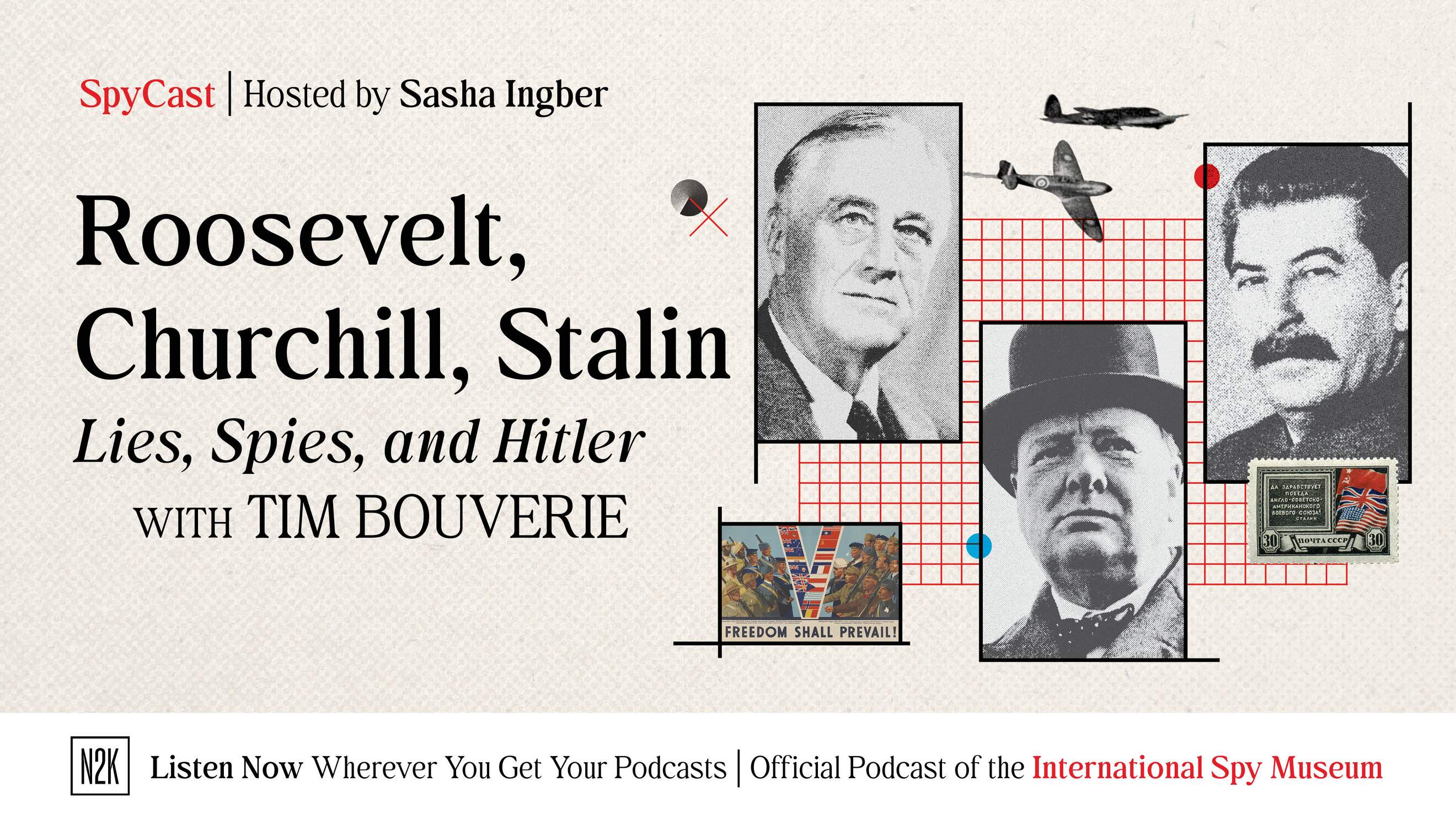


Roosevelt, Churchill, Stalin: Lies, Spies, and Hitler










Sasha Ingber: Welcome to Spycast, the official podcast of the International Spy Museum. I'm your host, Sasha Ingber, and each week I take you into the shadows of espionage, intelligence, and covert operations across the globe. Half truths, lies, distrust, frustration, and spying. These were part and parcel of the tenuous relationship between Franklin D Roosevelt, Winston Churchill, and Joseph Stalin, the Big Three, who were eventually brought together by their opposition to Adolf Hitler during World War II. From London, a British historian Tim Bouverie lays out the dynamics, and to take a cue from an old Facebook relationship status, it's complicated. Tim's new book, Allies at War: The Politics of Defeating Hitler, is out now.
Good morning from Washington, Tim, and welcome to Spycast.
Tim Bouverie: Thank you. It's great to be here.
Sasha Ingber: So I wanted to start by stepping out of chronological order so we can just break down the dynamic. Can we start by talking about what brought together the Big Three in this wartime alliance?
Tim Bouverie: Well, it was really Adolf Hitler. There is no simpler or truer explanation than that. When the war broke out in September of 1939, the United States, in conformity with legislation which had been passed throughout the 1930s, proclaimed neutrality, while the Soviet Union under Joseph Stalin was collaborating with Hitler in a carve up of Eastern and Central Europe.
And this didn't necessarily fundamentally matter because there was a very strong anti-Nazi alliance in Western Europe between Britain and France. And this was the Alliance, which after all had held the line against the Germans on the Western front for four years during the First World War, and no one, including Adolf Hitler, expected it to collapse in a mere six weeks in 1940.
And yet it is this appallingly shocking, unprecedented defeat of the second largest army in the world. That is the French Army in May, June of 1940. That causes a whole recalibration of alliances and strategic possibilities. It is this, which makes the German invasion of the Soviet Union possible. It is this, which after a while, increases the likelihood of American participation in what is largely at this moment, still a European war.
Sasha Ingber: So ultimately these three leaders are seeing either their own country or an ally be attacked, and they know where the future will go. With the Nazis, it was a marriage of convenience. Can you break down what they thought of one another on a human level?
Tim Bouverie: It is difficult to say, not because we don't actually have clear ideas about what some of them thought of each other.
We do, particularly Roosevelt and Churchill, but the war is long and the relationships change. I think the high point of the Churchill Roosevelt relationship is the winter of 1942 into the spring of 1943. That is the high point, but thereafter, it deteriorates through a series of disagreements due to differing views on ground strategy, how the war should be won, different views on British economics and the financing of the war, different views on imperialism. And finally, due to the increasing threat that Churchill and the British perceive, and some in the American administration perceive, but not really, Franklin Delano Roosevelt of the increasing power of Stalin and the Soviet Union, and how best to handle that.
Sasha Ingber: What about Stalin in his view of Churchill and Roosevelt as these years pass by? What's the evolution there?
Tim Bouverie: We have to remember about Joseph Stalin, which neither Churchill nor Roosevelt appreciated sufficiently is that Stalin views everything and I mean everything through his own prism of Marxism Leninism.
His view of Marxism Leninism is that capitalists are out to suppress and exploit the workers and to defeat the center of revolutionary socialism and world communism, the Soviet Union, he has no trust of these men and he has good reason not to trust them. Churchill is the man who tried to strangle the Russian revolution at birth by sending British and French and encouraging American troops to take part on the side of the whites against the reds in the Russian Civil War. Churchill then spends the 1920s campaigning against socialism and against the foul baboon of Bolshevism. The US government doesn't recognize the Soviet Union between the Russian Revolution of 1917 and the beginning of the Roosevelt Administration in 1933.
Stalin has very many reasons to distrust these men and this particular worldview is problematic for him because it doesn't allow him to differentiate between different types of capitalism.
One of the reasons he makes the deal he does with Adolf Hitler in the summer of 1939 is because he sees no ideological difference between capitalism in a Nazi fight form and capitalism in a democratic bourgeois form. So Stalin is continually suspicious and he routinely fails to accept the democracies of their world.
He does not accept Churchill and Roosevelt's protestations, that it is impossible for them militarily to reinvade France in 1942 or 1943 before they actually do so in the summer of 1944. He continually accuses them of trying to fight to the last Russian that they are hoping that this fight taking place in the steps and wastes of Russia will not only defeat the German army, but will weaken their even older foe.
Soviet communism
Sasha Ingber: And with that skepticism as the years pass by that, they have this pact. Has he ever shared intelligence with the Brits or the Americans?
Tim Bouverie: Very little to none that I'm aware of. The sharing of Soviet intelligence is even rarer with ideological allies of of the, of the USSR, but Stalin had also degraded his own intelligence network.
Stalin's paranoia in the thirties had led to the purges, and during this time, it wasn't just the Red Army, the Red Air Force and the Navy that were gutted, but also the foreign intelligence services. There became a persecution mania, which allowed people to denounce their colleagues as a way of trying to survive.
The way to prove that you weren't a capitalist agent or a trotskyist was to denounce someone else working for you. And so during this time, uh, the NKVD, that is the People's Commissary for Internal Affairs and the GRU, that is the military intelligence of the Soviet Union was seriously degraded. And thereafter, they continue to be in a parlous state because both they and Soviet diplomats were brought were too scared to report, honestly, often on what was happening in foreign countries. They were constantly trying to second guess what their masters and then their masters were trying to second guess what the ultimate master Stalin wanted to hear because telling him what he didn't want to hear. Was quite literally a matter of life and death.
Sasha Ingber: And we see some parallels to today when it comes to, uh, Putin and what the FSB calculated in terms of its invasion into Ukraine and how swiftly they could take Kyiv. But the Soviets were in the UK and the United States. Gathering intelligence. Conducting operations. Tell me more about how this was happening while the wartime alliance was at play,
Tim Bouverie: pretty much from the earliest days of the Soviet Union, Soviet agents had been recruited in foreign countries. The major capitalist powers, which were sent to provide intelligence back to Moscow Center, the central hub of Moscow espionage, but also to conduct where appropriate sabotage operations.
This particularly stepped up in the 1930s and recruitment was a lot easier in that decade because of the rise of fascism and so many people in Britain and America saw communism as the opposite of fascism. They looked at the Spanish Civil War and they saw that the only people that were really fighting fascism were the left and were the communists, and that allowed for further recruitment.
And in both Britain and America, a large number of converts to communism or old communists were recruited into serious branches of the government and of the security services of both countries, and continued to spy for the Soviets, not only throughout the thirties, but during the war itself. So while we don't know for certain every document, which was put on Stalin's desk, what we do know is that a vast amount of allied military espionage and diplomatic material, which Churchill and Roosevelt thought was confidential and was ostensibly nothing to do with Soviet Russia was being passed to the Russians and these spies, these Soviet spies who were British or American, they weren't Soviet nationals themselves.
Could justify their activities after June of 1941 by saying to themselves and later to their interrogators. Well, we are just passing on information to another ally. We're double patriots. We're supporting the British and the American course, and we're also supporting the Soviet course,
Sasha Ingber: And that brings us, of course, to the Cambridge five who were gathering intelligence for the Soviets.
Tim Bouverie: Certainly the Cambridge five were uniquely placed to give excellent information to Stalin. You had, uh, Anthony Blunt and Kim Philby as part of the security services and, uh, SIS, the Secret Intelligence Service in Britain. I mean, to give you just one example, Anthony Blunt, between 1941 and 1945, supplied Stalin with 1,777 different documents or files that we know of it. The number could have been it higher, and that included denunciations and interrogations of Soviet defectors or captured Soviet agents. And this allowed, uh, the Moscow Center to protect and warn other agents, other members of the Cambridge Five, about potential dangers that they were experiencing.
The sort of material which Stalin was receiving ranged from Enigma decrypts. That is the decrypts that the British were making of German signals traffic, military, aerial, and naval signals traffic, easily the most important secret of the second World War. They were passing on diplomatic briefing papers, diplomatic cables between Churchill and Roosevelt.
Stalin had the entire UK briefing books on the preparations for the Yalta Conference before the Yalta Conference even took place. Thanks to Donald MacLean's treachery, a man who was placed in the British Embassy in Washington and had very close access.
Sasha Ingber: And Yalta conference, 1945, thinking about what happens after the war ends and how the country should be divided ultimately.
That's where we also saw surveillance. Stalin had some of these villas bugged where Churchill and FDR were, to see what they were discussing.
Tim Bouverie: Absolutely. Soviet eavesdropping on the main Allied war leaders began at the first meeting between the Big Three, which happened at Tehran in November of 1943.
And in this, there was an extraordinary bit of Soviet subterfuge where they suggested that they had uncovered a plot. The Soviets did a German plot to murder the three main Allied war leaders in Tehran, and they said this, and they said to Roosevelt, please don't stay at the American litigation in Tehran, which is a little bit further away from where the conference is going to take place, which was actually at the Soviet litigation, come and stay at our litigation, which happened to be even better fitted out with listening devices than the American ones.
Roosevelt, who wished to curry favor with Stalin and win his confidence, went along with that, but he was warned as was Churchill that these rooms were going to be bugged. Churchill had been warned when he went to Moscow in August of 1942 that the rooms in the dacher at which he was staying were going to be bugged.
And yet both democratic allied war leaders continued. Their conversations were really quite reckless, abandoned, uh, indeed. They were so candid that Stalin, who every single morning before the plenary sessions at Tehran and then at Yalta, received a report based on the highlights of Churchill's and Roosevelt's private conversations and those of their subordinates.
Stalin believed that what was being practiced by Roosevelt was even disinformation. He couldn't believe how rude and dismissive Roosevelt was about Churchill in private, and he thought, well, this is Roosevelt playing a game. Roosevelt knows we are listening in, and he is trying to persuade us that he and the British are not so closely united as might otherwise appear by serving up this flack as a distraction.
Sasha Ingber: Was it that Churchill and FDR just didn't care that they knew these rooms were being bugged? Did they forget? I mean, what, what's the logic behind having that unbridled, unfiltered attitude in these rooms?
Tim Bouverie: It's very, very curious because Churchill had a genuine interest in espionage and intelligence and was highly secretive about the most important Allied War secrets. In particular, the Enigma decrypts known as Ultra and what became known as the Manhattan Project.
But Roosevelt had an attitude towards elements of diplomacy and elements of secrecy, which were frankly frivolous. The interservice rivalry in the US was unbelievable. Brits over in America during the war used to joke, however bad British and American relations ever got, they were never as bad as US Army and US Navy relations or relations between the FBI and the Office of Strategic Services. It was administrative chaos in Washington, one which Roosevelt did nothing to ameliorate.
In fact, he was hugely responsible for this chaos. And he was warned at various moments that there were high level communists in his administration, in the security services, even in the Manhattan project and did nothing about it. And part of this, I think, is based on the notion that, well, the USSR is an ally.What's it really matter?
Sasha Ingber: Even when the US is trying to secretly build atomic bombs? This information should also surreptitiously go to the Soviets?
Tim Bouverie: It, it was happening more. By accident and by design. It certainly was not Roosevelt's intention to let the secrets of the atomic bomb go to the Soviets. When it was discussed between Roosevelt and Churchill, how atomic information would be shared and there were people in the administration, the Roosevelt administration who thought that it would be seen as such a betrayal by Stalin for this weapon to be developed without him being informed and then just be presented with it, as it were at the end. People said, you have to bring the Soviets into your confidence. They decided not to. So it was more slip shot, it was more casual, it was more frivolous.
It was more lots of things going on and a lack of attention to detail that allowed so much espionage. And indeed, more espionage went on in Washington indeed, although less famous than even in London.
Sasha Ingber: When we come back, how Stalin’s distrust even extended to his own intelligence officers and how intelligence helped turn the tide of the war for the allies.
So with all of this intelligence flowing to Stalin over the years, how does it influence his behavior with FDR and Churchill?
Tim Bouverie: The curious thing about Stalin is that however good the intelligence he's getting. It depends upon your assessment of this. And indeed, that's not just true of Stalin. That's true of anyone.
And the problem with Stalin is he is so paranoid that he often doesn't believe the intelligence, the Cambridge Five are providing such good intelligence and such volumes of intelligence that Moscow Center and Stalin starts to believe that these people have become double agents, and that this is deliberate misinformation being sent to Moscow via London.
And why? What is it that most makes Stalin and Moscow Center suspicious of the Cambridge five. It is the fact that despite this glut of documents that they provide in the early part of the war, they do not give one instance of a British or an American agent, in Moscow, in the Soviet Union or in the Soviet embassies in Washington or London, and the Soviets can't believe that their, their agents are all over London, Washington, Britain, America, everywhere.
They cannot believe that Britain and America are not spying on the Soviet. In the same way.
Sasha Ingber: Right. So let's look at it from the other side. Why are the United States and the UK not spying on the Soviets? When we see so much effort being made to gather intelligence, uh, from Moscow?
Tim Bouverie: A huge amount of it has to do with resources.
The main effort had to go against Nazi Germany, Japan and Italy, and there simply was not the capabilities, certainly in Britain, to mount a major Soviet effort in the early stages of the war. And then from June, 1941, Stalin is an ally of the British and the Americans a highly, highly suspicious ally, and it is a directive of the British government and of the US government that espionage should not be undertaken against an ally because they think that any possible benefits will be so hugely outweighed by the adverse reactions, reactions, which could lead to the breakup of the alliance. And although they are aware that there is Soviet espionage going on in Britain and America, they try and root out where possible. But in the main, this is considered not as dangerous as access intelligence operations.
Sasha Ingber: You're speaking of allies, you're speaking of resources, but there was also a time when the Brits were gathering intelligence on the United States and tell us about that moment.
Tim Bouverie: The British were always gathering a huge amount of political intelligence on the US. Churchill told his son Randolph Churchill in late May of 1940, that he had found a way to win the war.
And Randolph was completely astonished at how could Britain possibly win the war? And Churchill replied, I shall drag in the United States. And to that end, a huge amount of British resources went. Resources which were combing the newspapers and congressional records looking for supporters, providing Britain with cutting edge, uh, political and diplomatic intelligence.
But there were also some dirty tricks, attempts to influence US public opinion. There was a map in 1941, purportedly a German map, ostensibly a Nazi plan to reorder Central and South America. Once the Germans had won the war, which found its way to the top of the US government and was brandished by Roosevelt in a speech he made at Navy Day.
Well, in fact, this map was not a genuine German map. It was a forgery by British SIS, that is Secret Intelligence Services, in New York. But one must say this, these clandestine operations weren't totally clandestine. The FBI was aware of British presence in New York. They were aware of what the British Embassy was doing in Washington, and indeed they collaborated to a large extent.
What often happened was that the British would point out to the FBI where Nazi agents were operating in the US or Japanese agents, et cetera.
Sasha Ingber: Right. But there was also an awkward conversation that the Brits had to have with the Americans about how they were able to break a naval code.
Tim Bouverie: Indeed. Shortly after Pearl Harbor, Churchill wrote to Roosevelt and said that Mr. President, in the days before US belligerency, our crypto analysts succeeded in breaking the US Naval code. You should realize that it is susceptible to being cracked. This is a case of, uh, crypto analysts showing what they can do and honing their skills, but it was a potentially embarrassing disclosure.
Sasha Ingber: And the Brits do start sharing intelligence with Stalin ultimately, um, including information on an imminent attack, uh, operation Barbarossa in 1941.But this, as we've discussed, is now being a trend, essentially falls on deaf ears. Stalin doesn't believe it. Tell us more about that.
Tim Bouverie: Stalin thinks that Churchill is the greatest trigger of them all. It's obviously in Britain's interest if Nazi Germany attacks and maybe brings the USSR into the fight. On the British side, he thinks it's disinformation designed to make him take an aggressive posture that will in fact, cause what the allies are warning of a German invasion. He thinks this is all disinformation, so he dismisses the warnings that Churchill gives him, which come from Enigma decrypts. It comes from the buildup of German forces, which have been diverted momentarily, but this isn't the only source that Stalin receives.
It is estimated that Stalin received 87 different specific intelligence warnings about Operation Barbarossa, and they came not only from the British, they came from his own agents, most famously Richard Sorge in Tokyo. All of this Stalin believes not least because he's coming to the grim realization that he has miscalculated that the Russian German alliance has ended sooner, far sooner than he anticipated it to ending. He therefore believes, as we often do when we're terrified that we are about to be proved wrong. You dig deeper into the illusion that you have built for yourself.
Sasha Ingber: You're describing skepticism on all sides, not just with Stalin receiving this information from the Brits, but also one of his own operatives, uh, Richard Sorge.
And let's talk more about Sorge. How did that relationship ultimately evolve? Because this was a man who was involved in very, very high profile operations and ended up being killed hanged. In 1944, after having to confess to the work he did for the Soviet Union,
Tim Bouverie: Sorge was one of the most amazing spies of the Second World War.
He's born in what would now be Azerbaijan, but he is of German descent and swiftly becomes a communist and he's recruited by Soviet military intelligence and works his way up as a journalist, posing as a journalist in not just Nazi Germany, but also in China, feeding an enormous amount of information back to Moscow, and finally, Tokyo. And it is through the incredible network of friends in the German and Japanese military establishment in Tokyo that he's able to warn of the onset of Operation Barbarossa warnings, which are ignored. But then, what he's really critically able to do, he is able to show that the debate within Tokyo about whether to attack the Soviet Union or to attack the British and the Americans in the Pacific has been resolved in favor of a Southern strategy into the Pacific.
And this allows Stalin to move five Army Corps from Siberia and throw them into the battle of Moscow. And if we really zoom out. This is the moment at which the tide turns. This is the moment at which the German war machine is halted, and it is Hitler's failure to take Moscow in the winter of 1941. That ultimately begins his defeat.
Sasha Ingber: If more intelligence had been shared between these three countries, as the war moved forward, what would the result have been? Might it have actually sped up the allied victory in your view?
Tim Bouverie: I think that all important intelligence was shared when it needed to be shared, and the danger of sharing something like the Ultra secret with Stalin was too great to contemplate. Stalin had been Hitler's ally between August of 1939 and June of 1941. He had been his ally once, he could be become his ally again. What if he was defeated and what if it it was revealed? The more people that know any secret, the more vulnerable it becomes, and nevertheless, pretty much everything essential to the Soviet War effort that was discovered through American British Crypto analyst espionage and otherwise was shared with Moscow. And actually it also should be pointed out that thanks to the activities of the Cambridge Five, Stalin, I’m fairly certain was aware that the British and the Americans had broken the German signals traffic.
Sasha Ingber: Sharing more intelligence during this wartime alliance, could that have also potentially opened up more vulnerabilities for the West when the Cold War began?
Tim Bouverie: It could have, although what we now know about Soviet espionage in London and Washington means that those vulnerabilities were already there and they were already being exploited. Although it is possible to make an argument, and this is going beyond my period now, that actually the real damage done to Britain and America was the complete undermining of faith in the professional civil service and the secret service that came when these traitors were revealed, and the amount of soul searching and the loss of faith in established practice that that brought about. And yet nevertheless, it seems pretty incontrovertible now that the Soviets would not have got the atomic bomb by 1949 were it not for the large degree of Soviet espionage, they would've got it. Stalin was working on his own atomic bomb in any case, but probably not so soon.
Sasha Ingber: Moving to today, we've seen examples where the United States and the UK have turned to adversaries on issues where there is alignment. The US turned to Russia for nuclear deterrence on North Korea, Iran in years past. Is it a good idea to work together when you have some common ground, or is it essentially opening up areas of exploitation as we've just discussed?
Tim Bouverie: I think it's undoubtedly a great idea. Politics, as Bismarck used to say, is the art of the possible, and it is not possible to go to war either in a hot or a cold sense with every regime, which doesn't share every ounce of your ideals at the same time.
And greater good can be done by allowing yourself with powers that don't share any of your ideals at all. Many of the death camps were liberated by the Red Army. I would say there are more people alive and more descendants of people in Europe today, thanks to the British, American, Soviet Alliance than there would otherwise have been.
And by working together, Britain and America and alliance with China or whoever on North Korea, if that could be made to work, then that might lead to further collaboration between the West and the Chinese on other areas.
Sasha Ingber: And yet the Russians have used the fact that they liberated many of these camps in influence operations to undermine what the United States did in World War II. Are we seeing echoes of this dynamic at play today?
Tim Bouverie: Undoubtedly, but this is not necessarily something new from the Russian point of view. Stalin paid very little tribute to British and American arms during the Second World War, and certainly by the end of the war as far as the Soviet people were concerned,
This was the great patriotic war. It was the Russian people, the Soviet Union, the Red Army, which defeated Nazi Germany, not the British and the Americans. The worrying difference now is that there are many voices and quite prominent voices in America that are questioning America's own involvement in the Second World War, undermining what has been accepted by both left and right in America for decades, which is America's essential, and indeed, I would argue, moral and heroic efforts in World War II.
Sasha Ingber: Tim, I know your book has many more complexities about the dynamic between the Big Three. I really appreciate you breaking down the intelligence side.
Tim Bouverie: It's been a great pleasure.
Sasha Ingber: Thanks for listening to this episode of spycast. If you like the episode, give us a follow on Apple, Spotify, or wherever you get your podcasts, and leave us a rating or review. It really helps. If you have any feedback or you wanna hear about a particular topic, you can reach us by email at spycast@spymuseum.org. I'm your host, Sasha Ingber, and the show is brought to you by N2K Networks, Goat Rodeo, and the International Spy Museum in Washington, DC



