
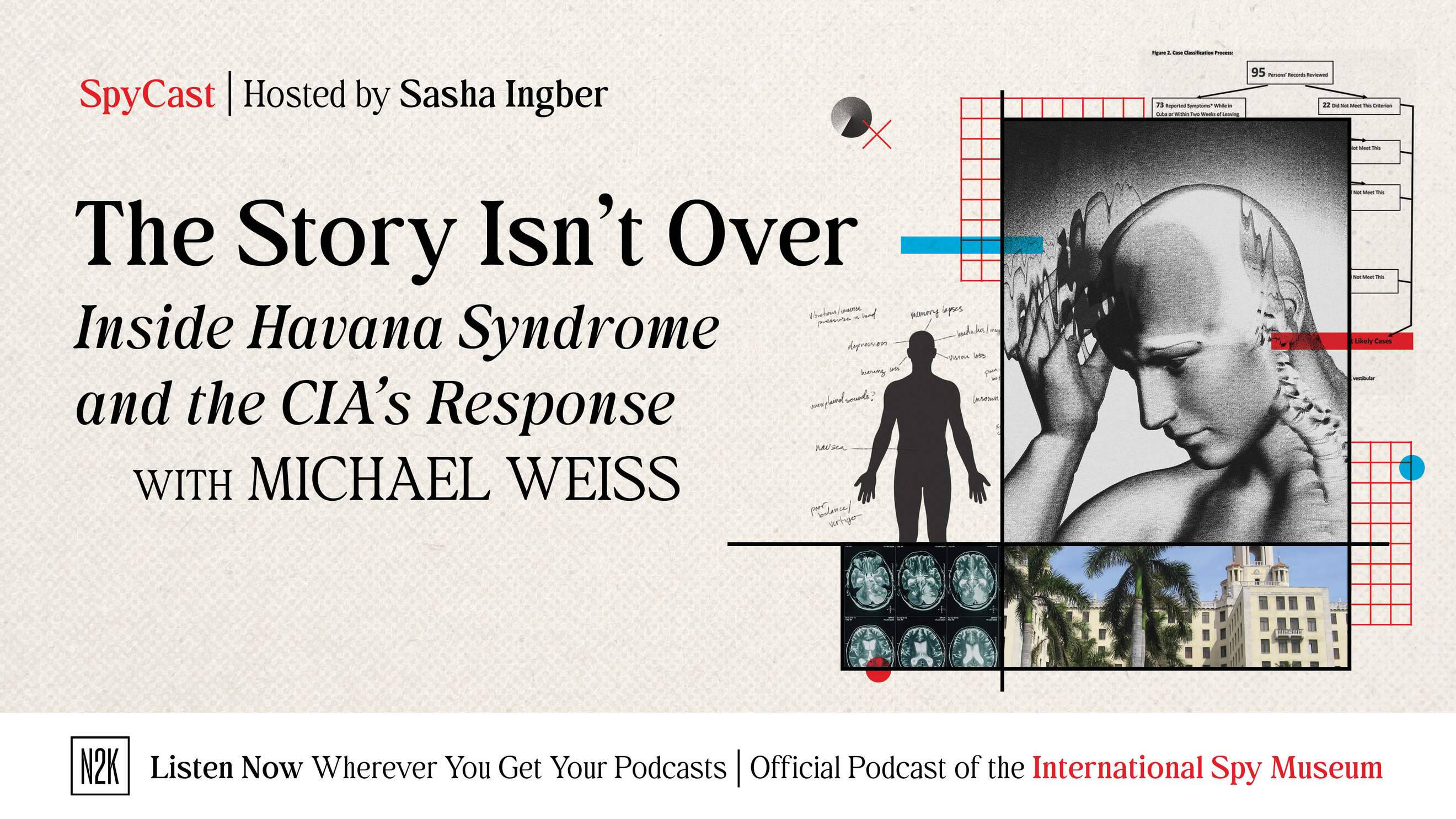


The Story Isn't Over: Inside Havana Syndrome and the CIA’s Response










Sasha Ingber: Welcome to Spycast, the official podcast of the International Spy Museum. I'm your host, Sasha Ingber, and each week I take you into the shadows of espionage, intelligence, and covert operations across the globe. Confusion and controversy are growing around the intelligence community's handling of Havana Syndrome, what the government refers to as anomalous health incidents or AHIs, the mysterious health condition has left a group of American spies, diplomats, and service members with serious brain injuries.
Many believe Russia's hand is at play. But an intelligence community assessment from 2023 said most agencies concluded it is very unlikely a foreign adversary was behind the affliction, and it hasn't changed its stance even as new details come to light. As I first reported, the US government bought and has been testing a weapon that some scientists believe is likely the cause of these brain injuries.
I reached out to the CIA, which declined to comment then and declines to comment now. Accusations of a coverup have been mounting from inside the House's Intelligence Committee, to journalists who have been covering AHI. Reporter Michael Weiss is part of a team that uncovered new information and we sat down together.
Hey, Michael, thank you so much for joining. I, I know you're in New York. You've got your books, you've got your aquarium in the background, making some water noises for us.
Michael Weiss: Yeah, usually it's the birds that I, I hear the most about on podcasts. So you get the fish today, Sasha.
Sasha Ingber: So let's get right into some stellar reporting that you recently put out.
You know, back in early January, I reported a major story on how the US government had purchased and was testing a device that could direct energy, which was one of the possibilities of what's behind Havana Syndrome.
Michael Weiss: Mm-hmm.
Sasha Ingber: And you expanded on that information with new details. You brought more to this idea of what this potential weapon could be, pulsing microwaves.
Can you explain more about how it's tested, who it was tested on and, and where it came from that this purchase even happened?
Michael Weiss: So this was acquired by the Department of Homeland Security using funds provided by the Department of Defense. Uh, the entire mission, the price tag was about $20 million. Um, and the device was acquired by a criminal Russian network, which is sort of a euphemism as we're given to understand for an organization that is not necessarily, doesn't necessarily specialize in arms dealing. So, uh, the implication I take from that is that these were operatives of the Russian special services who were doing some kind of side action. The device itself was new or off the shelf, so this specific device has not been linked to any known attacks, um, related to Havana Syndrome against American personnel.
It is portable. It, uh, uses pulse microwave energy, which is very important because the intelligence community's expert panel, which looked into plausible explanations for AHI anomalous health incidents, which is another name for what we call Havana Syndrome, um, linked the known symptoms to pulse, microwave radiation.
The device, uh, is, I think I said portable. It's concealable. It uses relatively limited power. So one of the important things Sasha to, to remember is a lot of skeptics of AHI said, well, if a technology like this even existed, hypothetically, the battery that it would require to to power it up would be the size of a garbage truck.
Not so. Um, the battery in this case is relatively small. Uh,
Sasha Ingber: and we even had Washington Post reporting from Warren Strobel and Ellen Nakashima
Michael Weiss: Yes.
Sasha Ingber: About a Norwegian doctor who ended up building a device and injuring himself.
Michael Weiss: A classic case of FAFO, if ever I saw one. But, um, the other thing to, to note about this device, uh, it can penetrate drywall.
And window pane. Um, I think the distance is several hundred feet or meters. And yeah, basically everything that was hypothesized about what kind of weapon could be used to inflict this kind of harm on American service people abroad and by operatives who could simply get away with it. Right. Not get caught.
This device seems to tick those boxes. We know that the DOD has had it at a secure US military installation for the better part of a year, and we know that it's been tested on rats and sheep. And guess what? They too have developed the physiological symptoms consistent with AHI. So a lot of people we've talked to both within the intelligence community and certainly among the cohort of victims whose cases are now very well known, feel a sense of indication because, you know, we kept hearing for years, well, if we obtained a device that could do the kinds of things that people say has have happened to, to victims of Havana Syndrome.
That would be a game changer. That would change our, our standard of evidentiary support. Well, here is the thing itself. And so now we're all waiting for everyone to come out and say, okay, maybe it's time to reassess, reassess our conclusions that there's no there, there. As the common refrain goes.
Sasha Ingber: Now specifically on the device, I'm told that there are literally hundreds of thousands of different configurations or any energy fields that you could create with the device from the carrier frequency to the shape of the pulse, to the pulses.
Repetition frequency. Now there could be other factors which could include people's own genetic backgrounds, and that would explain, I'm told why we see such variety in people who, uh, have symptoms in terms of severity, in some of the range of symptoms, specifically from some of these really serious cases.
Michael Weiss: Yeah.
Sasha Ingber: And so one of the ideas was that this could theoretically be tested in perpetuity. My question to you is what comes next? Now that this is out in the open, do you think the government will keep testing? Is it looking to assemble its own weapon? Do you think that this administration or a future administration will finally say, yes, this was an attack?
Yes, this was the Russians. Where do you see that going?
Michael Weiss: Well, just to ratify your own reporting on this, um, the device is programmable for distance, levels of intensity, different scenarios, and what we were told at the Insider and 60 Minutes was that the key to understanding the provenance of this, meaning that it comes from Russia, is not so much the hardware.
The physical components as the software make of that, what you will. I mean, we're just relaying what the reporting suggests here, so all of that is true. I do not really think that the federal government is gonna own up to what they have and what they know. The story we did at the Insider relied heavily on whistleblowers from within CIA, so we spoke to somebody who was part of what's called the GHIC or the Global Health Incident Cell.
It points to the culprit behind it being Russian state actors. So the question is, why not just come clean with this right at the start of this investigation? The argument we were given is the reason that nobody wants to own up to this is if this is true and we acknowledge it to be true, it is a declaration of war by Russia and that demands a reciprocal response, and nobody wanted to go down that ath, right? It's too escalatory, it's a nuclear power, et cetera. Well, since the full scale invasion of Ukraine, one might argue the United States has retaliated and then some by working with the Ukrainian government, sharing intelligence, providing weapons that have killed tens, hundreds of thousands of Russian soldiers.
So why not just kind of come up, come own this and say, yeah, we're doing this in part because the Russians have done it to us. I think a lot of it has to do with ego. A lot of it has to do with reputations and careers that were made. People were promoted by basically investigating AHI and saying there's nothing to see here.
So the human element in this, the, the kind of bureaucratic entitlement, I think is a factor unfortunately.
Sasha Ingber: The question of what the government does next is certainly not an easy one. It's curious because CIA director Bill Burns in 2021, traveled to Moscow, and I'm told by several people he spoke with Putin and it was then or soon thereafter.
That he told Putin to stop whatever these incidents were. If he was involved to stop or it would end badly for Russia. And then I'm also told that some incidents did decrease, but I'm told that there are also people nowadays that have not come forward. Who are still afflicted, but they aren't coming forward because they don't believe that they're going to be believed.
This puts their jobs in jeopardy and they also don't wanna give Russia the satisfaction of knowing that they were harmed, so they've stayed quiet. I'm wondering if you know of cases in the last one to two years that you can talk about.
Michael Weiss: So the, the opening of the story at the Insider, uh, published features a case of somebody who was hit in Central Asia, and we are rather cagey about the circumstances of this person's ordeal.
Why? Because this person is still in the CIA. And even though, even though he, uh, is known to be one of the so-called cornerstone cases, so somebody who the medical records are there. The blood tests show that he has biomarkers, which are two specific proteins that have leaked from the brain into [00:10:30] the bloodstream,
Sasha Ingber: which indicate a brain injury,
Michael Weiss: a brain injury of some kind, and he had been in perfectly good health literally hours before.
Uh, he was struck. This is a person who remains very cautious about coming forward and publicizing his ordeal. He's still being moved around in CIA, looking for postings overseas. And because there has been this kind of pariah effect that has descended upon those who have come forward, uh, they are mistrusted by their own cohort.
They're seen to be tinfoil hatted, conspiracy theorists. Now it's a, it's a twofold phenomenon, right? On the one hand, you have victims who are afraid to step forward for this, for the for mentioned reasons. On the other hand, you have people who are chiefs of station who do not want victims of AHI coming into their station for fear that it's going to put a damper on morale or it's going to lead to paranoia, uh, and no work will get done.
So there is a, almost an HR element to this. We are afraid of what this is going to do to our personnel in the field and back at headquarters. And this was seen, this phenomenon was seen as way too distracting, uh, to the business of just day-to-day espionage. We wanna get back to doing the job that the CIA is meant to do, which is stealing secrets and collecting.
And we couldn't do that so long as everyone was talking about AHI. So let's make it go away.
Sasha Ingber: And the real irony here is that by trying to make it go away. It hasn't gone away and it potentially has affected recruiting morale and many other areas. You know, in, in February, I went to a Havana Syndrome conference in Philadelphia, David Relman, Stanford University doctor who participated in some of the fundamental research that we're talking about here.
Michael Weiss: Co-chair of the Intelligence Community Expert Panel on plausible explanations,
Sasha Ingber: right and behind the National Academies of Science report in 2020, pointing to directed energy as a possibility here during this conference. He said, quote, regardless of what happened to this large number of individuals in the future, if we don't understand this better.
To become the unwitting victims of others who now see that there's an opportunity to cause in way that causes great and it sounds like this is what you're talking about and you and your partners at 60 Minutes and your reporting by saying that if undercover agents could purchase this device from Russian criminals, then there are dark implications here.
So since you're sitting here with me, I wanna understand if you think this is corrupt Russian intel officers who have sold this technology as part of a side hustle. If this is more about plausible deniability, like the mercenary group, Wagner Group, and Russia's, uh, cyber operations. Were was, was this stolen or, or was there infiltration here?
How do you think that it ended up getting into the hands of this criminal group?
Michael Weiss: There are a number of explanations. You've just, you know, uh, mentioned several. My hypothesis has been, because the first recorded case that we could determine was legitimate occurred in Frankfurt in 2014. It was a CIA officer under diplomatic cover working out of the consulate.
This had happened right after the Euromaiden revolution and Viktor Yanukovych’s flight to Moscow. My hypothesis has been Russia was preparing for a full scale invasion of Ukraine and wanted to take as many pieces off the chess board as possible. But again, coming back to the cornerstone cases, understand the way the Russian intelligence services work.
These are units within the GRU and the FSB and the SVR. They are rival risks. They are competitive to the point of murderous rivalry. Really. They often do things of their own initiative in an an effort to impress the boss, Vladimir Putin. If there's a device tech, the technology is there. This thing has been constructed and it has been given to one or more of these units.
These units will behave very opportunistically for a very little bit of investment. The return on it has been extraordinary For the Russians, they cannot believe their luck.
Sasha Ingber: Let's shine some light on the CIA now and especially on the global health incident cell, GHIC, as it's called. Tell us more about what you learned.
I know that from people I've spoken to, there had been tension between analysts and operatives that it was seen, that operatives out in the field. They're the ones who are seeing this, who were feeling this, who know people who have it. But a lot of analysts weren't touched by that.
Michael Weiss: Yeah, it's not so much that you, you have to be touched by, uh, AHI.
It's, I think the difference is one of approach with respect to how the Russians behave, what their tradecraft is like up close versus what you might glean from looking at a series of NSA intercepts or looking through the relevant, um, scientific literature that's been compiled since the Soviet period.
Let me put it as starkly as I can. I have yet to meet somebody who has come out of the director of operations at CIA, who doesn't fall into one of three categories, category one oh. I'm a victim of AHI, I just don't, I haven't made a big deal about it for the reasons that we've already discussed, right?
Fear of career advancement, you know, being held in suspicion by my colleagues. But, you know, I've been to Walter Reed, I've been in rehabilitative care. Here's my traumatic brain injury diagnosis. Here's how it happened. All of the same thing. They all fall into, uh, the pattern that has been now well established.
Category two. Somebody I know and I worked with very closely at a CIA station abroad was struck and I saw it and I witnessed it up close. And I'm telling you, this is not manufactured. This is not fantasy. This person is not a grifter. They're not looking to cash in. They have served in hostile terrains. They have been under firefight.
They've witnessed explosions of IEDs in the field. I mean, they've been through every kind of traumatic ringer known to man. They didn't just wake up one day and said suddenly, I, I, I, I've had hearing loss in one ear. I have intense vertigo. I have occipital neuralgia. I've gone blind in one eye. That didn't happen.
Sasha Ingber: And these are people, people who have been trained for a long time,
Michael Weiss: very well trained
Sasha Ingber: They care about the work that they do, and they are built for these high stress environments.
Michael Weiss: They're highly professional. I mean, one of the other things we do, Sasha, when we adjudicate cases, and again, I'm not speaking for all reporting on AHI.
The ones I, I can feel confident going out with are the ones that I have seen their medical records, and I know their service history, and I've talked to their colleagues, right? They have impeccable backgrounds in this. But category number three, my spouse, who is also in CIA, who was hit. Okay, so I have yet to meet someone from the director of operations who doesn't fall into one of those three categories.
In other words, no one I have met who has come out of the director of operations thinks that this is a hoax or that this isn't real, at least in again, that the sort of cluster of cornerstone cases, not in the thousands, not necessarily in the multiple hundreds, but certainly within the dozens. And they all have that one thing in common, which is they have all worked at a professional level, at a very high professional level, to counterman Russian malign activity the world over. So that is a hell of a coincidence if this happens to be some kind of manufactured syndrome. Analysts did not believe this was real because collection on the Russians had it, that Russians were talking about it like, what the hell are the Americans on about?
What is AHI? We are not doing this. The Russian services are so compartmentalized and siloed that even within the same organization or unit or subunit you don't necessarily know what your colleagues are up to because again, Russia is itself a very paranoid system
Sasha Ingber: and Russia is excellent at compartmentation.
This is well known.
Michael Weiss: yes. And they spy on their, their own people, and also they're not complete idiots. They can behave like the keystone cops, but they're, they're also, they're aware that the Americans and other services are listening in on them. So their capacity to plant disinformation for the purposes of trying to throw people off the scent is great.
Sasha Ingber: When we come back, Michael says, the CIA's skepticism of AHI victims transformed into spying on the cohort.
So you've set up this situation whereby the operatives versus the analysts, um, different sensibilities, different experiences. How is this now manifesting when the CIA's global health incident cell starts to look for answers? And I'm struck by a quote from someone that you spoke with who said, quote, it took us a decade to find Osama bin Laden, but months to get to the bottom of Havana.
Michael Weiss: And there is no bottom because there is no Havana to, to round out that quote. So when the, the GHIC was assembled. Three people were tasked with kind of running the show. So you had a director, deputy director, and then a third person who was also part of that troika, the first person, the director, I can't mention him by true name because he is still undercover,
Sasha Ingber: but he's the one who went after Bin Laden.
Yeah.
Michael Weiss: Yes. He gave his claim to fame was was being part of the team that found Bin Laden and all credit to him. I mean, he came from the counter-terrorism center, right. Which is its own kind of beast within CIA and very well regarded. But everyone who ran the troika, they all came from the director of of analysis and the head of operations at the GHIC wasn't even working full-time in the GHIC was working part-time.
And his side hustle was selling, um, first aid kits online. And I think the analyst came in with, uh, a great deal of bias and they understood what was required of them from the top. You know, the idea was we do not want this building coming out and saying that we're at war with Russia because the implications of that are enormous.
The, the bar was so high for evidentiary support. I mean, we have another quote in the, the insider investigation. You know, we went to war in Iraq on a post-it note, and every time we kept asking, well, what would be sufficient? For the CIA to say that a AHI is real and oh, the Russians are behind it. They kept moving the goalposts.
We have the device, it came from the Russians, and yet the assessment at CIA at least is unchanged.
Sasha Ingber: I know that you reported that some people were told to stand down from collecting intelligence on this right overseas and that there were no people with Havana syndrome, AHI, who were participating. My my thought is that they thought that it might bias the work.
What you're describing is that the work already was biased by people who went in not believing it.
Michael Weiss: We don't wanna see your medical records. Uh, nobody who's been affected by AHI can be part of this team. Uh, the one, the, the sort of anomalous hire, funnily enough, is our whistleblower, John Thorn. He was not himself a victim of AHI, but he was, for lack of a better term, a first responder in one of the the cornerstone cases in the entire cohort, which occurred in the central Asian country. Um, a CIA officer who not only was he affected, but his wife and child were affected, and his wife also had biomarkers. So again. Socio illness where there's physical manifestations of proteins that bypass the blood-brain barrier happening not just in one person, but in two people in a, a family of three.
It's very unusual. Yeah. So anyway, John Thorn was, um, a support officer in operations at the station in this central Asian country, volunteered to work at the GHIC because he felt he could contribute something. Having had that on the ground firsthand experience with AHI, and he said, I mean, from the moment he set foot in the building or in inside the investigative unit, the mood was one of, this is a complete boondoggle.
We already know the answer. We're just here to kind of. Wait out the clock and all the evidence that was coming in to substantiate it being real, or the Russians being behind it was dismissed. The phrase that that John said he heard time and time again was there is no there there. At one point he said that he would show up to work on an eight hour workday and he did 30 minutes of actual labor.
The rest of the day he'd be reading a book or wandering the grounds because there was no work to be done. There was definitely a perception that this was sort of an exercise in futility. It was a rubber stamping of a conclusion that had been pre-designed.
Sasha Ingber: And there have also been, um, reports including yours, um, and some who've also described to me moments where some people who say they have, uh, AHI have been made fun of inside this particular unit.
Michael Weiss: The worst thing that we heard, uh, and, and now we're being just specific to the GHIC. I can get into other cases of the CIA where senior leadership was, was either spying on victims or mocking them. But the worst thing that we heard came from John Thorne, who said for him the final indignity, which caused him not only to resign from the GHIC, but from CIA entirely was his direct report had come in to to work one day and said, oh, we're gonna all have a happy hour. Go to the bar, and we're gonna all behave like Havana Syndrome victims. So stumbling around like you've just had a stroke or you've been electrocuted or like you're severely drunk, and he's like, what are we doing?
Sasha Ingber: You'd also reported that there are videos that have shown people collapsing and even an infant who ended up going nuts in a nanny cam. What more do you know about this, because it sounds like you didn't actually see it.
Michael Weiss: The nanny cam incident that happened in the same central Asian country. That I've been referring to before where John Thorn had been deployed and one of the cornerstone victims was that's a case that has not been reported in the press because there were several hits in that country.
This one, and I don't have too many details here, but I can give you kinda the broad strokes, uh, involved a, an officer of the National Security Agency who was struck in a stairwell. Uh, there was another incident in Istanbul where I believe, um, two FBI agents and they were in a cafe and there was a guy with a backpack sitting in an adjoining table and the entire table.
So FBI agents, their spouses, and their children all succumbed at the same time.
Sasha Ingber: Were these videos seen by the GHIC?
Michael Weiss: Yes. We tried to query as many people from the other side who held that, no, actually there was extreme analytic rigor applied to the GHIC. We try to represent that viewpoint as best we can, but too many people have come out.
Stated that the, the, the, the opposite case, which is no, this, this was not, um, a very rigorous or, or even transparent, um, effort to get to the bottom of AHI. This was an attempt to just kind of, you know,
Sasha Ingber: it was curious to see how once this 2023 assessment came out saying, this is not about Russia. These are not attacks.
Um, we don't think that there's any, there, there, as you say. Yeah. That a lot of journalists completely dismissed it. They completely left it behind and only a few continued to go down the path of seeing really what happened here.
Michael Weiss: I think that's by the, by design though, Sasha. But I think one of the things that the CIA did in particular, deputy director David Cohen who leaked the interim ICA report with a mind of injecting it into the bloodstream or into the information ecosystem, that this whole thing was just a nothing burger. What happens is journalists go out and they report what they're told by their sources, and when they're on the record saying, you know, yeah, CIA says nothing to see here, this whole thing must just be a fantasy.
It becomes much harder for them to say, actually, we were misled, we were wrong. I mean, there's an old saying in journalism, you are your sources, right? And if your sources are lying to you or manipulating you, they make you complicit in the lie or the manipulation. And so again, you know, the factor of psychology and ego, I, I is a big one here.
Sasha Ingber: What would be interesting to know is if those people who were putting out the report in 2023 had the information that you've been reporting. Over 2024 and now and whether or not it really was an influence operation or if it was,
Michael Weiss: we had somebody with access to all the collected intelligence in CIA in real time when the interim report came out and then the full ICA came out and he said, this bore no resemblance to what we saw internally.
This thing was, was a complete stitch up.
Sasha Ingber: It seems like there were efforts from the very beginning to push people away from the directed energy theory to push people away from the foreign adversary side. Right. This is something that Relman has also discussed.
Michael Weiss: Yes.
Sasha Ingber: But let's also shift gears a little bit to the Pentagon.
I've reported on the cross-functional team, and I've been told that 2025 was a pivotal year. For the people who worked inside, they were getting closer and closer to authoritatively saying this was Russia. Were no longer able to have their communication channel to lawmakers. They were not informed of lawmakers requests for briefings because of the Office of Legislative Affairs, not informing them of these requests.
Right. They were silently moved from policy to research and engineering where they fear attribution won't be included. And I'm also told that they are losing 50% of the team. And maybe more moving forward.
Michael Weiss: So lemme just put a, what you just said is very important and I, I just wanna put a proposition to your audience.
If Havana Syndrome is some invented fantasy or conspiracy theory, and if there is sufficient evidence to show that, isn't it interesting that there seems to be a real concerted effort, quite a lot of energy expended into keeping organizations, units that are set up by the federal government to get to the bottom of Havana Syndrome from basically releasing their findings in full. I mean, transparency, sunlight is the greatest disinfectant, right? So if we're all wrong and we've been had by hysterical, you know, emotional victims with a sense of moral injury and their, you know, waging what to their minds must be a righteous crusade against their former employer.
Come out with it, you know, let the, the cross-functional team do its job and, and release it. Let the ODNI, the office of the Director of National Intelligence, which is sitting on classified intelligence and a statement saying the intelligence community did not conduct itself, uh, with due tradecraft with respect to this issue.
Let them come out and say it.
Sasha Ingber: Um, and that report has been sitting on the shelf for many months now.
Michael Weiss: Right. Why, why this, this effort to obstruct, why this effort to, to stop the gears from turning
Sasha Ingber: Marc Polymeropoulos, one of the CIA officers who says that he has Havana syndrome and has been very vocal providing interviews across the board to spread awareness on this. He told you that the agency has actually spied on the cohort. So it's not just that there were denials and undermining of credibility, but this takes it a step even further, Michael.
Michael Weiss: Yes. And that that is illegal because the cohort we're all private citizens. Um, and the CIA has no remit to spy on Americans.
If you suspect that an American is engaged in espionage against the country or working for a hostile adversary, and you've come across that evidence through incidental collection, you are duty bound to transmit that information to the FBI because that's their jurisdiction. So in this particular case, somebody was authorized on high at CIA to try and infiltrate the encrypted chats of the victims.
They were speaking to each other on Signal and Wickr, which, uh, was actually a CIA created, uh, messaging platform. Um. Uh, you know, that, that certainly sounds untoward, if not illegal to me. And again, why do that?
Sasha Ingber: Why did they do that?
Michael Weiss: I have no idea. You'd have to ask them. You know, intelligence work is supposed to be scientific.
It's supposed to be dispassionate and objective, and you're supposed to keep an open mind to having your mind changed. Right? New evidence comes in. We change our assessment and conclusions yet again, we have a device. The device comes from Russian hands, it has Russian components. It does everything. That victims have said have happened to them.
That has not seemed to change anything at a very high level.
Sasha Ingber: And by the way, a Pentagon official pushed back telling me that the cross-functional team's move will protect the integrity of the mission and enhance the war department's ability to deliver answers to those affected by AHI. And there are two agencies that change their minds, the NSA and the National Ground Intelligence Center, which is inside the Army.
So it's notable because these both fall under the Department of War. So when we look at how the CFT has been moved, how it's being made smaller, is there a correlation? And what role does the Pentagon play when so much of the focus that. Your group, your 60 Minutes have been doing has really fallen on the CIA.
Michael Weiss: right.There's a lot of hopefulness that DOD or ODNI I will get to the bottom of it. I personally believe that this is not gonna happen at the executive level. Um, I think that there need to be in congressional hearings. Into AHI and into the intelligence community's investigation into it. Names have to be named, you know, what personnel and very high levels of CIA were responsible for perhaps trying to influence other agencies in their assessments or, you know, leaking things prematurely for the purposes of convincing the media that this was just a wild goose chase.
Um, there's a, a, a list of, of witnesses a mile long that'd be lining up to, to testify. Uh, not just victims, you know, we have now people coming out from within the agency who were not themselves affected, but who saw what was going on internally, and were absolutely appalled by it
Sasha Ingber: in these agencies we often don't get the names.
We often don't get the full story, right. They're used to living in the shadows. They know how to do it, they know how to maintain it. When you see these ebbs and flows, these revelations that come from reports, whether it's by the House Intelligence Committee, which said we think that there's a coverup at play here, or amongst journalists like ourselves, it seems clear to me that this is not going away.
How do you see this ending?
Michael Weiss: Congress is probably the, the only way of getting the truth out, but I have to be honest, I don't put much faith in and credibility in, in, in, in them doing it either. I think that one of two things is, uh, likelier to get us closer to the truth. One would be somebody from within the US intelligence community leaking the information.
So kind of a benevolent Edward Snowden type. And number two, um, you get a walk-in from the Russian side. Who says, yep, I was in Frankfurt, or I was in Tbilisi, or I was in Vienna. We did this. Here's how we did it. Here's the device. Here's contemporaneous documentation of the operation. That would be too hard for, for most people to ignore.
Sasha Ingber: As we remain in this murkiness where reports come out, attention is here. To what extent is this hurting our intelligence community?
Michael Weiss: I mean, I've spoken to people who were sources on this investigation, on deep background who have spent time in the building up until very recently who say that it, it's sort of a ghost town.
Um, morale is low. Um, a sense of comradery and, uh, mission orientation is almost non-existent. And I just wanna leave you with this. I mean, when you have demoralization and disaffection in your intelligence organs, there's a real fundamental crisis, and that crisis is going to be reflected at all levels.
Sasha Ingber: Yeah. Well, Michael, I've been following your reporting and interviewing you for years now. You have extraordinary access, and I really appreciate you coming on Spycast to talk about some of your latest work.
Michael Weiss: Thank you so much, Sasha. Appreciate it.
Sasha Ingber: Thanks for listening to this episode of spycast. If you like the episode, give us a follow on Apple, Spotify, or wherever you get your podcasts, and leave us a rating or review.
It really helps if you have any feedback or you wanna hear about a particular topic, you can reach us by email at spycast@spymuseum.org. I'm your host, Sasha Ingber, and the show is brought to you. By N 2K Networks, Goat Rodeo, and the International Spy Museum in Washington, DC.



