
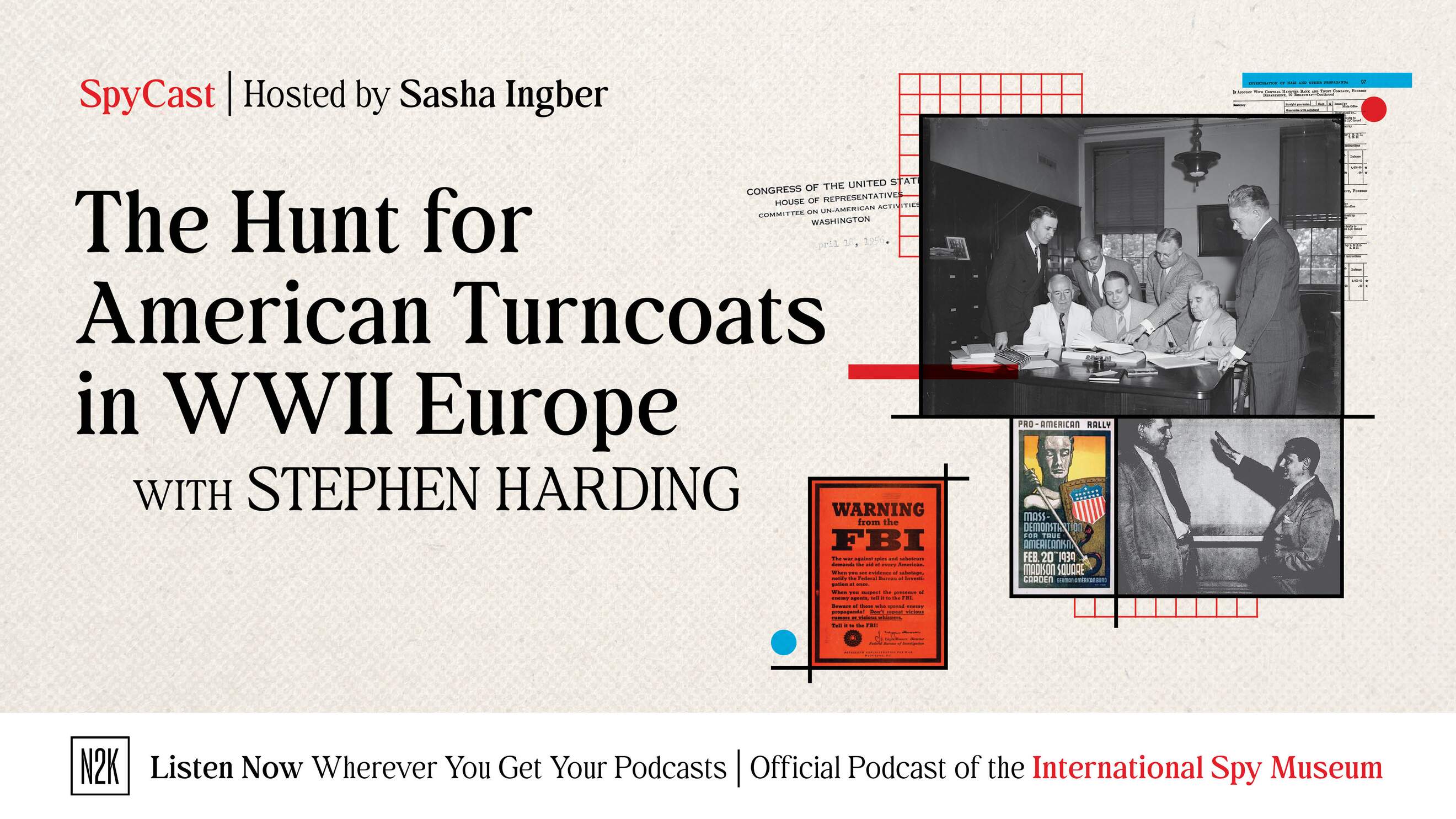


The Hunt for American Turncoats in World War II Europe










Sasha Ingber: Welcome to Spycast, the official podcast of the International Spy Museum. I'm your host, Sasha Ingber, and each week I take you into the shadows of espionage, intelligence, and covert operations across the globe. It's a story that journalist and veteran Stephen Harding uncovered. A secret component of the FBI's European operation whereby agents traveled abroad and undercover to track down American citizens who had betrayed their country during World War II.
The traitors ran the gamut, from spreading propaganda for the fascists to joining Nazi spy Rings, and what became of them is just as varied. Steve pieced together the mission and the targets by interviewing the relatives of retired FBI agents, sifting through British archives and making Freedom of Information Act requests.
It's all documented in his new book, G.I G-Men. Stephen, thank you so much for joining us.
Stephen Harding: Oh, it's my pleasure. Thanks for asking me.
Sasha Ingber: So let's get into it. We think of the FBI as a domestic agency. So tell me why did Jay Edgar Hoover start this mission overseas?
Stephen Harding: Mainly, it was a power struggle, an administrative power struggle between, uh, Hoover and the Military Intelligence Services, the Office of Naval Intelligence, uh, the Army's Military Intelligence Division. Hoover decided that because the FBI had been responsible since World War I really for chasing spies, that it was logical for the FBI to, um, chase Americans overseas who had collaborated with the Nazis or the Italian fascists.
It, it was a very difficult thing for him to achieve because he had to deal with, uh, various agencies and the heads of those agencies. But he eventually won. And in 1940 created a sub-organization of the FBI called the Special Intelligence Service. The SIS and its task was to operate, uh, intelligence and counterintelligence operations in Central and South America.
Uh, in, in making that happen, Hoover managed to anger everybody else in the US federal government, but he was determined that the FBI was the best organization to chase spies, whether they were Americans or foreigners.
Sasha Ingber: Uh, tell us more about the Central and South American efforts before we move on.
Stephen Harding: Both Japan and Nazi Germany, and for that matter of fascist Italy had agents operating in, uh, the Southern Hemisphere.
And at that time as at other times in American history, the United States government figured that the, uh, southern Hemisphere was our territory. Uh, so Hoover put together this organization in, initially, it wasn't very well structured. None of the agencies sent spoke Spanish or Portuguese or very few of them.
So they would get down there and they sort of stood out like sore thumbs, but eventually they did very successfully roll up a couple of Nazi spy rings, uh, as well as dealing some blows to the Japanese intelligence, uh, operations there. So Hoover considered the SIS to be a success and he based the formation of the Army Liaison Unit on that success.
Sasha Ingber: So now Hoover sets his sights on Europe, and among the early targets are journalists who work in radio and print. Can you tell us about who some of these people were and the kind of work that they were doing for the Axis Powers?
Stephen Harding: The initial thrust of the ALU, the Army Liaison Unit operations in Europe was to track down Americans who had done propaganda work for the Italian fascists or the the Nazis.
One of the first people that they targeted was Ezra Pound, the leading poet of the modernist movement who had lived in in Italy since the late twenties and was a huge supporter of Mussolini and the Fascists. Um, there he volunteered to do propaganda broadcasts. He wrote materials for them. And then there was a second group that after the Germans occupied France in 1940. A lot of American journalists had been there to cover that occupation because as you know, the United States wasn't in World War II until after Pearl Harbor. So you had all these radio and print journalists. Jane Anderson was one, Constance Drexel, Max Koischwitz, who had been a very popular professor Uh in New York, in the university system, a lot of these people, um, fell into working for the Nazis or the axis. In general, um, mainly because they got caught in Europe, they needed work or as with Ezra Pound, they were huge supporters of fascism.
Sasha Ingber: So it was a mix of ideology and money.
Stephen Harding: Yeah, money, power. And in a couple of cases, uh, it was, uh romance. Several of the, uh, people who became propagandists were involved in relationships with either German women or Italian women or whatever. So, you know, I mean, selling out your country can happen for a lot of reasons. Uh, and love was one of them.
Sasha Ingber: Now, did any of this work bump up against the First Amendment?
Stephen Harding: Well, you have to remember, um, until December 8th, uh, when we officially went to war against the Axis, it was not illegal for Americans to broadcast for, you know, uh, radio Germany or the Italian stations or, uh, after the occupation of France for the Vichy government because they, we were not involved in the war.
Um, people always need to bear in mind the distinction between treason and sedition. Treason is a wartime crime. Uh, the United States has to be at war with somebody and somebody has to give our enemies aid and comfort. In peace time, it's sedition. You're working against your own, your own government, out of your political beliefs or, uh, again, for money.
Sasha Ingber: Let's move on to some of the other people who were involved in working with the Nazis and the fascists before we continue on the path of what happened to these people. And how it went hunting them down. You also found that some of the collaborators were average everyday Americans.
Stephen Harding: Indeed. Uh, the, the best example of that, um, there was a guy named Frank O'Neal.
He was a, a, a jockey, a horse racing jockey, and a very successful one. He'd been very successful in the United States. He moved to France with his wife and children, and was doing so well that they had a mansion outside Paris, and he just got kind of caught up in it. He was, he was trying to pay his mortgage and everything.
There was a gentleman named Maurice Gagnon, who is a, a, an American of French parentage. Uh, he, he was an insurance agent in the United States, divorced his first wife, moved to Paris, married a, um, a French woman, and set up a very profitable practice. He fell, fell into informing on his neighbors. Once the Germans had occupied Paris, he would go to the the local Gestapo office and tell them people who he believed were involved in anti-German activities and he was paid for it.
Unfortunately he, once you start doing that sort of thing, it's very difficult to get out of it. So he was one of the prime suspects. There were other people that the FBI agents were ultimately going to be looking for. Among them were people that were known as folks Deutsches, uh, Americans, and were not really sure how many, because most of those records were destroyed.
A lot of Americans ended up in the German military, uh, primarily in the, the. German army, and so they were suspects, but they also had really no control over having been there. There were other Americans who were drafted into what was known as the Organisation Todt, the industrial company that built a lot of the fortifications in occupied Europe.
And again, they didn't do it willingly. Uh, they were conscripted. So there were this whole second tier of people who really did not betray their country willingly. They were forced into it, uh, because the, the other option was you go to prison or you be executed.
Sasha Ingber: So now a lot of the examples that you've given are of men, and as the FBI begins to cast a wider net you described to me that there were also women who were caught up in this and you called them horizontal collaborationists, that is a term that one cannot forget. Tell me about who some of these women were and, and really how much of a threat did they pose in context of the other examples that you've given?
Stephen Harding: Yeah, there were, um, just as a surprising number of French women ended up in romantic relationships with German soldiers and later paid the price for that. Um, there were American women living in France when it was occupied by the German, most of whom we, we will never know their names. They were going to school, they were models, and they ended up in relationships with Germans that were just mainly romantic relationships or to pay the rent.
Uh, but the ones we know most about, there was a woman named Florence Gould, an American born in San Francisco, French parentage, who ended up marrying a millionaire named Jay Gould. And they had a interesting relationship. Uh, he spent time at their home in the south of France, and she stayed in Paris because she, she wanted to be, um, one of those Grand Dames who, who held salons with artists and writers and musicians. She ultimately ended up having serial romantic relationships with a lot of very senior German officers in the German occupation administration including the head of the Gestapo in Paris, and various other things which up to that point would not have been other than very bad decision, except that she, and to a lesser extent, her husband Jay, helped organize sort of a phony bank in the south of France that was gonna be used to launder money belonging to German officers who wanted to get their cash out of occupied Europe and into Switzerland.
And so she became an immediate target, uh, of the FBI gentleman. Another American woman was Ruth Dubonnet. She was an American who married Andre Dubonnet, who was the head by that time of the famous Dubonnet apéritif Organization. He was very wealthy. He was a very famous Frenchman because he'd been a, a hero in World War I as an aviator.
But both of them got close, very close to the Germans. They held parties, soiree, they were seen in public with senior German officers. Um, and whether or not Ruth became romantically involved with Germans, we're not really sure, but she gave them sort of the sheen of legitimacy by appearing in public with them both before and after Pearl Harbor.
Sasha Ingber: It's amazing to think about how these women were able to form these relationships with Nazis of the highest levels. I mean, going back to Florence Gould, she also was running a prostitution ring to serve the Nazis.
Stephen Harding: She was, uh, it was an organization, I won't attempt the French. Um, they called them the gray mice.
These were generally well-to-do French women who were willing to sleep with Germans for money. And, uh, Florence was one of the co-founders of this organization. And she felt entitled to do anything she wanted because she was incredibly wealthy and she, um, felt that she was above the norms that other people were held to.
Ruth Dubonnet also could be said to be of, of that same, uh, frame of mind that, you know, I'm too rich and too famous. You can't really do anything to me. And, and they both found out ultimately that that wasn't true.
Sasha Ingber: Yeah. One of the other people that the FBI set its sights on was a doctor. Let's talk about Ignaz Griebl.
Stephen Harding: Yes. Uh, Ignaz. He was a very interesting guy. Uh, you know, when you think of the perfect spy, um, generally you think of somebody who's, um, so plain as to be almost invisible and, and he fit that mold. He was kind of a mousy little guy. He was a, a German veteran of World War I. After the war, he became a doctor, largely financially supported by, um, a woman a few years older than him who was a nurse that he met, uh, after he'd been wounded during the war.
She essentially put him through medical school. They both, uh, immigrated to the United States. He set up a practice in the largely German section of New York. He treated members of the German expat community. He, he was a, a generalist. He did some O-B-G-Y-N, he did some surgery. He did other things. But what he also did, he was recruited by the Abwehr, the German military Intelligence Service.
And he set up what turned out to be a very successful spy ring, uh, operating generally out of New York, up and down the east coast. The problem was, despite being incredibly mousy looking, he was a serial womanizer. Uh, even after he married the nurse who put him through medical school, he had a series of affairs with, uh, women in the German American community.
Um. Which again brought him not only to the attention of those women, uh, and their husbands mainly, but also to the FBI and the FBI started an, uh, investigation of him that was led by a, a, a famed FBI agent named Leon Turrou. This guy was famed as a spy catcher and, and, you know, uh, the guy who caught gangsters and stuff, they arrested Griebl.
And Turrou interrogated him and was very impressed by, by Griebl's sincerity. He, he even passed a polygraph test. He ratted out all of his, all of the members of his spy ring and Turrou thought, well, let's, let's let him go. Let's let him get outta custody for a minute and, and follow him and see what happens. And then he'll come back and tell us everything.
That didn't actually happen. Griebl immediately stowed away on a German ocean liner and went back to Germany, leaving his wife and some fairly disappointed girlfriends behind.
Sasha Ingber: And I do wanna talk about what happened to these people that were describing, but let's, let's go somewhere else. First, I'm curious to understand who were the people who could have been improperly targeted because if we fast forward in time, Hoover was behind the surveillance of civil rights leaders like Martin Luther King, Jr. Were there people who were unfairly hunted down by these FBI agents?
Stephen Harding: The, uh, agents themselves, the ones dispatched to, uh, Europe were working primarily, um, from information they were able to uncover while they were there.
But of course they had, um, names that were provided, um, from FBI headquarters in DC and there were people who were unjustly accused because, for example, this, uh, Frank O'Neal, the jockey, the biggest problem, uh, that he faced was, he stopped racing because he got old and rather large for a jockey. So he opened a, a very popular bar, um, in Paris after the Germans occupied Paris. Uh, the bar became popular with German officers. So he sort of was painted by that brush when he was not really a supporter of the Nazis, but he had to make a living because he wasn't racing anymore, and he and his, uh, son were actually initially picked up by the, the Germans when they occupied Paris, but they were immediately let go because he had a good reputation as being pro German.
And he wasn't really all that pro German, but that association made him a target of the FBI when they arrived in Paris in September of 1944 after the liberation. One of the people that they, uh, that the FBI guys targeted based on hearsay was a young woman who had turned out was the daughter of one of Dwight Eisenhower's favorite American generals.
She had been living in Paris before the war, and she had done a few very innocuous, uh, radio things about fashion and about, you know, the racing season and stuff. The FBI agents in, in France didn't know what level, so they started investigating her and at one point, uh, Fred Ayer, who was the, the lead agent in Paris, got called before General Eisenhower, who was not happy that one of his favorite general's daughters was being investigated. So they quickly cleared up that she wasn't any kind of a spy or anything. So there were things like that where people were sort of, um, guilty by association because they had gone to events where they were Germans or they had a bar that Germans frequented.
So there were, there were quite a few, um, not really guilty people that got investigated.
Sasha Ingber: And do you have a sense of the breakdown? How many really deserve to be hunted down, and how many shouldn't have been in the research that you did?
Stephen Harding: Well that's, uh, that's a little difficult to say because some of the records are still classified, which ought to make people think, you know, why are records, personal records of individuals still classified 80 years after the end of the war.
Initially there were only two FBI agents working in France, Fred Ayer and Don Daughters, uh, who were respectively the head and executive officer of this group of agents, they were tremendously overworked, I would say, of the cases that they were assigned, probably about 60% were later not followed up for various reasons.
Sasha Ingber: Now, you've mentioned the names of two of the FBI agents who were involved in this. Uh, Fred Ayer. Don Daughters tell us more about who they are and what kind of work they were doing.
Stephen Harding: They had to be absolutely fluent in one of the European languages. Fred Ayer, who was, um, from a very well-to-do family in Massachusetts, had spoken French literally since he was a child because his mother, uh, was a Francophile.
Um, Don Daughters was, uh, from a, a less aristocratic American family, but both ended up at, at Harvard. So he spoke French and some Italian and some German. Now none of them except Don Daughters of the roughly 18, Uh, FBI agents who became part of the Army Liaison Unit, none of them had any military experience except Don Daughters, but they were all very well trained FBI agents, most of them had law degrees, which was a general requirement in those days. They knew how to interrogate people. They had worked counterintelligence operations. In fact, um, Fred Ayer, one of his first assignments when he became a um, an FBI agent was to conduct audio surveillance of a young naval officer who was thought to be having an affair with a German agent.
Sasha Ingber: This program started with an FBI agent named Frank Amprim. He embedded with the US Army.
Stephen Harding: Mm-hmm.
Sasha Ingber: Tell us about what he was doing and how he set the tone for all of the agents who then came after.
Stephen Harding: Yeah. Frank Amprim, uh, grew up in Detroit. He was, uh, a native born American. His parents were both Italian but from different parts of Italy.
So Frank, uh, grew up speaking two different Italian dialects, which was a very useful trait. He had worked a couple years before the war as an attorney. Uh, he had, uh, gotten his degree, but after Pearl Harbor, he, uh, wanted, uh, to do something. So he joined the FBI and he did some basic case work in Florida against the mafia.
But his language skills, uh, made him very, very useful because of this desire that Hoover had, that his ALU people would speak the language. He was the first guy to be tapped to go overseas. He did some basic, and I mean very basic, uh, military training at Fort Belvoir in Virginia. Uh, the others would go through training at Camp Ritchie, Maryland, Uh, later on. He was taught to fire the basic Army weapons. He was taught you know the basic army etiquette about who you saluted and who you didn't salute, and he, uh, was taught the basics of army counterintelligence operations. He was then sent to North Africa and his primary goal was to track down as Ezra Pound.
But he also had secondary goals of, uh, doing research on Italian records that might provide information about Italian espionage in the United States. In fact, he became sort of an unofficial member of a, of an OSS unit and advanced with them across North Africa, into Sicily and then onto the Italian mainland.
And it was there that he really got into. Um. The Ezra Pound case
Sasha Ingber: when we come back, the challenges the FBI agents faced abroad and what eventually happened to people who were caught.
When it comes to the FBI agents, were they communicating with each other on the ground during their missions, and what kinds of challenges were they facing? It seems like this is daunting work you've described how they're just overwhelmed by the onslaught of intelligence that they're receiving.
Stephen Harding: Absolutely. All of these FBI agents operating overseas had to be very close to the army counter intelligence core units that were actually conducting. Um, a lot of the operations in newly liberated territory. And, and, you know, FBI agents in the states, they face, you know, gangsters and, and all kinds of things, but they didn't generally have to face artillery and landmines and the possibility of air attack.
And when, um, Fred Ayer and Don Daughters initially got to Paris there was still the danger of what were known as stay behind agents. These were German agents who had remained in the city after the Germans evacuated. So there was the possibility of assassination and also dealing not only with the American military, but with the British military, with the free French.
There were all these administrative problems, but they did get out. They had to get out in the field to, uh track people to do surveillance. Uh, so they would, you know, get a Jeep from the motor pool. They had their weapons and they would go out and about. And at one point the Army, uh, lost, uh, temporarily a, an incredibly important coding machine, um, called a Sigaba and they couldn't find it.
So they, uh. Gordon Sheen, the head of counter turned to Fred said, can you guys look for this? And they were able to determine. Operating with the, uh, CIC guys where this thing was, it was at the bottom of a river. Uh, some, some French people had stolen the truck. It was in for the gasoline in the truck.
They didn't care about the, the coating machine. And when they got in the gasoline out of the truck, they dumped it in, in a river. So they found it and there was a, a ceremony in Paris at at Eisenhower's headquarters. It's like, wow, we found this, let's open it up. And, and somebody said, no, you really don't want to do that because there are explosive charges inside there, and if you don't open it correctly, it will kill everybody in the room.
So the, the ceremony was somewhat low key after that.
Sasha Ingber: Extraordinary stories that you've uncovered here and the information that they found. How important was it to the Justice Department in conducting trials of traitors or collaborators?
Stephen Harding: As it turned out, very few of the people that the FBI agents were able to prove, uh, had collaborated with the access powers.
Very few of them were actually tried. Um, several of the, the broadcasters, uh, Ezra Pound was put in a mental institution for their 13 years. A couple of the, um, broadcasters did some jail time, but for the most part, you have to remember at the end of World War II, uh, in 1945, the, uh the focus of the American government shifted from beating the axis to dealing with Soviet Russia.
So many, uh, many of the people that the FBI guys investigated, the Department of Justice determined it just wasn't worth the time and money to try them. So some of 'em were given a slap on the hand, others were just let go.
Sasha Ingber: And then there are people like Florence Gould who had a lot of money, a lot of connections.
That must have also been very helpful for them.
Stephen Harding: Yeah, there were, you know, people with connections. Uh, this Warrington Dawson, this gentleman, um, who had helped the, uh, Germans in Paris, had at one time been, uh, Teddy Roosevelt's secretary when Roosevelt, after he got out of office, did a big trip in Africa.
Uh, Dawson was his secretary, wrote a lot of great articles and had been maintained a sort of a tenuous connection with people in the White House. And when he was, uh, arrested and was interrogated by the FBI, he had been a former State Department person. Um, and he started dropping, um. FDRs name, and again, it, it just became too much of a, uh, of a administrative hurdle to, um, you know, prosecute some of these people.
While several of the German officers, including the, the gentleman who had, uh, led German intelligence against the Soviet Union were not only not tried, um, that particular gentleman was made the head of the new West German Intelligence Service. It was all about this war's over. There's a new war coming.
You know, Soviet Russia had been our ally. They were now gonna be our enemy. So a lot of this just kind of fell by the wayside.
Sasha Ingber: So can we stand in the shoes of the men who did this work? What did it mean to them then when the majority of the people that they had pursued did not face justice because now we were moving onto the Cold War,
Stephen Harding: um, a lot of them took that very badly.
In fact, Fred Ayer only stayed in the FBI for less than a year. Uh, and, and the majority of the men who had been in the Army Liaison Unit left the FBI and went to other jobs. He went back to being in, in Frank Amprim's case he went back to being an attorney. Um, Fred re worked briefly, uh, in government and then later in life, uh, ran to be Attorney General of his home state.
Don Daughters, uh, went to work for a, uh, a major international shoe company. A lot of these agents became private investigators or went back to work as in local police because they were, I think, honestly disgusted by all the work they had done was simply set aside because of the demands of the Cold War.
Sasha Ingber: and nobody knew the work that they had done.
Stephen Harding: Not right away. Um, a lot of the information I uncovered, um, had never really been, uh, found. It was all, most of it was in the national archives, but the parts, uh, that I found most interesting were the daily reports. I mean, I went through thousands of pages of documents that Fred and, and Don, uh, and the other agents had generated of their interrogations, of their day-to-day work.
Hans Wenthur, uh, one of the gentlemen who interrogated, um, Ignaz Griebl kept a, a delightful daily diary that his daughter shared with me. And it wasn't just about who he interviewed and who he interrogated. You know, he went to Berchtesgaden in Germany and he did this, and he did that. So these agents were important to the war effort right up until the war effort stopped.
And then most of them decided to move on to other careers.
Sasha Ingber: Now, did Hoover just decide it's time to end this program and focus on the Soviet Union? Was Congress involved in any of the, uh, repositioning here?
Stephen Harding: No, it was actually, um, again, another sort of test of wills between two powerful people. There was an army major general, his last name was Sibert, uh, who was the head of army intelligence in Europe at the end of the war.
And Sibert believed that all intelligence in post-war Europe should be conducted by the Army. Uh, so he did everything he could when the war officially ended to, um, push the FBI out of the situation. Now, there had been. 18 roughly agents in Europe and Sibert, uh, dictated that there could only be two from that point on.
And Hoover said, that's impossible. Two agents can't carry it out. So he just said, you know, I'm just gonna pull all my guys back. He did, uh, rather abruptly, and Hoover went back to investigating communists, uh, which was a big thing during the Cold War. Um, and, and ultimately civil rights leaders, the protestors, uh, against the Vietnam War.
Um, Hoover was, was obviously not a saint, and we have to remember that the agents that went to Europe were people of their time. They were excellent Uh, FBI agents, but undoubtedly they carried some of the same prejudices and thoughts about American society that everybody else did. But the important thing is they put those aside to do their job and they did a very good job that really was never publicized until I started looking into it.
Sasha Ingber: and it makes me wonder what they would think of you writing this book today.
Stephen Harding: They probably hate it because it, uh, it, it, it sort of reveals what they were doing. And the secret to counterintelligence is not to ever tell anybody what you're doing, just to do the surveillance and the research and everything else. Uh, I, I like to think. That Fred Ayer, especially, he was a, a, a wonderful man.
I wish I had met. He died very young of a heart attack, but he was a, you know, not only an FBI agent and, and a lawyer. He was a raconteur. He, he loved to party and, uh, although he was also a dedicated family man, uh, he was. Very early on in the Cold War, he became the assistant Chief of Intelligence for the Air Force and did some very important work.
Uh, unfortunately as I mentioned, he, he died young of a, of a heart issue, so a lot of these guys never got any of the credit that they really deserved. And I'm hoping that at least through this book, um, we can redress that error.
Sasha Ingber: So what was it like for you piecing this story together when, as you had mentioned earlier in this conversation, so much has remained classified 80 years later?
Stephen Harding: Well, um, I suffer from a syndrome, Uh, which I refer to as research rapture. It's, it's fairly common among journalists and, uh, historians, you really want to find things out. For me, the best part of, of writing the books that I've written is the research you get to, to know stuff, and then like, uh, the FBI agents or anybody else, like journalists, which I have been on and off throughout my life.
You, you put things together. You follow the, the dots where they go. I love that part. Um, it's, it's not easy because especially when you're dealing with, uh, intelligence organizations or counterintelligence trying to find records, uh. can be difficult. A lot of Freedom of Information Act requests, uh, which unfortunately now is much harder than it was even when I was researching this book because a lot of it has been put beyond the reach of journalists and historians.
Um, for example, I would find records in the National Archives, uh, that were still classified, and then I realized, oh, wait a minute. Let's try another thing. So I would go to the British National Archives and the same records were there and they weren't classified and they weren't redacted.
Sasha Ingber: That must have been a glorious moment.
Stephen Harding: It was, it was wonderful because one of the documents I got from the FBI, um, that I'd waited a year and a half to get. It was one page and the only thing that wasn't redacted was the header on it. Everything else was just black.
Sasha Ingber: Don't you just love that?
Stephen Harding: I don't actually, but um, but I found the same document in the UK National Archives and totally unredacted. So, you know, we can talk at length about the, um, need for classification of documents, uh, but in, in a lot of cases it's just not necessary. Things are classified because people think they should be classified. Whether they should be or not is a whole different question.
Sasha Ingber: Are there questions that you weren't able to answer and, and what were they?
Stephen Harding: I, I think I answered all of the questions that I really felt it was important to answer, but one of the things that I really would like to know is what happened to Ignaz Griebl when he disappeared in Austria in 1945. He fell off the map and has never been seen again, and I've always wondered why is that people leave trails, even in the, certainly in the digital age, but even then, um, why was he never found?
Uh, was it because he went over to the Russians? That's quite possible. He was kind of that kind of guy. He'd work for whoever paid him. Um, maybe he died, maybe he changed his name and became a something or other in post-war Germany. That's the kind of thing I'd like to know. And again, that goes back to the research rapture issue.
You wanna be able to close the book on things. And the fact that I don't know what happened to him is something I'd like to know.
Sasha Ingber: What did the descendants of these FBI agents who you informed for the first time, this is what your, your father, your grandfather did, you know, did they have gratitude for learning about this?
Stephen Harding: Yeah, they were very happy to, to learn about, you know, because there, there was a certain, um feeling that, well, if you, if you were in the FBI during the war, you, you somehow weren't good enough to be in the military, you know? But all of these guys were young fit. I mean, they could have done anything in the military, they wanted to, but it was the FBI where they really found their nation were able to do something.
So it was nice for a lot of the, uh, descendants of these guys to know that, that their fathers did an important wartime job. And I think they're very, very pleased. There was also one family I approached who did not know that their relative had collaborated with the Nazis. That's a very hard piece of news to hear, so it wasn't all good news for the people that I contacted for this book.
Sasha Ingber: Thank you so much for coming in to talk about your incredible book, G.I G-Men.
Stephen Harding: My pleasure. Thanks for having me.
Sasha Ingber: Thanks for listening to this episode of spycast. If you like the episode, give us a follow on Apple, Spotify, or wherever you get your podcasts, and leave us a rating or review. It really helps. If you have any feedback or you wanna hear about a particular topic, you can reach us by email at spycast@spymuseum.org.
I'm your host, Sasha Ingber, and the show is brought to you by N2K Networks, Goat Rodeo, and the International Spy Museum in Washington, DC.



