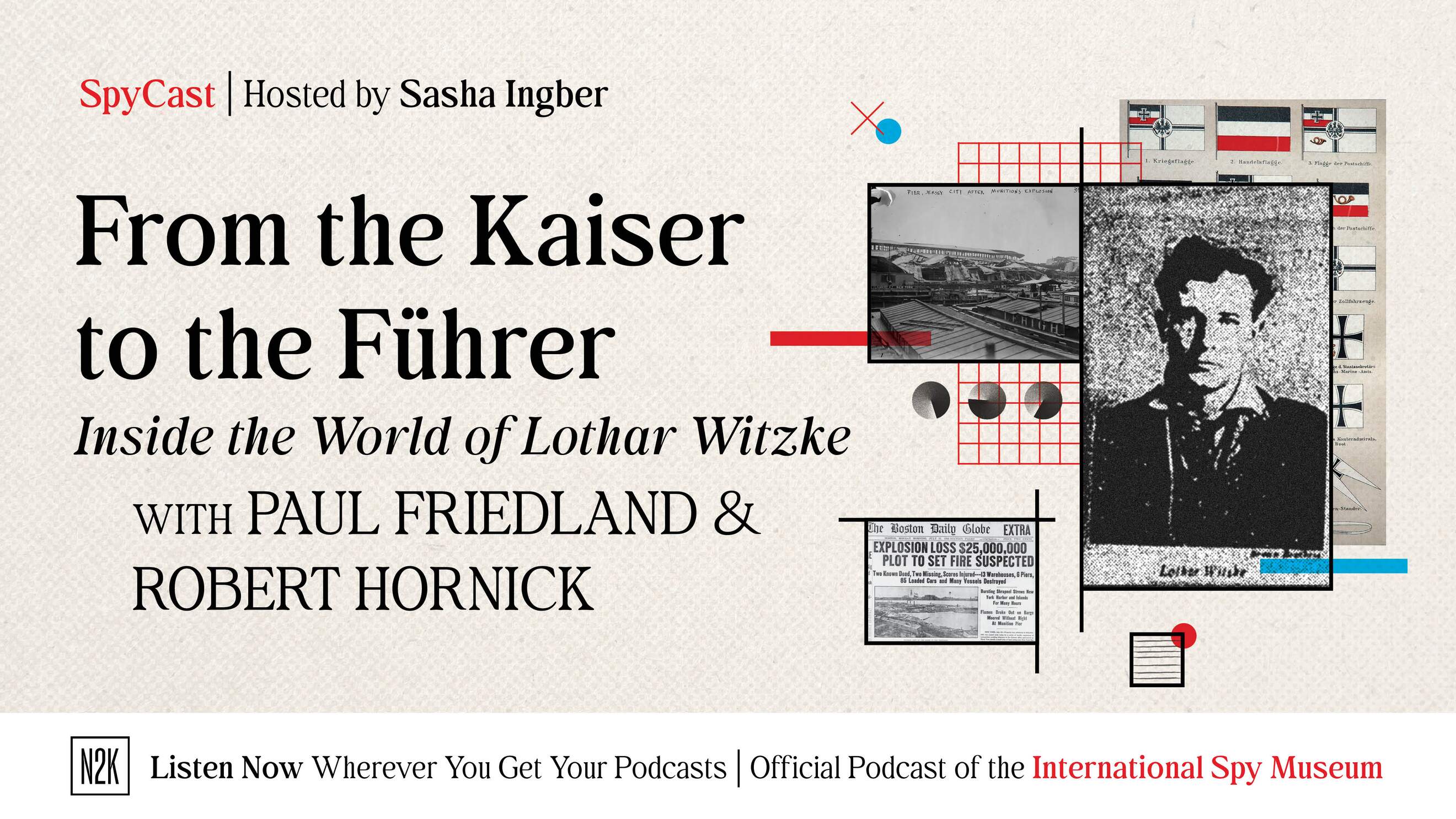


From the Kaiser to the Führer: Inside the World of Lothar Witzke










Mark Stout: Welcome to Spycast, the official podcast of the International Spy Museum. I'm Dr. Mark Stout, filling in for Sasha Ingber today, and we're stepping into the hidden world of spies shaping events around the world. One of the more notorious German spies of the 20th century Lothar Witzke lived a life of intrigue from escaping the death penalty in the first World War to joining the Nazi party in the second.
It's a story that Robert Hornick and Paul Friedland stumbled on by chance, with help from Witzke’s grandchildren and mining through archives, these lawyers pieced together SKAs story, sifting the fact from the fiction, and figuring out what made this infamous figure tick. Citizen of the Shadows, the lives and lies of Lothar Witzke is out now.
Paul Friedland, Robert Hornick. Welcome to Spycast to talk about your new book, Lothar Witzke, AKA, Pablo Waberski. The subject of your book hasn't really been a household name for over a century now, so I'm curious how you heard about him and what the genesis of this, uh, really excellent book project is.
Uh, maybe we can start with Robert.
Robert Hornick: Sure. We, we originally intended to write a book, uh, about presidential pardons, and in putting together a list of interesting people who had received pardons, uh, we read about Witzke and found him particularly interesting and gradually realized we were more interested in writing a book about him than about presidential pardons.
So we were off.
Mark Stout: Sounds good. Um, as everybody who's written intelligence history knows, you usually don't have all the sources that you would want to really tell the story and answer all the questions that you might want to answer. Um, because of the nature of the business, you know, intelligence is pretty much definitionally secret.
Uh, there's not often a lot of paper trail. And then, you know, when in your case you're looking at something that happened a hundred or more years ago. Things get lost. Things get destroyed. So can you tell us a little bit about the sources, uh, that you were able to bring to bear in writing this really actually quite fulsome book?
Robert Hornick: The sources were primarily documentary. We had one good source of documents, which was, um, uh, the transcripts and evidence submitted in an arbitration in the 1920s and thirties between the United States and Germany.
Mark Stout: The Mixed Claims Commission.
Robert Hornick: The Mixed Claims Commission, and it was the place where we started.
And among other things, we found, uh, hundreds of letters that Witzke had written as a young man. Um, uh, and those documents led us to look for others, including in Germany. And uh, that was much harder to find in Germany 'cause they had been destroyed in, in war and uh, uh, through lack of care years.
Mark Stout: What kind of archival repositories did you mine in Germany?
Robert Hornick: There, there were government, uh, uh, archives in Berlin, for example, that we, uh, we used, there were, uh, military archives in various places. We had a specialist in doing military research. Help us, uh, look in those, uh, and you, we got a little bit here, a little bit there. And, uh, that was how it worked.
Mark Stout: And I think you had some help from his family, his descendants as well.
Paul Friedland: It, it changed our book writing process, so we tracked down his grandchildren and, uh, you never know in advance whether they could be defensive about the past of a notorious spy saboteur and Nazi
Mark Stout: and Nazi
Paul Friedland: or whether they're going to be enthusiastic. And it was the latter and they were, uh, happy to, uh
cooperate with our book. They gave us, uh, critical information including photographs and other family correspondence.
Mark Stout: So your book starts out basically, in essence in the World War I era. So World War I, of course, starts in August, 1914 in Europe, but the United States doesn't join the war until much later.
Initially, it's, it's neutral. Um, but American neutrality didn't look especially neutral from the German point of view because we were busily selling munitions to the British, the French, the Russians, you know, the, the enemies, uh, of Germany. And so as you explore, you know, substantially in your book, there's a sabotage campaign, uh, by Germans here in the United States to try and blow up munitions and sabotage ships carrying them and that sort of thing.
And at the time, the US didn't have much in the way of a security or intelligence set up. So, um. So it's time. As a German agent, an agent of German intelligence starts during that period of neutrality when operating in the US is actually fairly easy. Um, but it ends, uh, after the United States enters, enters the war.
If I recall correctly, he's arrested in February, 1918, you know, when the US intelligence and security system is going going gangbusters. Um, so can you summarize a little bit of his work in the secret world? During the period of American neutrality before we declare war on Germany in April, 1917?
Robert Hornick: Well, it, he was, uh, retained to do maritime reconnaissance and, uh, his, his early months of being a spy was, uh, was doing just that, uh, particularly in San Francisco, but elsewhere on the West Coast. And, uh, uh, he also acted as a courier, uh, to deliver various, uh, documents for officials in San Francisco to other places in the United States. Um, but the focus was, uh, maritime reconnaissance, and, uh, that's what he did.
Mark Stout: How did he happen to get into this business? Can you tell us a little bit about his background? What, what kind of, what kind of person, uh, was he, that he seemed appealing to German intelligence at the time?
Robert Hornick: He had, he had been a sailor. And had been on a, a vessel that had sailed from, uh, Germany to Mexico to Australia, back to Chile, where it put up during the war in Valparaiso.
And he got restless and, uh, jumped ship and, uh, uh, took a American vessel up the coast to San Francisco, and it was in San Francisco at, uh, one of the gathering places of the German community. He met the head of, uh, German intelligence and they got along very well, and, uh, he was hired and it was off and running.
Mark Stout: So probably the most significant instance of German sabotage in the United States came in July 30th, 1916. Um, do you wanna tell us what Black Tom was and why it was important? A very strange name. I under never understood where the name came from, but we didn't dwell on that. Tell us about black Tom.
Paul Friedland: So America, as you mentioned, for the first three years of the world was neutral, but American munitions companies were busy selling munitions to France, Great Britain and Russia, the three enemies of Germany. And Germany decided to try to do something about that, and they organized a ring of undercover German agents in America, all American munitions manufactured in the country were transported by rail to a railway terminus on the New Jersey side of the Hudson River near the Statue of Liberty. And that slip of land was called Black Tom because it had been formerly owned in the 19th century by a former slave. And all munitions were kept at the Black Tom railway terminus until they could be loaded on outbound ships.
The German undercover agent's mission was to try to interdict, uh, munitions going across the Atlantic, and they naturally took notice of black Tom and they decided to detonate it. And at two in the morning on Saturday, July 30, they did exactly that. The explosion shattered all the windows, uh, from the Bowery to Manhattan.
It's reverberations were felt as far away as Philadelphia. It damaged the torch of the Statue of Liberty.
Mark Stout: That was one of the things I thought was particularly interesting as you discussed this. I had never realized that the torch had been open. It was a place that tourists could climb up to until that day?
Paul Friedland: No, not since then. Not since. And it's never been reopened. And it was front page news of the young New Yorkers, uh, who, uh, was affected by. It was a young Franklin Dental Roosevelt when he became later president, uh, in, during World War II, after Pearl Harbor. He, his administration infamously ordered the interning for the duration of the war of all Japanese Americans on the West coast without evidence against them without due process.
To try to justify, uh, that unjustifiable decision, he commented to his assistant Secretary of War, we don't want any more Black Toms, so it's not known today. It was notorious for that generation of Americans, and in the wake of the explosion, the Americans naturally investigated who was responsible, and they came over time to decide that two German undercover agents had rode on a boat from the Manhattan side of the Hudson River to the New Jersey side to the railway terminus, and had detonated the explosion. And the Americans concluded that the man rowing the boat was Lothar Witzke.
Mark Stout: but they weren't aware of that immediately. I assume they, they, they came to that conclusion, I imagine, after he was arrested in 1918.
Paul Friedland: I, I can't say yes or no to that. It was a gradual unfolding the uh, key was testimony or articles written by the double agent, a Polish Jew who penetrated the German spy cell in Mexico City and told American intelligence about him leading to his arrest.
Mark Stout: Um, so was in fact Lothar Witzke the perpetrator of the Black Tom explosion?
You, you discussed this extensively in your book, uh, and I thought it was particularly fascinating.
Paul Friedland: This is the major controversy in question about Lothar Witzke's life. The Americans were convinced that he was responsible. The consensus of historians is that he was, we assumed for most of the writing of our book that the consensus was correct.
Robert Hornick: Sure.
Paul Friedland: And that he was in fact responsible. But the more we probed, the more we came to doubt it, and we ultimately have a conclusion that challenges the consensus. The core evidence is are documents that place him in San Francisco at the time of the black time explosion. And while there is testimony by this Polish Jewish double agent who recounted how Witzke had told him that he had been on a rowboat and detonated Black Tom.
There is, uh, doubt about it. There's no, uh, physical evidence that places him on the East coast and Witzke had some history of false boasting about acts of sabotage. So in a it's not a black and white, it's not a hundred and zero. There are, there are strong arguments that he did it, and there we believe stronger arguments that he didn't do it.
And we set this out in our book.
Mark Stout: So this might be a good time to ask. Um, how did being lawyers affect the way you approach this book, particularly here in this, in this discussion of whether or not he did Black Tom? I really see a. you know, a a, a weighing of evidence and a discussion of weighing evidence.
I, I see it in other places too, but particularly strongly here that, that screams lawyers to me. So, uh, like to tell us, uh, tell, tell us a little bit about how your profession approached the way this book came out.
Robert Hornick: Well, you're exactly right to pick up on, on that point. Um, it was more the kinds of lawyers we were, we were arbitration, uh, specialists and were involved in that kind of litigation and, uh, that kind of training.
Uh, was a appropriate for examining the evidence in this case. And I, I would say that was the primary motive, uh, for ending up looking at the evidence and concluding that it didn't prove what people thought it did.
Paul Friedland: The, the particular reason why our training, uh, mattered here is that much, although not all of the evidence for and against his responsibility for Black Tom is in the, uh, voluminous records and transcripts of an interstate arbitration between the US and Germany in the 1920s and 1930s about responsibility for black time.
Mark Stout: So in a sense you're following in their footsteps. But, uh, I, they concluded that, uh, he was responsible for Black Tom.
Paul Friedland: They didn't conclude one, one way or the other about it.
Mark Stout: Ah, excellent, excellent.
Paul Friedland: They concluded the German agents were, but not that Witzke was one way or the other.
Mark Stout: Okay, Witzke is gonna end up arrested by the Americans here. Uh, but that's, um, the culmination of a trip northward, uh, across Mexico. Um, give us sort of the, the story of like why he went on this journey from Mexico up to the United States that would end so badly for him.
Robert Hornick: His, his boss, Kurt Jahnke was in Mexico City and had asked Witzke and two other, uh, German agents. Uh. Mr. Altendorf and, uh, uh, uh, he was a, an American double agent working for both sides,
Mark Stout: which Jahnke didn't know, obviously.
Robert Hornick: right. And there was also a British, uh, double agent that traveled with them. And, uh, they went north together and a alerted the Americans, uh, that they were coming to Nogales and they were, Americans were ready for them when, uh, Witzke crossed the border into Nogales, uh, and they arrested him immediately.
Mark Stout: Uh, and what were they planning on doing when they got to the United States? What did Jahnke ordered them to do specifically?
Robert Hornick: Witzke’s job was to try and stir up trouble in, in America. Uh, he, he was focused on, for example, the Irish community. Uh, trying to get them, uh, riled up against, uh, uh, the Americans so they could make trouble.
There was an American military base nearby and he was trying to recruit, uh, some soldiers from that base to rebel against, uh, uh, the US. Uh. So
Mark Stout: basically
Robert Hornick: that kind of thing.
Mark Stout: Basically trying to weaken the United States, which is now a war with Germany through spinning up domestic unrest.
Robert Hornick: Exactly.
Mark Stout: Uh, and the Irish Americans, I assume, uh, they thought might be a a, a fruitful target population because they had longstanding gripes against the British, our allies
Robert Hornick: exactly.
Mark Stout: Witzke ends up arrested in January, 1918 in Nogales, Arizona. Uh, what kind of city was that? Uh, you make a very interesting comparison in your book to a, uh, an iconic Cold War city.
Robert Hornick: Yes. Um, it, it appeared to us in reading about it, that it was kind of the, uh, Berlin of its time. And, uh, it was a freewheeling city with, uh, lots of spies running around, and the Americans also had a an intelligence operation headquartered there.
Mark Stout: But it was also a divided city too. Like Berlin was during the Cold War.
Robert Hornick: it was divided, uh, in this case between Mexico and uh, and the United States.
Mark Stout: If I recall, you know, one side of the street in Nogales, you could be in Mexico and on the other side of the street you were in the United States.
Yes,
Robert Hornick: yes.
Mark Stout: Was there any kind of barrier or could people, were people just wandering back and forth across the border, which would be wonderful if you're a spy, it seems to me, in trying to infiltrate the United States, so would be falling, like, falling off a log? Is is that what Nogales was like?
Robert Hornick: It wasn't quite that free.
Uh, there was a, a, a barrier, there was a fence and, uh, uh, you did have to, uh, get questioned at the border before you crossed it.
Mark Stout: I can't imagine that was too onerous a process.
Robert Hornick: no.
Mark Stout: So. Comes to Nogales. Uh, escorted as it were by not one, but two spies, uh, one for the Americans, one for the British, which just boggles my mind.
And he enters, uh, into Nogales and he's immediately snatched. Can you tell me, tell us about his arrest.
Robert Hornick: The Polish double agent had alerted, uh, his superiors in Nogales that, uh, Witzke was coming and, uh, he had taken some photographs and sent those ahead so that the Americans would recognize Witzke when he crossed the border.
So there was plenty of, uh, foreknowledge and awareness he was coming and, uh, uh, they were waiting for him. With guns and, uh, multiple people. And he didn't get far.
Mark Stout: welcome to the United States. And then he was immediately arrested once he was fully in the US?
Robert Hornick: He'd been allowed in the US the day before. Uh, so he'd actually been there the, the evening before and crossed back over to his hotel and in Mexico.
And it was the following morning that he was arrested when he crossed.
Mark Stout: So they clapped the handcuffs on this guy. Um, what happens next?
Robert Hornick: There was a lot of questioning, uh, of him. Um, uh, he later in life alleged that he had been tortured. Um, we don't know if he was, it's possible he was, uh, but, uh, uh, there was definitely an intense several weeks of questioning.
He was then sent to Fort Sam Houston in Texas, where the questioning continued and, uh, uh, ultimately it was decided to try him as a spy. He was tried in a military court by a military commission.
Mark Stout: Why?
Robert Hornick: Uh, because they could control the outcome.
Mark Stout: Military justice being not exactly just, is that what you're suggesting?
Robert Hornick: Well, just more under the control of, uh, the people that wanted to see it controlled.
Mark Stout: So there was a certain amount of mystery about this, to put it mildly. But he was carrying what would turn out to be a absolutely incriminating document on his person. Do you wanna tell us a bit about that?
Robert Hornick: Yes, he, he, uh, had a, a note from, uh, uh, an official in Mexico City that actually called him a spy, uh, for, uh, the Germans.
It was written in code and they had to send it, uh, to Washington where there was a fledgling, uh, cryptography department, uh, being developed in Washington,
Mark Stout: in the military intelligence division
Robert Hornick: the military intelligence division. Exactly. And they were eventually able to, to break the code and translate the, uh, the document.
Mark Stout: So what did it say?
Robert Hornick: Uh, it said that he was a spy.
Mark Stout: Why would he be carrying such a thing?
Robert Hornick: Uh, the, the idea was that he could use the document, uh, to get money from various, uh, Mexican consular officials, uh, as he traveled around.
Mark Stout: So he's put on, uh, trial in the military justice system.
And how does that go? What's the outcome?
Robert Hornick: Well, the outcome, not surprisingly, is that he was, uh, convicted and sentenced to hang. There was a group pushing for him to be, uh, hanged quickly, and there was a group that was more doubtful that he should be hanged quickly.
Mark Stout: Why
Robert Hornick: Some people weren't sure that military courts was the proper place for him.
Uh, there was also a provision in the law that gave ultimate control over what happened to him, to the President of the United States. And, uh, it was decided to, uh, push it up the, the line to President Wilson and he took his time.
Mark Stout: And what did Wilson do then?
Robert Hornick: ultimately he commuted the sentence to life in prison?
And Witzke was sent to Leavenworth.
Mark Stout: Right. If I recall correctly, you said he was sentenced to making little rocks outta big rocks for the rest of his life at Fort Leavenworth? Yes.
Robert Hornick: Well, I guess you could put it that way.
Mark Stout: Okay. Um. So at some point here, uh, after the Wilson administration, after the end of World War, I, uh, he ends up pardoned.
Robert Hornick: Yes. He, he, um, uh, applied several times for a pardon and was turned down. Uh, eventually the German government itself got involved. The US was trying to develop friendly relations with the Germans, and so they took seriously the request that he be, uh, uh, pardoned. Uh, eventually, uh, Calvin Coolidge did so
Mark Stout: except Calvin Coolidge didn't know initially that he'd actually pardoned this guy.
How does, how does that happen? What the heck?
Robert Hornick: That one, I can't explain, but, uh, well,
Mark Stout: can you tell us what happened?
Robert Hornick: True that, uh, when the newspapers published, uh, the news that Calvin Coolidge had pardoned Witzke, uh, Calvin Coolidge, uh, uh, became upset because he knew nothing about, uh, the pardon and, uh, there was a flurry of activity in the presidential suite for an afternoon and uh, it was eventually straightened out and he got on board.
Mark Stout: I have to imagine that some staffers got chewed on by the president.
Robert Hornick: You would think
Mark Stout: when we come back we look at Witzke's relationship with the Nazi party.
So he goes back to Germany. What's his life and his future career, uh, like in Germany, after he's, uh, escaped the hangman's noose in the United States.
Paul Friedland: he went back to Germany. At the time of hyperinflation, Germany economy was in complete collapse. It was street fighting between nationalists and communists.
Witzke was always a man of personal, physical bravery, and he participated in the street fighting on the nationalist side against the communists,
Mark Stout: Nationalists, meaning Nazi or nationalists, meaning other right wing, but not Nazi?
Paul Friedland: It was not yet Nazi.
Mark Stout: Okay.
Paul Friedland: Uh, but he detested the Weimar government. He ascribed at the time to the stab in the back theory, which said that Germany lost World War I only because they were stabbed in the back by, um,
Mark Stout: Jews and Socialists, I think
Paul Friedland: at home.
Correct. He needed money and he was helped to get a job by the German government representatives. Who were representing Germany in the interstate arbitration brought by the US against Germany. The German agents were worried that Witzke would be paid by the Americans to give testimony on behalf of the Americans.
So they made sure he got a job and the jobs they got from were actually back in Mexico and then, uh, elsewhere in Latin American, ultimately in China. During the course of these years where he lived in exclusive ex expat German enclaves in these places, uh, on a visit back home, he, uh, met an attractive young woman and married her, and they had kids, and he became a family man in addition to all his other, uh, adventures.
Mark Stout: By adventures you mean philandering.
Paul Friedland: He was a womanizer. He was a good looking guy. He loved women and they loved him. He almost always had at least one woman in his life. And, uh, his womanizing would play a major role, uh, throughout, throughout his life, especially towards the end of his life and even on the day of his death, which I guess we'll come to in a moment.
Mark Stout: Yeah. So he does, in fact at some point then become a member of the Nazi party. Uh, and he even joins the German Abwehr.
Paul Friedland: Well, he became a, a, a member of the Nazi party in 1932 and, uh,
Mark Stout: before Hitler took over.
Paul Friedland: That's right. Uh, Hitler took over in March, 1933. Uh, so the question arises whether that shows true belief or opportunism on his part.
I think the best explanation is that the Nazi party for millions of Germans then represented, uh, vitality, adventure, and that's what Witzke was. He had a spirit of adventure. Uh, Nazi ideology, uh, probably did not much interest him, but it also didn't offend him. Nazi atrocities later didn't, there's no evidence that they bothered him either.
Uh, but we can see his, um, joining the Nazi party in 1932 as part of his spirit of adventure, I think,
Mark Stout: Was he particularly antisemitic by the standards of the time and place that he was in?
Paul Friedland: There's no evidence that he was.
Mark Stout: So what was he doing for the Abwehr and tell us about the Abwehr.
Paul Friedland: The Abwehr was Germany's counterintelligence organization.
It was natural in some ways that Witzke would be recruited for that. And he was recruited for late in the 1930s. So when the buildup, uh, under the Third Reich in the buildup to World War ii, he was already in the Abwehr. As the war started, uh, he was a commander in the Abwehr. He ran a, uh, ring of, um, undercover agents smuggling explosives into Great Britain with the idea of, uh, industrial sabotage.
Didn't amount to much, but we see examples there of Witzke’s mastery of Spycraft.
Mark Stout: Yeah. So there's a wonderful story about a, uh, a, uh, a briefcase at one point, uh, that made me chuckle.
Paul Friedland: so Witzke traveled through the Netherlands in 1940, uh, with a, a colleague from the Abwehr carrying a suitcase full of explosives to ultimately get into Great Britain.
Uh, he and his colleague checked into a hotel in the, in, in the Netherlands, and Witzke came to guess correctly that the hotel staff suspected that they were carrying contraband and might search his room. Witzke left his, uh, the explosives in a suitcase hidden in plain sight in his room. Went out, came back to his room just as he, uh, anticipated, uh, a hotel staff, uh, was, exited his room as they arrived, having searched his room and having found nothing.
And his colleague, uh, looked at him with amazement and Witzke laughed and said, that's an old trick. What you, what you don't want them to hide, you hide and play in sight. What I think this story shows is his coolness under pressure, something a, a, a trait he would exhibit throughout his life.
Mark Stout: So what happens to him at the end of the war?
Uh, being in the Abwehr is not exactly a, a, a, a, a possibility, uh, after 1945. In fact, the Abwehr I guess, gets reorganized into the SS at one point, but, uh, continuing as a Nazi intelligence officer is not an option. After 1945, what happens to him?
Paul Friedland: Witzke knew how to make it make his way in life. Notwithstanding five years of imprisonment in Leavenworth.
And then after the war, he was imprisoned by the British for a year in a deification facility outside of Hamburg. But he emerged from this seemingly unscathed, and he became a wealthy CEO uh, during the 1950s. And he lived a good life and he felt he had nothing to apologize about.
Mark Stout: Was he involved in the espionage business at this point, or he had, he left that behind him?
Paul Friedland: Uh, the answer to that is, uh, equivocal. He, so he was imprisoned by the British for a year. The company that he worked for was ultimately owned by the Brits. He was a member of the elite Anglo German Club in Hamburg. These are all British connections. Uh, there are context that could lead one to think he might have been a British agent.
On the other side, the Stasi, the East German Stasi, a deeply penetrated, uh, business circles in Hamburg and throughout, uh, west Germany. And they particularly targeted former Nazis so they could blackmail all this is context. It doesn't amount to hard proof that he was or wasn't an agent for or for whom in the 1950s, except the circumstance of his death, give us much harder evidence.
Mark Stout: Which are also pretty dramatic and pretty mysterious, which I think is a nice summary for large portions of Lothar Witzke’s life.
But, uh, can you tell us about that?
Paul Friedland: Witzke retired in 1962. On the first day of his retirement leaving his house, he turned to his wife and daughter and said. Now I'm gonna do the greatest feat yet. Now we have to pause there for a moment. This was a man who was accused by the Americans of responsibility for the most spectacular act of sabotage in US history.
This is a man who was the only German spy captured by the Americans convicted and sentenced to be hanged. This is a man who was, who got, uh, the Medal of Valor from his country for his courage in both World Wars. He's saying, I'm gonna do the greatest feat. Yet, in 1962, within a few hours, he was dead. The Hamburg Police investigated, told his wife, sorry, he died of a sudden heart attack.
They told his daughter something else. They told his daughter he was found dead in bed and he had been with a woman many years later. Witzke’s daughter Helga got a visit from a former East German who they were convinced was a former Stasi agent who told uh Witzke’s daughter that Witzke had been killed in bed in a honey trap by a Stasi agent as payback for being a double agent for both the Brits and the Stasi where he was supposed to be working only for the Stasi.
Mark Stout: plausible.
If that was an error in which things like that did occasionally happen, but sounds like once again, we don't quite have the smoking gun as it were.
Paul Friedland: That's right.
Mark Stout: So what do you think made Lothar Witzke tick? What kind of person was he ultimately? You know, he's a, he's a guy with a gazillion girlfriends. He's a guy who tends to lie and boast a lot.
Uh, he becomes a Nazi, uh, to help us crawl inside the skull of this guy. He's really interesting. It seems to me
Paul Friedland: what made him tick changed over time. We have his youthful correspondence to his parents. When he first leaves home from East Prussia and goes to the port town in Bremen to join the merchant Marine there, he gives wide-eyed descriptions of the new world he was seeing.
He sees his first jukebox, he sees his first traffic jam. There's an innocence and there's always a spirit of adventure, and there's also a real patriotism that comes throughout his correspondence. There's also, he naturally is looking to make his way in life, and he had the tools to do that. He was very intelligent.
He had an amazing ability to learn language. Over time, the picture hardens, uh, cynicism comes in. He was, as he thought, betrayed by a double agent, the Polish Jew in Mexico City. He then had years at Leavenworth. He then returned to the hyperinflation of Germany. An experience that scarred a generation of Germans.
When we then see him living in, uh, exclusive German expat communities in the 1930s, he's all about himself and all about making money. During World War II, he's in it for himself. Wealth and women is what he cares about. There's no hint of concern about higher causes.
Mark Stout: And, and I think you said in the book that, you know, we got to the second half of the war when it looked like Germany might possibly not win, and suddenly he was much less committed to the cause and was much less ardent about the whole, the whole proposition too, I believe you said.
Paul Friedland: That's right. Uh, there was one day he was walking with his daughter, Helga, and they visited a church and he saw a priest kneeling down in prayer and Witzke said contemptuously to his daughter.
A man does not bend his knee. For Witzke self-reliance was what he had learned over the course of his life.
Mark Stout: So all in all, uh, an enigmatic man who I think, uh, deserves much more public attention. And I'm delighted that you've written this really excellent book, which I very much enjoyed reading and commend, uh, to everyone, uh, in particular people interested in World War I, which I also think should be a larger group in this country.
So, Robert Hornick and Paul Friedland, thank you so much for joining us on Spycast.
Robert Hornick: Thank you very much.
Mark Stout: Thanks for listening to this episode of spycast. If you like the episode, please give us a follow on Apple, Spotify, or wherever you get your podcasts, and leave us a rating or review. It really helps, and if you have any feedback or want to hear about a particular topic, you can reach us by email at spycast@spymuseum.org.
I am your guest host, Dr. Mark Stout, and this show is brought to you by N2K Networks, Goat Rodeo, and the International Spy Museum in Washington DC.