
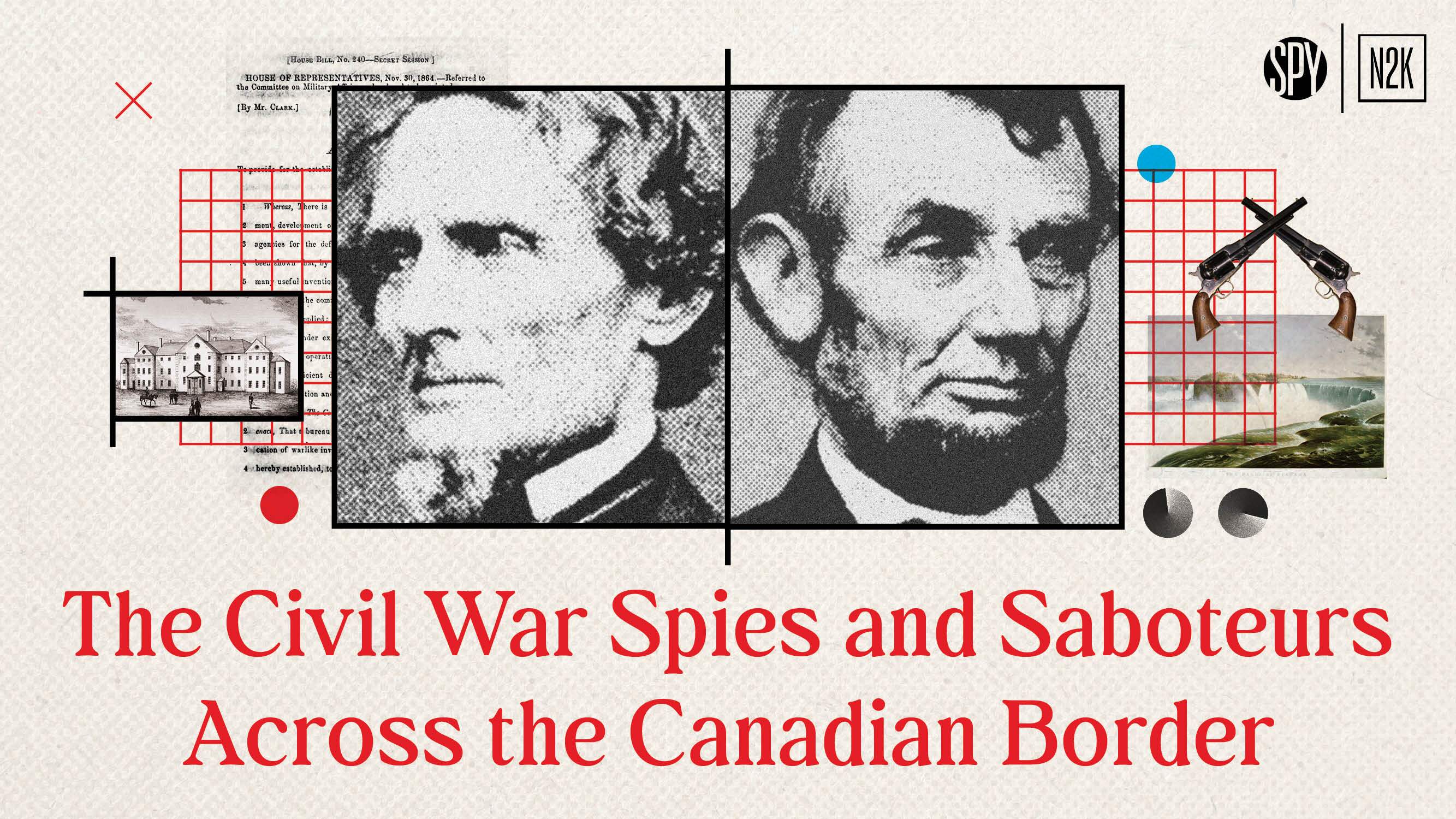


The Civil War Spies and Saboteurs Across the Canadian Border










Mark Jacobson: Welcome to Spycast, the official podcast of the International Spy Museum. I'm Dr. Mark Jacobson, filling in for Sasha Ingber. Today we're stepping into the hidden world of spies shaping events around the world.
It is 1864, and against the backdrop of the US Civil War, a war the Confederacy is losing. A group of spies and saboteurs have set up a base in Montreal, Canada, in what we might term today as a sanctuary or a safe haven.
Canada would become home to several infamous Confederate missions, some of which are detailed in Tim Wendel's novel Rebel Falls. Now, while this book may be fictional, it's grounded in several real life stories. I sit down with Tim Wendel as he takes us across the border into the world of Civil War espionage.
Tim, thanks so much for being here with us today. As you know, I'm a great fan of your works on baseball, but I wanna talk to you about Civil War espionage today.
Tim Wendel: Oh, it's great to be with you, Mark. And yeah, let's talk about Civil War espionage. That'll be fun.
Mark Jacobson: So let's set the stage a little bit. It's the end of 1863.
We're looking at, uh, General Lee, Commanding General of the Confederate troops being in a tough position after Vicksburg and Gettysburg. Uh, we're looking at Jefferson Davis, uh, the president of the Confederacy not being left with with many options, really. Uh, what is it that creates this sort of desperation that encourages them to consider what we would call today in a regular warfare campaign based out of Canada?
Tim Wendel: Well, I just said Mark, the Confederates at this point in time are desperate. Uh, they're pinned down, Lee's pinned down in Petersburg, outside of Richmond. Uh, the war is not going well. And so actually Jefferson Davis somehow finds a million dollars in gold and sends it up to the US Canadian border. Why?
Well, Canada's neutral and it looks like they can create a lot of mayhem potentially. And also they got their eyes set on the presidential election. Lincoln is coming up for reelection. Uh, he's not sure if he's gonna win. That's how bad war fatigue, war wariness is in the north. And so the Confederacy sees a chance if they can do something along the border, maybe the union will fold.
Mark Jacobson: Now, is there something beyond Canadian neutrality that makes Canada an ideal operating base for, for something like this?
Tim Wendel: Well, it's the Great Lakes. It's like this unguarded border and everything's, the focus has been on the eastern seaboard, you know, pinning down blockades blockade. Blockading the Confederacy, and again, the battles have been all to the south, so this is kind of an unguarded flank, and that's the feeling from Richmond.
If we can do something up there, it's not being patrolled very well. It's not being watched. Let's see what, what? You know, we can take off and do
Mark Jacobson: so, remind our audience again. Uh, what's the significance of the Great Lakes at this point?
Tim Wendel: There's very little going on militarily. Um, there's like only one battleship left, union battleship left on the Great Lakes, the USS Michigan, which is a great ship.
I mean, it's got 14 guns, iron steamer, et cetera. That's it. And, and they, they've pretty much the, the Washington and the Lincoln administration has said that that one ship will, do, you know, that that can patrol up and down Lake Erie. May take a glimpse in, up at, you know, the welling canal and that'll keep anything, um, kind of, uh, waffle down, so to speak.
So again, there's not much going on, and the only thing that works into what the Confederates are thinking or planning is, there's Johnson's Island off Sandusky, which has 3000 Confederate prisoners of war that have pretty much been sent there since Gettysburg cream of the crop when it comes to generals and such.
Hmm. Well, what if they were set free?
Mark Jacobson: Lee has given in, uh, instructions or, or sent, uh, folks to Montreal. Um, Lee has, uh, provided them with a little bit of seed money, if you will.
Tim Wendel: Mm-hmm.
Mark Jacobson: So. What's the, what's the plan here? Who are the leaders of, of this, uh, uh, this sanctuary, uh, effort? Uh, what are their instructions and how do they organize?
Tim Wendel: Well, one could argue, maybe they should have been a little bit better organized. You've got, uh, some newcomers to it that are a little bit gone rogue at times, operating on their own. But one of the big ones is a guy named John Yates Beall. And John Yates Beall comes from a planner, uh, family. Uh, he went to University of Virginia, certainly, uh, Southern sympathizer, and he's been also very accomplished on doing raiding parties and such, uh, using ships, uh, on Chesapeake Bay.
He's very much tuned in on, Hmm. You think we can go after the Michigan? Yeah. I think that we can do that,
Mark Jacobson: but how would, how should we look at these attempts? Is this sabotage? Is this, uh, is this political warfare? Is this terrorism that they're about to undertake?
Tim Wendel: That's a great question because it's so much up for debate that even when some of these characters we're gonna get into are captured, these are the questions they're asking at the military tribunals. Is this terrorism? You know, are they working on behalf of an army? You know, how much direction is Richmond giving them? And nobody really comes up with a great answer. And um, and in large part, guys like Beall and certainly some of the folks that he had under his wing, I would say are pretty much operating on their own.
Mark Jacobson: Well, that suggests a little bit of incoherence. So was there a stated goal? Was it, or was it broadly, uh, defeat the union through these unconventional means?
Tim Wendel: Well, yeah. Defeat the union and create mayhem and such. That's still a question today,
Mark Jacobson: Tim. This is all the backdrop for your novel Rebel Falls a, a work of historical fiction and there are some real characters.
Uh. There's also Sarah Edmonds as well, uh, who's a, a union spy who, uh, you base one of your characters on that. Could you tell us a little bit about, uh, Sarah and a little bit more about, uh, about Bennett and Beal?
Tim Wendel: Oh, I'd love to. Um, so it was Sarah Edmonds. Um. Canadian by birth actually. And, uh, she is, when the war breaks out is in Michigan, um, is passionate about the union side.
And I think that's one of the things that mean we're still intrigued by the Civil War to this day, is how passionate people got on either side, willing to take terrible risks and go to great ends. So Sarah Edmonds decides she needs to do something. And she disguises, disguises herself as a man and joins a Michigan Infantry Unit.
And she served about three years in the war, a number of different, um, roles. Uh, she was a field nurse. She was actually on the front lines. She was a spy for a little while too, and then abruptly left the war before it ended. And looking back through the record of Sarah Edmonds, it's, um, apparent not just to me, but to other people, she was probably suffering from PTSD and I'm, I'm done. I'm outta here.
And one of the things I find remarkable about her story is now flash forward 20 years, the war has been over for some time and she's not in the best of shape financially. And she decides my life would be a lot better if I had that military pension and literally went to court in a sense, outed herself to her regiment, you know, buddy, so to speak, and revealed herself that she was a woman.
Which everybody was agog over. And that kind of took me down, I guess, a rabbit hole a little bit in writing Rebel Falls, uh, you know, the main character is based somewhat on Sarah Edmonds, but, uh, the character Rory Chase is also based on other prominent women who played major roles in the Civil War. And I think if there's any theme that bubbles up with Rebel Falls, it's, that's one of them that we've forgotten how important women played.
You know, the roles that they played it, it's very, very difficult as you can imagine, Mark, to get some idea of numbers. But the last time I checked through, uh, Smithsonian, et cetera, more than 500 women had disguised themselves as men to fight in this war.
Mark Jacobson: And this isn't women who are joining to become nurses, to be clear.
No. This is women who fought in combat.
Tim Wendel: Yes. And, and so to have a character that, like Rory Chase, who's very much based on Sarah Edmonds and others, you know, come to the forefront, uh, was a lot of fun.
Mark Jacobson: And we only really know about, uh, women like Sarah because of their pension applications that, that describe their service.
Correct?
Tim Wendel: Correct. I mean, again, the numbers we're guessing it could be many more. Um, but it's only the ones that maybe are buried in the Presidio or go back and try to get their, and successfully get their military pension that we know about.
Mark Jacobson: Tim, tell us a little bit about Bennett Burley. He's another one of the, uh, real characters who plays a role in your book?
Tim Wendel: Oh, Bennett Burley. This is like, when, when you're doing a book, I know you know this too, mark, but you, you're looking for these characters that kinda walk into your life and go, hi, I'm here. That's the way Bennett Burley was. Bennett Burley is one of, um, he's, he's a self-proclaimed, pretty much soldier of fortune.
He's one of the great many as our civil war is going on that are, as they say, drawn like moths to the flame. You know, they're coming from all over. Uh, Bennett Burley came from Glasgow, Scotland. Uh, he was, uh, second oldest large family, so he wasn't gonna get an inheritance. He'd already married and that marriage was going downhill fast.
And so what's a guy to do? Oh, let's go off and we'll join the American Civil War. And he pretty much from, uh, I have been able to find in my research lands in New York, and unlike maybe a Sarah Edmonds or certainly, uh, John Yates Beall. He, you know, you know, when it comes to ideal idealism and whatever, he doesn't have a lot of skin in this game,
Mark Jacobson: and there's no, you know, he's coming from, you know, he's coming from Scotland.
Yeah. He's, he's not an abolitionist. He, he's decided he's not throwing in with the confederacy because he's, you know, pro-slavery, correct?
Tim Wendel: No, no, not at all. It's like, you know, something's going on over there across the ocean. Let's go see what's going on. 'cause right now my life's not going very well here.
So he ends up. Going, joining the, you know, the Confederate effort and it seemed like almost a flip of the coin and um, but he hits it off with Beall. Even though they're very different, you know, almost an odd couple. I mean, Beall's very serious, Burley's kind of a joker. Um, but Burley is a very good, um, motivator of men and he believes a lot in Beall.
And, um, he, he ends up joining, he first joins forces with, uh, Beall on Chesapeake Bay. And he's pretty much Beall's right hand man.
Mark Jacobson: Tell me how is this coordinated with General Lee in any way or with Jefferson Davis? Explain how this works. Looking back up at their chain of command,
Tim Wendel: um, it's, it's faulty at best, shall we say.
And, and, and again, how much did Jefferson Davis and his administration, administration have a hand in this, okay, they got a lot of money and you know, there is this spy network going along the northern border, but how organized or how succinct is it? And that seems to break down at times. And unfortunately, or maybe fortunately, but um, when you talk about the Beall Burley dynamic, if anything, it empowers them even more.
Oh, somebody's not looking over our shoulder. Let's go do this. Okay. You know, we've kind of got the go ahead, so we'll, we'll make it up as we go along.
Mark Jacobson: Now what about their lieutenants or the people they recruit to take part in this? I, I suspect some of them have been around for a little while. Some of them may have been part of the Northwest conspiracy, but yeah, I suspect there, there are some other interesting folks, uh, hanging out there as well.
Tim Wendel: Yeah. Well, you've got certainly, let's just say loyalty or loyalty to the Southern Confederacy or. You know, we're well ahead of the Southern cause, but, um, let's just say that's sketchy at best sometimes because I think it's, you know, you have died. And true ones who believe that, okay, we really gotta do something radical here to save the confederacy.
Others, in a sense, they somewhat mirror Burley to an extent, even though Burley's a pretty good, uh, spy, pretty good soldier or whatever. Um, they're just kind of in it for the fun.
Mark Jacobson: Let me start to zero in then on the USS Michigan operation, we've already talked about why it's a target. It's on the Great Lakes, it's the only ship there, but what's the plan?
What's, what's the objective? What are they, what do they want to do with it if they capture it?
Tim Wendel: Well, they wanna do is a two-pronged attack if they're able to seize the Michigan. Number one. Let's see if we can free the prisoners on Johnson Island. And from what I can figure out, it was not so much that we were gonna bring them on board, the Michigan for an extended time.
It was almost like, let's get them set up and they can run amuck and, and like the, now this new flank of the war, you know, Northern front. And the other thing that they wanted to do, and again, it's timing. Here comes the presidential election, the timing is, um, let's have Lincoln lose 'cause he is running against George McClellan.
George McClellan seems ready to make peace with, uh, the Confederate states. Let them go in a sense and if we can seize the Michigan now we're talking about like Beall and Burley point of view. Uh, you know, they've got these great guns. Hmm.
Mark Jacobson: So the idea is play off the war weariness things aren't going well, they're going so poorly that look, you've, you've got this war in the rear here too.
Tim Wendel: Mm-hmm.
Mark Jacobson: Confederacy's not just concerned with Washington DC, Northern Virginia, and Pennsylvania.
Tim Wendel: Exactly. And you know. We talk sometimes about October surprise, so to speak, in presidential election. Man, this would've been an amazing October surprise. You know, Lincoln's actually asking his cabinet, do you think I can win?
And they're kind of, uh, I don't know. They seem about 50 50. Lincoln himself isn't sure if he's gonna win, because again, war weariness, war fatigue is running rampant. And so, whoa, if this happens on the eve of the election, you know, what's the last thing people remember? If we're going to the voting booth, you know, are things going well or.
Oh my God, they just shelled buffalo in Cleveland. I'm voting that guy out of there.
Mark Jacobson: So walk us through the plan. How is this gonna work? Who's, who's gonna move where? What are their responsibilities?
Tim Wendel: So Beall and Burley and their men, and their men are roughly 20 to 23 others. This seems to be a little bit up in the air, but how loyal are they to the Confederate?
Cause that's pretty much up in the air too. Anyway, they, uh, start coming on board, uh, a steamer, a ferry that has left the Detroit area and is coming towards Sandusky.
Mark Jacobson: So they've already infiltrated into Michigan?
Tim Wendel: Yeah.
Mark Jacobson: At this point.
Tim Wendel: Yeah. And at that point, and Detroit was a hotbed for that because it was so close to Windsor.
You kinda go back and forth. And ironically, one of the, and the name of the, the steamer was called the Philo Parsons. And the Philo Parsons, it didn't just start in Detroit had several stops. On the British Canada side too. And it wasn't like they all rushed on at once, and they did have this down a little bit.
Beall was one of the first on board, uh, Burley, and they're coming on at different stops. There was four different stops for
Mark Jacobson: Okay. A little bit of trade craft there.
Tim Wendel: Yes. Yes. And, and the last stop, they threw this big kind of trunk up on deck that was kind of bound in rope and stuff. And we went, oh, okay.
And here come the rest of the men. So now by the time they've come out of the Detroit area, St. Clair River into Lake Erie, they've got 20 plus of them on board. And as they move into open water, that's when the trunks broken open. And the various, there wasn't a lot, but the various weapons, pistols and such are taken out.
And, uh, that's when they take control of the steamer and they're heading towards Sandusky. Sandusky's in a sense. And they did their homework pretty well here. Not only do you have Johnson's Island, but you've got the USS Michigan at Anchor just outside the harbor at Sandusky. Ironically, if you ever go up on the what, Cedar Point, rollercoaster, you can see all this stuff.
Mark Jacobson: That's exactly right. It's, I, first thing I was thinking of when you brought that up was, you know, Johnson's Island, Hey, home of Cedar Point.
Tim Wendel: That's right. Cedar Point. I'm never going on that rollercoaster again. But um, so that's all going pretty well. So they've got control. They have their, their weapons out, what view that they have, and they're heading towards Sandusky.
Now, this all happened on what, September 19th, 1864. A Monday. It seems to be business as usual. Here comes the steamer heading toward, um, Sandusky. Now then things get kind of a little sketchy and Beall Burley maybe aren't thinking the best on their feet at this point, I. They seem to, and it, it, it's, it's some question if this was true or not, but as they're kind of approaching, as you well know, Sandusky has a number of islands off the coast of it.
Um, Kelleys Island, middle Bass Island, you know, great summer places to go now. And, um, as they're kind of starting to near Sandusky, one of the crewmen. And even though they have control, you know, Beall and Burley have control of the boat. At this point, when the crewman says, oh, he starts making hints that they're running low on firewood.
Mark Jacobson: This is one of the crewman, uh, on the, on the ferry?
Tim Wendel: Yeah, on the ferry. Pretty much saying, Hmm. I, I think we need the reload in a sense. We need more firewood to complete this. Now is that a ruse, was that true? Uh, that seems to be up in the air, but Beall fell for it, so to speak.
Mark Jacobson: And what impact does this have on the plan?
Tim Wendel: It starts knocking it sideways and it starts letting other things in pretty quickly. On the Beall Burley end, it means they've gotta make an unscheduled stop at Middle Bass Island and uh, and everybody on the island, even though sometimes the captain would be dropped off or the Philo Parsons captain dropped off at Middle Bass Island.
But here comes a steamer and everybody's going. And what's, what's this doing here? What really complicated things was as they're kind of there getting the firewood they supposedly need or they didn't need. Another steamer pulls in The Island Queen and that has, I believe it was about 20 30, uh, union infantry guys who had just been furloughed and suddenly things are going, uh oh, whatcha gonna do with these guys?
And they pretty much have to now take control. Beall and Burley, control of The Island Queen too.
Mark Jacobson: So you have 20 to 30 people.
Tim Wendel: Mm-hmm.
Mark Jacobson: Whose job it is going to be to now has to be, to take control of two steamers and prisoners, the crew.
Tim Wendel: Mm-hmm.
Mark Jacobson: And these, uh, these former union infantry, uh, personnel. You still have to take the USS Michigan.
How? How are they gonna do that with the Michigan and an entire crew?
Tim Wendel: Well, one of the things they're counting on back in Sandusky, and they are fervently believing this is gonna be the case, is a Confederate spy. A guy named Charles Cole is in Sandusky and he's been there for quite some time and he's kind of coming across as a rich swell, so to speak.
Supposedly he is got oil money and he's a fervent backer of the union, even though he's a Confederate spy. And on this night, on the night of, uh, September 19th, he's throwing a big party for those on board, the Michigan. It's like, come on everybody. You know, I love you guys. You, you get, you know, we should salute all your efforts.
And so that's what, in a sense Beall and Burley are counting on is in a sense that they, yeah, they've got these other complications and they end up furloughing. You know, since you know the, the union troops, I'm, you know, you can't do anything for 48 hours and they weren't going to be able to anyway. 'cause all the steamers are pulling away from Middle Bass island.
It's not like they're gonna be able to do that much.
Mark Jacobson: Even so, they have to let them go.
Tim Wendel: They gotta let 'em go. So things are still kind of going okay. They've let, they, they, they don't have to keep all these guys prisoner. You know, everybody seems to be somewhat still enthusiastic on their side for, um, this attempt on the Michigan, but by now they, they're setback timing wise.
So it's now nightfall. And they're drawing near the USS Michigan and their belief is Cole's done his job. Cole's like ferried a bunch of the, you know, as many sailors as he can off the Michigan, and it's throwing him a big bash.
Mark Jacobson: So you've got the, the sailors in the Michigan are at the Bash. Mm-hmm. Timing is a little bit delayed, but still within the window.
Tim Wendel: Yep.
Mark Jacobson: What goes wrong?
Tim Wendel: What goes wrong is they get so close to the Michigan and what they're waiting for is a signal from Cole that, yeah, you know, everybody's liquored up at the party. There's barely a skeleton crew left on the Michigan. Go for it. There's no signal. They get nothing. There's no word. It's getting darker and darker.
And they're sitting there within stone's throw of the Michigan, which is all shadows, which is all you know. Are there people there? Not. And at this point, say the less loyal among Beall's crew, um, his, his force, maybe they start seeing things. I start going, oh, I saw shadows over there. You know, I don't think, I think there's a lot more sailors on their boat than we think there are, and too soon for Beall's, Beall's point of view, things ratchet up.
In a sense, he's facing a mutiny now. His men won't go ahead. He's pretty much urging them. There it is, there's the prize. We can take it. Let's go. And they refuse.
Mark Jacobson: So you're seeing the limits of that mercenary loyalty as opposed to the sons of the Confederacy. It's also showing the limits. Beall's leadership, I mean mm-hmm.
This, this is, he's not able to motivate them in any way. He's not able, able to, uh, you know, give them that rousing speech. We're, we're this close. I know we haven't gotten a signal, but this is our mission. We're gonna do it.
Tim Wendel: Yeah. And, and I think that was a huge surprise to him because he was, um, from what we know of him, he was very good at communicating.
You know, he was very good at convincing people, but he just, at this point, when he is so close potentially to seizing the Michigan, he thinks, um. His men let him down.
Mark Jacobson: How does Beall let them know of his final decision?
Tim Wendel: Well, he knows he can't take it without him. He can't take the Michigan without his force.
And at that point it seems like he's down to three or four diehards. So begrudgingly he turns tail and starts to flee and the Philo Parson starts, um, heading back over across Lake Erie and there in full retreat. And at this point, they're not sure how many sailors are on the Michigan, are they in now pursuit of this what might, might be. And by that point, the other, um, steamer has been scuttled and, um, so they're, they're heading back. But there was a great deal of, um um, anger, I guess from the Beall Burley, whatever. 'cause one of the things
I came across was, and Burley, Burley being Burley and Burley's always, you know, somewhat sticking up for his top commander is pretty much shooting from the hip, so to speak, is very much, you know, uh, wants to do right as they make it back to Detroit and back to the St. Clair River and they're now letting off the disloyal ones, you know, in clumps in groups, and supposedly Burley even told, uh, asked Beall, do you want me to take a shot at a couple of them? And, and Beall was magnanimous and said, no.
Mark Jacobson: When we come back, Tim discusses another mission that didn't go quite as planned.
Tim, that may be the end of the USS Michigan operation, but there's some other actions too. Uh, some of them are, are successful. Uh, tell us a little bit about the robbery in St. Albans.
Tim Wendel: Oh, yes. Well, in a sense, Mark, that's what we remember today is, is this the robbery in at St. Albans where a group of confederate spies on horseback come across the border and rob several of the banks there.
And it throws a huge scare into that part of the world. And, and it's an ongoing court case that goes on pretty much in British Canada. After that, that kind of keeps all of this spy and espionage, um, in the news, so to speak.
Mark Jacobson: how, how much did they get away with?
Tim Wendel: Oh my gosh. They got away with, uh, hundreds of thousands of dollars that I don't think ever was returned, and I don't think any of them ever really got, um.
You know, wherever sentenced or you know, verdict, uh, guilty verdict. So, um, and it's funny because if you look up now spy espionage activity along US Canada border, um, that's the thing that jumps out. 'cause it, it somewhat, it happened and it sent the shock waves throughout the border. Whereas if you think back on Beall, Burley, the Michigan, how close they were, boy, if they had seized the Michigan.
That would've been much, much more than robbing some banks at St. Alban's. But it underscored how tense things were along the border. It underscored what's Britain's role in all this, and they were trying to figure that out. And if you jump ahead a little bit, it's, it's started to plant the seeds in Canada that among their prominent politicians that we better get our act together. Or in a sense, even if that American Civil War ends we're ripe for the picking.
Mark Jacobson: So in other words, even though the Canadians are are looking the other way initially at what's going on in Montreal, uh, there's a a point where they say, well, we're gonna have to worry about what happens after the war.
Tim Wendel: Yeah. And we're gonna have to somehow come together as a country, even though we've got different languages and we're spread out. You know, of almost, you know, the entire continent. And, um, but I think there's also Mark, I think there's a misconception today too. I mean, history's somewhat revisionist, you know, it's certainly written by the victors at times.
And I think what has happened in terms of at least Canadian point of view or what the Canadian's role is, it's pretty much, um, and even Martin Luther King alluded to it, he called it the North Star. You know, in terms of Underground Railroad, you had to get to Canada, especially in after the fugitive slave laws were passed in 1850.
'cause that's the only place if you were freedom seeker, you could be totally safe, was in Canada. And certainly, you know, they played a, a very major role, but it wasn't all one way.
Mark Jacobson: Yeah. So, I'm thinking of Casablanca now, and the Canadians were shocked that there could be any Confederate insurgency.
Tim, as we get towards the end of the war, there's, there's something that breaks that relationship, uh, between Beall and Burley. There's one last mission. Tell us about that.
Tim Wendel: A train is gonna run from, again, from Ohio. Uh. In a sense just south of Buffalo.
Mark Jacobson: And this is when,
Tim Wendel: this is be, uh, early 1865. So in a sense, they've gotten away,
Mark Jacobson:
The election's over
Tim Wendel: election's over
Mark Jacobson: Lincoln's president.
Tim Wendel: That's right.
Mark Jacobson: Things are going downhill fast.
Tim Wendel: That's right. And um, Lee's on the ropes big time. And so what they're looking to do is derail a train which has gold on it. Again, boy, these guys are like that kind ki I love the gold. But also there was a number of um high level Confederate generals, POWs on this train and, uh, just south of Buffalo. The plan was to derail it. And, and by that point, enough snows fallen. They were gonna escape by sled, you know, sleigh and, which just kind of bizarre. And, and the more Burley hears about this, Burley just goes, I think I'm done.
And he's, he's feeling maybe, the authorities more on his tail than maybe Beall is. Maybe Beall's in denial. It's tough to tell. So they split, they split over this, and this is, and Burley's, right. This scheme doesn't make a lot of sense
Mark Jacobson: despite Burley's reservations, Beall goes on with the plan. What, how is he going to derail the train?
Tim Wendel: He's gonna knock out a couple rails and that's going to, in a sense, stop the train. But their timing's a little bit off yet again. Um, they barely have, they don't really have the rail. You know, off, so to speak, they haven't dislodged the rail and here comes the train. It's ahead of schedule. Uh oh and the train, the train pretty much stays on the tracks, but they, the guys on the train know something's off here. And it's almost like a scene on a Butch Cassidy and the Sundance kid. You know, it's almost like the train is stopped and all of a sudden uh oh who's coming off the train, all these uniform policemen and such, and, um, sheriffs, and the chase is on.
All of a sudden Beall's going, oh, we gotta get back across the border. There's the border and they're south of Buffalo at this point. Not a lot, but it's gonna be tough. And they kind of skirt and they split up. There's like 20 of them and Beall's with a 17-year-old who probably doesn't have a lot of loyalty toward the Confederate cause, and they skirt Buffalo and end up in Niagara Falls and they were exhausted.
By the time they reached this and it was just Beall and his young accomplice, he was probably wishing he had Burley with him at this point, and they fell asleep in the train station and were apprehended. And because he's on the US side of the border, this is bad news for Beall because he's now in a sense, US custody.
He hasn't escaped over to the Canadian side,
Mark Jacobson: so it's the end of the war. What happens to our, our three characters?
Tim Wendel: Well, let's start with Beall, because it's the most tragic. So he's sentenced to hang and there's a period of time, several weeks due to the sentencing and the date of the hanging. He's on Governor's Island at this point in the New York Harbor, and he, um, a petition starts to circulate, you know, free Beall, you know, a number of people, you know, go to Lincoln who's won reelection
Mark Jacobson: from former Confederates or from others
Tim Wendel: from 92 members of Congress. Several Supreme Court justices. This is where, in a sense, having an established rich family potentially helps. And they're all saying, pardon them. They're urging Lincoln to pardon them. And, but Lincoln, and if you remember, you know, you know, Lincoln tended to pardon everybody, but he didn't, pardon Beall and he didn't pardon Beall in large part because he was under a great deal of pressure from John Dix, who was still like the uh, acting, you know, general governor in New York. Just saying, this is a bad guy. You know, you've got to finally make an example of one of these guys. And now this is where we get really into some ether, I guess.
Um, supposedly one of the people that's outraged about this is John Wilkes Booth and his, if you think about it, about this time, John Wilkes Booth originally in his dealings with Lincoln wasn't gonna assassinate him. He was gonna kidnap him. You know, that was the original kind of plan and, um potentially that maybe the genesis of that is that Booth knew Beall and that they were friends.
But, um, Beall's hung. And ironically, one of the things I find very curious about it, you talk about not wanting to make somebody into a martyr or something, but there he is on the scaffolds, you know, gal's pole on. On Governor's Island and they let him turn and face the south with the noose over his neck.
He was going, I dunno about that.
Mark Jacobson: Is that apocryphal? Or they actually do let him face the south.
Tim Wendel: They did, they let him do it. He asked to do it. They let him do it. So, so Beall's gone. Burley, Burley escapes, you know, he, he escapes a situation in Canada and he heads back to Great Britain and I think in one of the most amazing encore's or second acts of, uh, history, he makes himself into the most famous war correspondent on Fleet Street.
He writes for decades for the London Daily Telegraph. So he was a newspaper man through and through. And um, you know, we've talked a little bit about Sarah Edmonds, which is kind of the Rory Chase basis, but there's another tie in with the Rory Chase character and that's Fanny Seward, who is the only daughter of William Seward.
And one of the things I wanted to do in writing Rebel Falls was have a connection with Washington somehow, um, you know, the city, what's going on in the government there, especially the administration that gets me into DC that allows me to have, and what we know of Fanny Seward was, she was, um, she loved the, she was very much a social animal of DC. She was the one who accompanied her father, secretary of State to DC. And what we know about Fannie Seward is unfortunately, she, um, she passed from tuberculosis about a year after the war, and everybody came to her funeral in Auburn. By that point, Lincoln had been assassinated, but now President Andrew Johnson comes, et cetera, et cetera.
Mark Jacobson: Tim, let me ask you a final question. Could any of this have possibly made a difference given where the Civil War was in 1864?
Tim Wendel: Wow. That's a good question, Mark. My, my first reaction is no, but then I'm thinking how weary was the north about the war and, and even Seward in some of his writings. He says, at one point.
We've amassed these huge armies and if we lose the south, that will be, in a sense, regrettable, that will be, you know, difficult to take, but. Maybe we turn our attention to the north, and again, roads are kind of leading back to Canada. I wanna put it past, you know, that administration suddenly turn on a dime and invade Canada, you know, 51st state.
We've heard that before.
Mark Jacobson: Well, a long shot, a gambit, a hail Mary. Call it what you will. Fortunately it fails. Tim, thank you for spending time with us today to talk a little bit about Civil War Subversion espionage and spies.
Tim Wendel: My pleasure, mark.
Mark Jacobson: Thanks for listening to this episode of SpyCast. If you like the episode, please give us a follow on Apple, Spotify, or wherever you get your podcasts, and leave us a rating or review.
It really helps. And if you have any feedback or want to hear about a particular topic, you can reach us by email at spycast@spymuseum.org, I'm your guest host, Dr. Mark Jacobson, and this show is brought to you by N2K Networks, Goat Rodeo, and the International Spy Museum in Washington, DC.



