
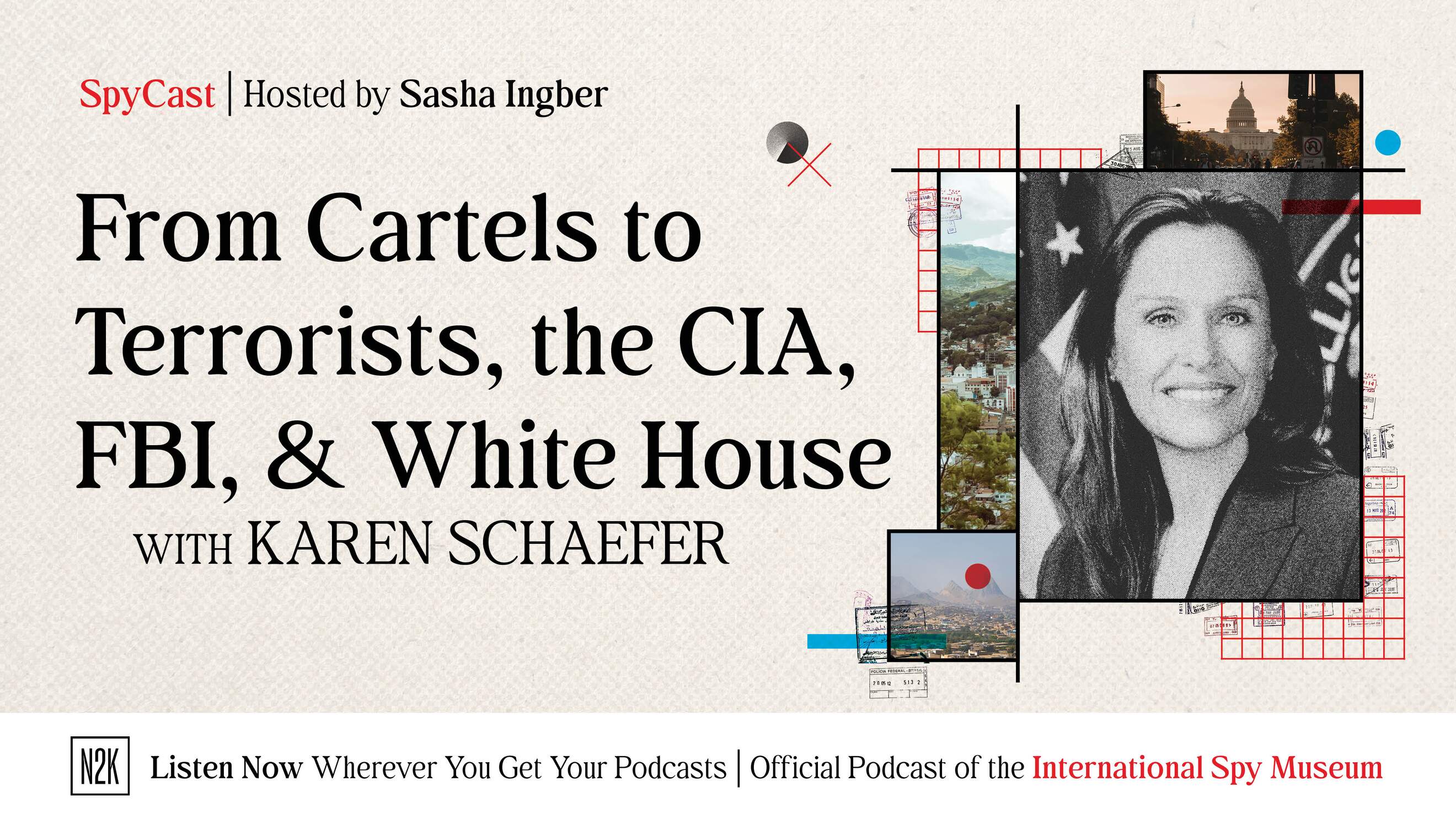


From Cartels to Terrorists, the CIA, FBI, and White House: The Vast Career of Karen Schaefer










Sasha Ingber: Welcome to Spycast, the official podcast of the International Spy Museum. I'm your host, Sasha Ingber, and each week I take you into the shadows of espionage, intelligence, and covert operations across the globe. Karen Schaefer retired from the CIA in 2019, after 26 years of service. She started out in Latin America and ended with a stint at the FBI.
In between, she earned numerous intelligence awards and held key positions that spanned operational, supervisory and policy roles. Her many job titles included Chief of Base in Iraq and Director of Intelligence Programs in the White House's National Security Council. Well, what was it all really like? We talked about how her career began, how she navigated being one of the only women in the room, and how she brought different intelligence agencies together.
Karen, welcome to Spycast.
Karen Schaefer: Great to be here, Sasha. Thanks so much for inviting me.
Sasha Ingber: So can we start out with your childhood? I know you grew up in the seventies and the eighties in South America.
Karen Schaefer: Mm-hmm.
Sasha Ingber: In authoritarian military regimes.
Karen Schaefer: Mm-hmm.
Sasha Ingber: Suppression, disappearances. Can you bring us into your childhood?
Karen Schaefer: Sure, sure. I grew up overseas because I was a dependent, and my father was agency as well, and so he was posted overseas and he specialized in Latin America, so we were in Mexico, Honduras. Then as you noted, Argentina and Chile rounded out our tours in Latin America. What I remember the most is Argentina and Chile, because I was a bit older when we lived there, and as you noted, it was during the time in the late seventies when they were both run by, essentially, in the case of Argentina, it was a military junta. In the case of Chile, it was, um, the dictator Pinochet. So it was, it was incredible. I mean, you, you'd have sort of surreal experiences where, you know, as a kid you don't always appreciate it, but looking back you realize, hey, we have armed guards posted at our house around the clock.
That's a rather unusual experience. You know, my brother was out playing with one of his best friends and while they were playing after school, his father, who was an executive of a petroleum company, was kidnapped and held for ransom, and I think paid possibly the highest ransom ever paid for someone.
So you have all these surreal experiences that really shape your understanding about the world at a very young age. So I, I feel very grateful, um, not saying that I would wanna replicate all those experiences, but it was certainly an eye-opening way to grow up.
Sasha Ingber: Did you feel American? You had mentioned how your father worked for the CIA.
Karen Schaefer: Mm-hmm. Um, I did, you know, my mom was very good at making sure that we spoke English in the house. I started speaking Spanish before I actually spoke English, but she was very good about incorporating customs and traditions for all the holidays and we were very tied to the embassy. And if you've ever been a part of a smaller community, the embassy sort, everyone sort of rallies around each other and you create this very close knit community of expats living overseas. So in, in some ways, you feel more American when you're overseas than you do actually when you are back home and immersed in everyday life in the United States
Sasha Ingber: because you were part of a group of Americans who had seen the world
Karen Schaefer: right?
Sasha Ingber: And the everyday American may not have. Now you had thought that your father worked as a diplomat.
Karen Schaefer: I did.
Sasha Ingber: He worked for the CIA for 50 years.
Karen Schaefer: He did.
Sasha Ingber: What did you see growing up? Did anything kind of feel like maybe it wasn't how it was supposed to be. Did, did you ever have any questions growing up?
Karen Schaefer: Well, you know, I think like most kids, I'm very, you know, I was very self-absorbed and I rarely asked my father about his job because that's not what you do when you're a kid.
You don't care that much about what the adults in your world are doing. And so I don't think I had the intellectual curiosity until much later. But what's interesting as well, and it's a phenomenon that's very common among kids who grow up and find out later in life that their parents are actually agency as opposed to State Department is that, you know, you have this perception of your parent as sort of this nerdy adult that you know has a terrible Spanish accent that you're always, you know, trying to work around.
And when it's revealed to you. And in my case, I interestingly enough found out through a third cousin who was visiting our house when I was in college, and he says, uh, well, I just think you're, you know, I can't believe I get to meet your dad. His work is so great. And you know, of course we're all like, yeah, I mean, you know, he was a diplomat.
Big deal. And they're like, no, no. He see, and of course I'm picturing my dad, the guy with the flood khakis and the white sweat socks and the, you know, LL Bean loafers. Like the nerdy guy puttering around in his garden, I'm like, oh no, James Bond. This is not right. And yet he was. He was.
Sasha Ingber: And what was it like when you really talked to him about it?
Karen Schaefer: So, you know what's interesting is my dad was very old school and he never really spoke to us about his job. So even after we knew, it was really interesting. It wasn't until he and I actually worked together. He was overseas when I applied to the agency, he didn't even know I had applied. I made the decision after I graduated from college and he was on a tour in Africa and I didn't even tell him because back then there were no secure communications. He was Chief of Station, so we assumed his phone was tapped, and so I couldn't talk to him about anything over the open line, so you know, it was
Sasha Ingber: mm-hmm.
Karen Schaefer: Quite some time before I had a chance to sit down and say, Hey, just FYI.
Sasha Ingber: What did he say when you told him, hey, now I'm in the agency?
Karen Schaefer: Yeah, I think he was excited. But also concerned, I'm his daughter. So of course there is the excitement. Very proud, especially once I had been accepted. Um, incredibly proud but nervous. It's a, in particular, as a woman, it's a very difficult job. It can be, particularly in the places that I served, very dangerous.
So like any father, you know, he wanted me to be happy. He wanted me to do something that I was going to be passionate about, but I think he was also understandably very concerned that I would be in harm's way and you know that I would cause him a lot of sleepless nights and he wasn't wrong. So
Sasha Ingber: Yeah.
Payback Dad?
Karen Schaefer: Yes. Oh yes indeed.
Sasha Ingber: But were you wearing LL Bean shoes?
Karen Schaefer: I was not.
Sasha Ingber: Alright.
Karen Schaefer: Although comfortable shoes is an imperative as an operations officer.
Sasha Ingber: A fair point. Fair point. But um, and this was not a question about fashion, just for the record. So this was at a time when the United States was cutting back on defense spending, on hiring
Karen Schaefer: Oh yes the peace dividend
Sasha Ingber: This was the Clinton Peace dividend.
Karen Schaefer: Mm-hmm.
Sasha Ingber: Yeah. Now you're in the agency, right. And in the beginning there is this rigorous training.
Karen Schaefer: Mm-hmm.
Sasha Ingber: What is it like for you?
Karen Schaefer: It was intense and um, oftentimes overwhelming, but I feel like it prepared me incredibly well for the work that I was gonna do.
You know, I think as a woman, you come in with some. Some folks have very specific ideas about whether you should or shouldn't be in, in, uh, the field. And we had some older instructors that definitely my sense was that they didn't necessarily believe that women should be operations officers. And so I think that there were occasions where maybe, um, I was scrutinized in ways that perhaps my male colleagues weren't.
But having said that, I prefer that because it, it gave me an opportunity to really hone my craft in a way that I knew that I could do the job that was expected of me. But there were definitely times when it was very intense. I, I went through a high threat course that was three weeks long before I went to my first post. My first post was the highest threat post in the world at the time, and they gave us three weeks of training. One was, um, high, uh, threat driving, sort of defensive driving. One was hand-to-hand combat and one was firearms.
During the combat, the instructor paired me with the biggest guy in the class who proceeded for a week to, you know, during these red man exercises to really take me to task. And at the time I was so frustrated, I thought, oh my God, I could be with anyone and, and why are you putting me with this, you know, six three, two hundred and twenty pound guy?
That's even when he is doing his, you know 30% or 40% that you're supposed to execute the moves, it's leaving bruises all over my body. And funny story my brother was getting married at at the, the weekend after I finished that training, I showed up and it was a strapless dress. I'm in the wedding and I have bruises all down my arms, all around, you know, the,
Sasha Ingber: what did you say? Because, you know
Karen Schaefer: well, my mother was horrified. I actually can't even remember what I said, if anything, at the wedding. But in hindsight, it's those experiences that test you the most, but also I think it cemented my resolve. It's like, okay, you don't think I can do this?
I'm gonna show you that I can do this. And it was, for me, it was great because it really did prepare me, not just for the physical challenges of the job or the emotional challenges, but just having the mindset that everything, there's gonna be an added layer of complexity. As a woman in most of the things I do, I'm going to have to think about things differently than my male counterparts.
Everything from car pickup meetings, to hotel meetings, dynamics between men and women because unsurprisingly, most of our assets are men. So things that I would have to think about that my colleagues just wouldn't. So the training in that way served me incredibly well.
Sasha Ingber: And let's talk a little bit more about that first post.
Karen Schaefer: Mm-hmm.
Sasha Ingber: In South America.
Karen Schaefer: Mm-hmm.
Sasha Ingber: In the drug corridor where, as you mentioned, this was the highest threat level in the world.
Karen Schaefer: Right.
Sasha Ingber: There are various threats that you're having to worry about that go beyond being a woman.
Karen Schaefer: Absolutely. I mean, we were expected to do all of our operations at night. So you're dealing with the basic physical threat to you, the security environment, because in my first post there was rampant crime.
I actually was held up at gunpoint. Um, so I experienced that firsthand during, while I was on a surveillance detection route to meet an asset. So I had to abort the meeting. You had the narco, narcotics trafficker threat ever present. And then you had what we would refer to as the the narco terrorist threat.
All of these indigenous terrorist organizations that were also looking constantly to create, um, challenges for the local government, but also to kidnap high value targets so that they could then use them as hostages to achieve certain political demand. So you're constantly on your back heels and you know, it was a great first post because I'll tell you what you learn very quickly that you don't have downtime, you have to always be on. I went with a colleague of mine to one of his meetings. He was meeting with a woman who was married to a narco trafficker and she was providing intelligence on the narco trafficker, and I was his backup and I'm, it's this surreal experience while you're sitting in a hotel room.
And you're serving as the quote unquote backup if something bad happens. And you know, I'm a 23-year-old young woman, and I'm sitting in there and it strikes me out of nowhere, wow. If something really does happen. I'm his backup, and if this goes south, I have to be on my game.
Sasha Ingber: You're so young and yet you're given so much responsibility.
Karen Schaefer:Yes.
Sasha Ingber:And you end up taking those skills, serving in two dangerous tours in South America.
Karen Schaefer: Mm-hmm.
Sasha Ingber: But then 9/11 happens.
Karen Schaefer: Yeah.
Sasha Ingber: And now because of these skills that you've developed, you end up in Afghanistan.
Karen Schaefer: Mm-hmm.
Sasha Ingber: At Gecko. Firebase.
Karen Schaefer: Mm-hmm.
Sasha Ingber:In Kandahar.
Karen Schaefer: Right.
Sasha Ingber: Can you tell us about this base and some of the work that you were doing there?
Karen Schaefer: Yeah. It was, uh, the Wild West, as you mentioned, I had already in my first two posts said was firearms qualified, high threat meeting qualified. So I was able to volunteer in one of the first surges and so I was forward deployed. I thought I'd be serving in Kabul and happy day, they forward deployed me to Kandahar and I was, there were a total of five of us, and I was the only woman.
Sasha Ingber: And this is a legacy of Mullah Omar, right, who was the leader of the Taliban.
Karen Schaefer: Exactly.
Sasha Ingber: So Kandahar is not Kabul.
Karen Schaefer: No, it is not Kabul. And it is, uh, you know, like, like most things I think there, by the grace of God, I mean, we were there during the honeymoon phase.
It was shortly after they had very quickly routed the Taliban. You know, it was an incredible experience, but it was, everyday was a challenge. One of my most surreal experiences was probably the chief of base and I were invited to a dinner. There are several major tribes in Afghanistan. One of the largest is the Pashtun tribe, and one of the tribal leaders of a subset of that tribe was Mullah Naqibullah, who was probably one of the biggest power players and ultimately ended up being one of the biggest allies for us.
Forces on the ground in Kandahar in particular, which as you noted was Mullah Omar stronghold. So, so very, very important ally. And we were building that relationship at the very onset. And so the chief of base and I are at this dinner and he's talking to us and, and telling us, well, yeah, we don't like the Americans, but we hated the Russians even more.
And proceed to tell us the story about how they went in and how they took Kandahar base, captured it from the Russians by waiting until they were all drunk at once. They had received their vodka shipment and slit all their throats. So I'm looking at the chief of base who's sitting across from me and I'm, I suddenly look around this and you know, we're surrounded by all of his tribesmen who are all around us in a circle with AK 47s.
And as we're driving back, we were, we're like good God, I, if, if they had wanted to do us harm, this would not have been a hard thing. Right. So you, it's moments like that when you realize, again, back to that surreal nature of the job, it's the risks that you have to take. I'd like to think they were calculated risks.
Sasha Ingber: There were certain moments of vulnerability, right. That you felt were strategic to take.
Karen Schaefer: Right. There was very little security at the base as the woman, I used to joke that I felt totally comfortable throwing out the chick card. I was like, we need more security at this space. There is nothing between us and the Taliban if they decide to come back.
And I was, you know, I was there for a y the year anniversary of 9/11 and I thought, well that would be a great statement for Mullah Omar to make, to come back and, um, retake his compound while we're there. So,
Sasha Ingber: right, because he went into hiding after 9/11.
Karen Schaefer: He did.
Sasha Ingber: And it took several years for him to die.
Karen Schaefer: Yep. When we were first setting it up, it was very primitive and they didn't have, um, running water. I mean, we, we were setting up perimeter security. We were doing all of these things, sort of like building a, really, like building a 747 in flight. One time, I, we were driving, we always had a buddy system, but there.
Vehicles we bought on the economy. They were low, so they were thin skin, no armor, nothing special, not kitted out. One of 'em broke down and thank God the special operations, we were co-located behind us on Gecko Base. They came by and grabbed us and picked us up.
Sasha Ingber: Nothing like having special forces to fix your car issues.
From there, you moved on to another incredibly important job, which was, uh, a counter-terrorism position in Iraq. Where you worked with General Stanley McChrystal.
Karen Schaefer: I did.
Sasha Ingber: And this was to dismantle a network of Al-Qaeda leader Abu al-Zarqawi
Karen Schaefer: Yep.
Sasha Ingber: Can you talk about that experience of working with McChrystal working in Iraq?
This was an incredibly important moment in 2006.
Karen Schaefer: Yeah, I mean, it was an extraordinary experience. If, if you've ever met General McChrystal, you know that he is one of the most revered leaders in in the history of, of the Joint Special Operations Command community, but it was very intimidating because I stepped in and once again, at least on that side of the house, there were no other women.
And unfortunately I had had some pull me aside before I went out to Iraq and had said, Hey, just so you know, the command JSOC folks are a little worried that you're gonna, by your arrival, you're gonna screw up the, the environment or you're gonna, you're gonna kind of throw off the team esprit de corps as the woman there.
And I thought, well, that's very helpful. Like I'm not really sure
Sasha Ingber: way to put out the welcome.
Karen Schaefer: Exactly. Yes, exactly. Well, that was my, thank you for being so helpful and encouraging me as I step out to my first field command.
Sasha Ingber: Mm-hmm.
Karen Schaefer: But at the end of the day, as we talked about before, it just, it ended up being a challenge that I took on and accepted.
I, I was absolutely terrified my very first briefing with him. But what I've realized over the course of my career is that, you know, when someone throws down the gauntlet, I'm happy to pick it up and all it means is that I double down and I might never be the smartest person in the room, but I'm typically gonna be one of the most well prepared.
So, despite what I was told, General McChrystal and his team could not have been more welcoming. So whatever I may have been, um, told, none of that was reflected in how they chose to engage with me. He was an extraordinary partner. He was someone who really believed in the interagency. He also knew the value added that the agency brought to the table, and he was extraordinarily supportive.
Sasha Ingber: And how did that work in terms of finally getting Zarqāwī. This is a man who had done so much harm to Americans, to Europeans, um, militant who was responsible for beheadings, bombings, uh, rocket attacks. He was really an, a notorious jihadist.
Karen Schaefer: Right. Well, you know, this is the classic case of the importance of intelligence, right?
It was a textbook case of the find, fix and finish, and one raid begets another raid, begets another raid. You also had incredibly intelligent and very, very experienced. There were actually, quite a few of them were young women. I'm proud to say that, that I had worked with also at headquarters, who then forward deployed and were actually a part of the whole take down that worked at the agency who did nothing but the hunt for Zarqawi, very similar to the Osama Bin Laden operation. But having said that, you realize that it's also very fleeting success. Because that happened in June. I arrived at the base in July and 2006 and 2007 were probably the bloodiest year for American soldiers on the ground in Iraq because much like my experience with uh Latin America and, and or the, um, narcotics traffickers, you can chop off the head of the snake, and then suddenly there's 10 other snakes that are vying for that same role that are going to be more vicious, more, ruthless in order to achieve their aims, which is exactly what we saw.
Sasha Ingber: And you bring up something that kind of takes us into the next question here.
You were the group chief of the Iran Operations Division at the CIA.
Karen Schaefer: Mm-hmm.
Sasha Ingber: Um, right now, as we sit here right, we're seeing whether or not the regime can survive.
Karen Schaefer: Mm-hmm.
Sasha Ingber: One person was essentially neutralized. Right? Ayatollah, Ali Khamenei was killed by the United States and Israel.
Karen Schaefer: Mm-hmm.
Sasha Ingber: And then another person, his son comes up and all of everyone is being taken out and everyone is being replaced by people who were more radical than those who came before them.
Karen Schaefer: Right.
Sasha Ingber: So can you talk more about what your job was when you were leading this Iran operations division?
Karen Schaefer: Yeah, I think it, well, I think you've hit the nail on the head that it's never about one single person, the Iranian Revolutionary Guard Corps, Quds Force, which is their paramilitary special operations folks, are oftentimes the ones that are, um, making the dec the most important decisions. I think that our efforts when I was in Iranian operations division, our efforts there and the whole point of the community human, uh, cell that we organization that we tried to set up was that we needed all the tools in the toolbox to go against this target set because it was so sophisticated.
The Iranians are incredibly well educated, they're very sophisticated adversary, and they're very ruthless. So part of the idea was how do we as a community, you know, whether it's CIA, DIA, NSA, how are we pulling all of the levers to try to identify who these key Quds Forces in particular folks are, that are running these net surrogate networks that are then killing our, our guys, and I'm happy to say that you know everything from, you know, DIA's assets on the ground to CIA's assets on the ground to treasury's ability to take financial reporting to sanction or seize assets. We were able to leverage all of that to have some impact.
Sasha Ingber: And it sounds like in this position, you as a person who moved away from being on the ground, now you're sitting at the table. You're able to make decisions that are shaping intelligence.
Karen Schaefer: Mm-hmm.
Sasha Ingber: So, right. Does that give you the ability to now empower more women?
Karen Schaefer: Yeah, I think absolutely. As, as you start to step up and manage people, you obviously de facto inherit an ability to move players on the chess board more effectively, and that certainly includes actively, um, looking for opportunities to promote women, to put them in positions that will help them get promoted. And then also, frankly, just there, there are so few women on the operations side of the house that rise up all the way through the ranks to, and stay in the SIS cadre that, um, and
Sasha Ingber: that’s senior intelligence service.
Karen Schaefer: So just by being in these positions, I can't tell you how many young women would come up to me afterwards when I would run these meetings and it's, you know, 99% men and then me oftentimes, right. And they'd say, I saw you leading a meeting this one time. I couldn't believe it. You know, you become a role model for young women who are coming up through the ranks.
Sasha Ingber: When we come back, Karen talks about reviewing intelligence programs in the Obama White House and her attempts to bridge the CIA and the FBI.
Moving forward with your career. There's pieces that I'm leaving out because you did so much. We don't have infinite time, unfortunately. You end up at the Obama White House, and this is something that takes you out of what you were previously doing, even when you were now more on the decision maker side at the agency.
Now you're reviewing covert programs inside the National Security Council. What is this experience like? What are you concerned about? How fast paced is it when you're at that level?
Karen Schaefer: Well, uh, you know, any operations officer worth their salt knows that this is the kiss of death assignment for an operations officer because it is all paperwork, it's all about policy.
Having said that, um. I was in what was called the Intelligence Programs Directorate, and I was in charge of the covert action portfolio. So I essentially ran the overviews of all the covert action programs, and it was fascinating. It was a case study on how policy is not just drafted, but implemented and how it's reviewed because I was in charge of doing the annual reviews for all of these policies, and it was also a, you know, graduate level course in leadership because I would sit in the IPCs, the Interagency Policy Committee.
So it, it's the working group meeting usually at the action level officer. So all the different agencies would meet in the IPCs, then it would get kicked up to the deputies committee meetings, which were usually the deputies of the agencies, and then to the PCs, the principals committees. So all of the department heads of organizations and the way in which some of the senior cabinet members, you know, asked the most incredible questions, and just listening to the questions that folks would ask was extraordinary.
Sasha Ingber: When you look back at your time at the NSC, were there programs that you wished had stopped or continued? There are a lot of journalists who spend time covering Obama's drone program which um, did result in the death of a US citizen who had committed acts of terrorism.
Nonetheless, that is seen as one of the more controversial programs.
Karen Schaefer: Yes, the al-Awlaki strike. Yes. Look, “Everyone imagines how covert action will start. No one imagines how it will finish.” Uh, when I worked for my deputy director, one of my favorite quotes of his, because by its very nature it is the most dangerous.
It is typically the type of work that can get people into the most trouble, and it is for that reason that it requires the greatest amount of oversight. I will say that my takeaway, from my time down there is that every administration had ample opportunity to review every program with precision, like laser-like, um, oversight to decide is this a covert action program that should remain in place.
Is it still relevant? Does it still embody the goals? And the methods that we want to achieve as an administration, and in some cases the decision was no. You'll recall that one of the very first things that President Obama did when he came into office was abolish the renditions detentions and interrogations Covert Action Program.
So each president, I would say, has ample opportunity to put their fingerprint on those covert action programs,
Sasha Ingber: and I'm sure that as a person who spent time on the ground in some of these countries, it meant something different to you than it would for someone who is mostly in Washington.
Karen Schaefer: A hundred percent.
Sasha Ingber: Toward the end of your career, you also told me that you were quote unquote volun-told to go to the FBI.
Karen Schaefer: Mm-hmm.
Sasha Ingber: Which is a very different environment than the White House or the CIA.
Karen Schaefer: Yep.
Sasha Ingber: Sometimes there are tensions between these two different entities, even though they’re part of the same puzzle looking at the threats of Russia and China and other adversaries.
So tell us about that time in your career and what you were able to do there.
Karen Schaefer: I feel like every assignment was really extraordinary in its own way, and I loved my time at FBI had worked from my very first tour in Latin America with the FBI, very closely as an operations off at the tactical level, but it wasn't until I was really inside of the FBI that I appreciated the breadth and scope of their mission.
You've got hyper, hyper successful type A individuals at the agency, hyper successful type A individuals at the FBI. So invariably you're gonna have huge egos that are butting heads. It's like a, you know, the uber athletes, right? I mean, they're super competitive. They all are very, very dedicated to mission.
And they wanna achieve results. And so I actually consider it a good problem to have that there's a bit of friction, I think, figuring out how to harness that. And that's really what I did. We would try to bring people to the table to have discussions about these, you know, major programs when they would clash.
And the idea was it should never be an either or, it should always be an and. And so what we found was that the only way you do it is by forcing people to get together, like making sure that they're forced to sit down, making sure that they get to know each other, they spend time together, they talk about and agree on specific ways that they're gonna collaborate.
Sasha Ingber: Taking us into today, having ascended through the ranks at the agency and having leadership roles beyond the agency, are you still getting calls from women? Are you giving them advice? What are they asking you these days?
Karen Schaefer: Yes, thankfully, all day, every day, almost every day, I have some kind of a mentoring call.
It is actually one of the things that I am the most passionate about, so I try to encourage women not to self-select out. It's a passion of mine because I do think we can make a meaningful difference, and I think in many ways. We can be better than our male colleagues at aspects of the job. And I'm on several boards.
The Women's Foreign Policy Group, if any young women are interested in national security, is one of the boards I'm on and I, it's again, an organization that focuses on encouraging young women to be part of the solution.
Sasha Ingber: For women who are at the agency right now, especially in a moment where we are leaning forward on operations and this administration has pulled back on the diversity, equity, and inclusion.
What are women calling you about?
Karen Schaefer: I mean, I think some are concerned, um, you know, the women that are inside of the building have figured out, you know, we, we hire really smart people and to your point. In our discussion earlier today, you pick your battles and you figure out how to navigate the roadmap.
Frankly, I'm concerned more about young women considering a career in national security because those are the ones that I think don't have the agency when they're first starting out to able to really stand their ground. And I think I can appreciate the concerns that they have about how they will be treated as women, but also the kinds of work that they may be asked to do.
And you know, my advice is it's a different landscape than when I went in and I still think there is no greater honor. But having said that, going eyes in, eyes wide open, understanding and making decisions based on what's best for you and for your career and for your wellbeing.
Sasha Ingber: Hmm. So is it a harder environment right now?
Karen Schaefer: Absolutely. Absolutely. I think so. I think for any young person, I just think that there's a complexity, the politicization of the national security. You know, when I went in I, I don't think I could have told you what political party any of my colleagues were ascribed to, whether they even voted. It was not politicized the way that it has been now.
Um, and it's a concerning trend because national security threats, our national security threats regardless of political party, that's not, this is not a partisan statement. It's a, it is a fact that the threats are not changing. People's interpretation of the threats are, and that is concerning because it puts young people who are the best and the brightest and continue to want to serve in really difficult positions where they aren't sure if they'll be hired or fired.
The instability. Continuing resolutions, you name it. And this has the potential, I believe, unfortunately, to have an impact. I hope I'm wrong, and I hope it's short-lived, and I hope people appreciate the damage we're doing to national security when we choose to politicize the process.
Sasha Ingber: Karen, appreciate you coming on.
Karen Schaefer: Thank you so much for having me, Sasha.
Sasha Ingber: Thanks for listening to this episode of spycast. If you like the episode, give us a follow on Apple, Spotify, or wherever you get your podcasts, and leave us a rating or review, it really helps. If you have any feedback or you wanna hear about a particular topic, you can reach us by email at spycast@spymuseum.org. I'm your host, Sasha Ingber, and the show is brought to you by N2K Networks, Goat Rodeo, and the International Spy Museum in Washington DC.



