
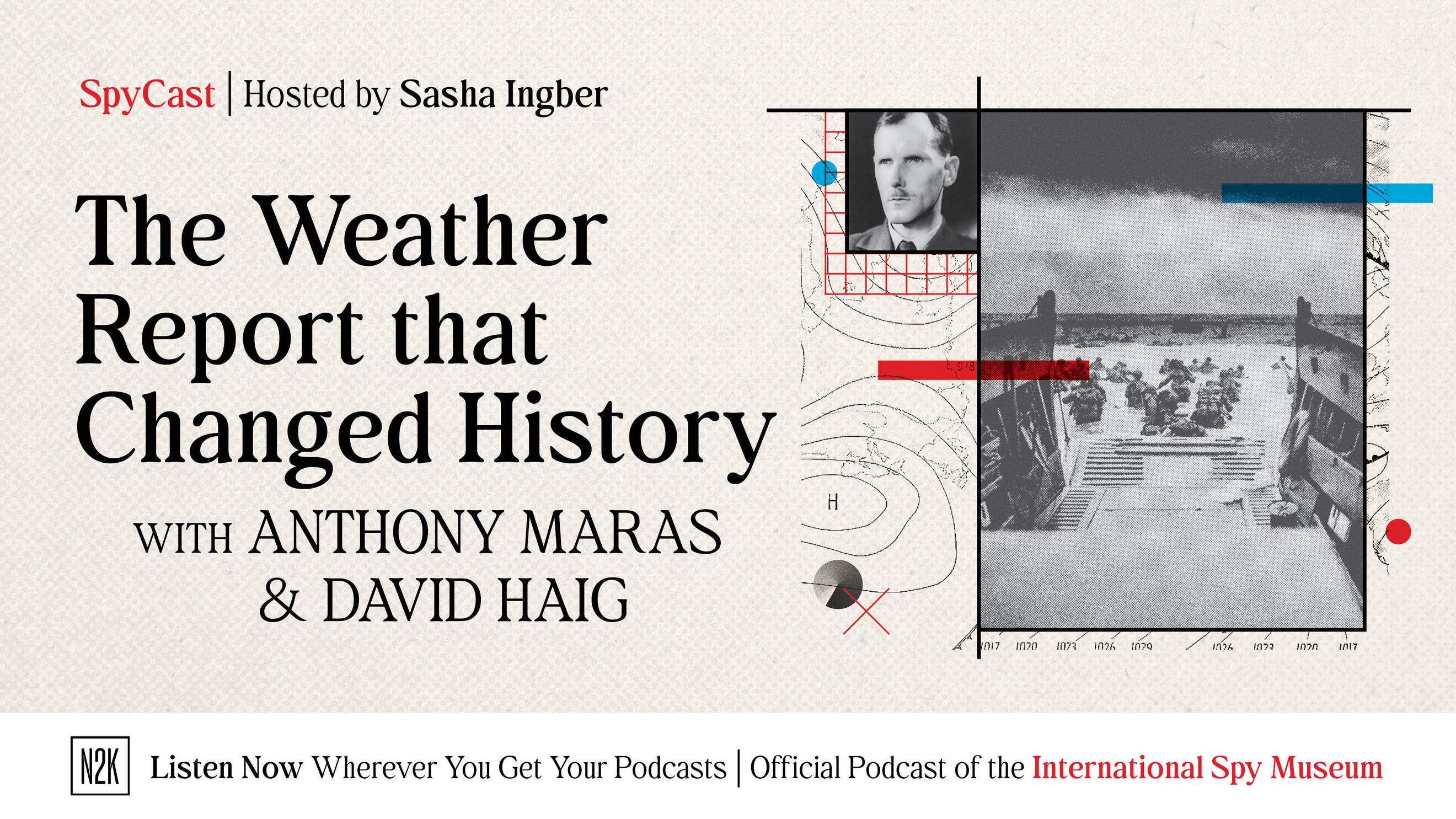


The Weather Report that Changed History










Mark Jacobson: Welcome to SpyCast, the official podcast of the International Spy Museum. I'm Dr. Mark Jacobson filling in for Sasha Ingber today. We're stepping into the hidden world of spies shaping events around the world.
"If any blame or fault attaches to the attempt, it is mine alone." This is the end of the announcement Supreme Allied Commander General Dwight David Eisenhower had prepared in June 1944 in case the D-Day landings failed. He never had to deliver it, but the fact that he wrote it tells you all you need to know about how precarious the success of the invasion really was. And at the center of that uncertainty was something no army could control: the weather. This is the premise of the new major motion picture Pressure, the story of the small team of meteorologists trying to predict the unpredictable. I'm here today with the screenwriter of Pressure, David Haig, and the film's co-writer and director, Anthony Maras, to discuss how a simple weather forecast proved to be a critical piece of intelligence.
Anthony and David, thank you for joining me today.
David Haig: Thank you for having me, and us.
Anthony Maras: Great to be here.
Mark Jacobson: David, how did you come across Group Commander J.M. Stagg in the first place? And, and what made you think that his story wouldn't be just a footnote to history, but really the, the focus of what would become, uh, not just a great play, but then a great screenplay and movie as well?
David Haig: Well, in 2011 a very distinguished theater in Scotland, in Edinburgh, the Royal Lyceum Theatre, approached John Dove, who's a theater director, and myself and asked if we could find a hero on the sidelines of history who was Scottish.
And so we researched, and up came James Stagg and his extraordinary contribution to the landings of D-Day and the future, you could even argue, of, of, of Western civilization, 'cause this Second World War had to be won, and he was a serious contributor to that victory. And I started writing the stage play, and I thought it was an irresistible story.
Mark Jacobson: Well, you certainly can't overstate the importance of D-Day. And, and I also think it's important for our audience to understand how meticulous you were in your research. It wasn't just historical records of, of the military campaign, but we're talking meteorological records, conversations with the family.
And David, can you tell us a little bit more about his background, what enabled him to be the type of person that Churchill would send to Eisenhower for the most important operation of the war?
David Haig: He was the son of a plumber from, uh, a small village near Edinburgh, um, Dalkeith. And I, uh, personally, actually, I have a personal thing here.
I'm s- I, I have some Scottish blood in me myself, but the, the traits I have always admired more than almost anything else in certain Scots is this, uh, integrity and honesty that is disguised within a certain peremptory bluntness. And, and, and I find it an incredibly appealing trait. And, and I think Anthony would probably sort of support the theory that it's a fascinating character to deal with, particularly for you, Anthony, filmically, because so much is going on inside, so little is revealed on the exterior, that it's fascinating to investigate one of those human beings, as it were, you know?
You know that there's so much ticking on the inside.
Mark Jacobson: And Anthony, if we could dive into that a little bit, what did you want to see come out on the screen, uh, in particular with Andrew Scott's performance as Stagg?
Anthony Maras: One of the things that I found really compelling, I guess, about Stagg's character was how he evolves, uh, in the screenplay and, and how you go in looking at this character one way, and you get a very different picture of him by the end.
But then you kind of think, "Well, where did that transition happen?" And I think what's beautiful about the screenplay is that Stagg's almost like a storm. You know, he comes into the halls of Suffolk House- And he takes no prisoners, he means business, he's hyper-confident, and he doesn't suffer fools. He's not really, you know, quote-unquote likable in the typical sense.
And what's, what becomes fascinating is that you see this storm come through and everyone's kind of on edge because he's a force. But then you see the clouds start to sort of open a little bit, and you get this big burst of humanity, of sunlight through the clouds. And it might be a simple thing where he's talking about his wife or he's on the phone, a very important phone call that happens in the film or something that happens at the end of the film, and it, and it results in a picture of a man who you thought was just this wound-up strict sort of disciplinarian meteorologist, and you realize there's this big heart beneath him.
And I think the sort of way that Andrew is able to oscillate between those two worlds, you see a full picture of a guy under pressure. And that speaks to the bigger picture of, of what the film's about and what, uh, you know, on a very basic level makes it fascinating. You got the world's most brilliant minds locked in a room trying to second-guess nature, and watching them kind of go insane over this three-day period as they're trying to figure out, do we launch the biggest seaborne invasion in history or don't we?
It is important to remember these were the greatest minds the Allied world had to offer. They all wanted the same thing. They wanted to win. And to watch not just these men or personalities, but their ideologies, their points of view on how the world works clash against one another, as, you know, as a filmmaker, is inherently dramatic.
Mark Jacobson: The movie starts off with uncertainty and chaos and things that cannot be controlled, and that's a series of accidents that happened during Operation Tiger, one of the, the practice landings, uh, for the Normandy invasion. Uh, German torpedo boats, uh, sink a number of Allied landing craft, and of course, you show the friendly fire incident, uh, where naval gunfire kills Allied troops, American troops, uh, that are under Eisenhower's command.
In fact, Eisenhower insisted that that live fire take place to, to make the practice more realistic. What were you all trying to show in terms of what this does to Eisenhower and his willingness to assume risk as the planning and decision-making went forward for the 6th June invasion?
Anthony Maras: There was another reason for it though, is like, it it went to Eisenhower's character, but from a very basic story construction point.
It's how do you show the consequences of failure to the audience of, if we make a mistake, what does it look like on the other side? And so upon learning that there was this massive dress rehearsal for D-Day, it was only six weeks out, went horrifically wrong, and more died in, uh, Exercise Tiger than on Utah Beach.
And I just felt that, you know, after we looked at the m- multitude of different ways you could start this film, that it was really important to show the consequences of failure so that for the rest of the film, it, it has a different kind of power when you're watching these, like, fraught discussions about, do we invade now, and are the Germans gonna find out, and all this sort of stuff, because it comes down to if we screw up, forget about the hundreds that died at Exercise Tiger.
When we're facing Nazis, you know, bunkered up on a fortified position, which is the hardest, pretty much the hardest military thing to do, to invade across water to a defensive position, we're just gonna, we're gonna be slaughtered. And, and that has to hang over all their heads for the tension to work, and also to reflect what actually happened in real life.
It was driving Ike mad throughout the course of the film. It's why he was smoking four to six packets of cigarettes a day. He's drinking 20 cups of coffee. Like, can you imagine drink-- I'm on my first cup now. I'd be a nightmare by 20 cups. He had an ulcer on the back of his hip, right? That was a stress ulcer that Kay was dressing by night.
Mark Jacobson: Eisenhower's under this enormous amount of pressure, as you, uh, are able to show the audience from the beginning. In fact, he's very concerned about the uncertainty. At one point, you know, Brendan Fraser as Eisenhower says, uh, you know, strongly, "I, I need certainty," uh, from Stagg. Tell us about why the weather, why certainty in the weather is so important for the D-Day operation.
David Haig: Well, one of the principal reasons is that the landing craft were antiquated and archaic and flat-bottomed. So, so anything over about force five, um, would have been potentially lethal and could have caused as many as 80 to 100,000 deaths. Added to which, it, it may not have, uh, it probably wouldn't have changed the course of the war, but certainly it would have elongated the war and caused a huge number of extra casualties on the mainla- on mainland Europe.
Um, and so to, to get that forecast right had colossal potential repercussions for, for, for Western civilization, no less
Anthony Maras: There's also the moon, you know, for the paratroopers to land-
David Haig: Yes ...
Anthony Maras: they didn't have night vision
David Haig: Yeah ...
Anthony Maras: obviously. So they needed the moon. The tides had to be a certain level so that the boats could go in.
David Haig: Yeah,
Anthony Maras: yeah. But, you know, if they, if they didn't, if D-Day wasn't a success, though, you know, there... a lot of people talk about this and they're like, "Okay, well, the Soviets were already on their way through to Germany, and they would have rolled over them." Yes, true. But then what- what does Europe look like after that?
You know, so had they not got on the continent then, there are multiple scenarios that could have eventuated. There could have been a treaty where, you know, west of the Rhine or west of some point, it's Nazi, and to the other side it's Soviet. Yeah, yeah. It could have been the case that the entire of continental Europe was Soviet.
Yeah. It's history now because it happened. Anything can happen in war, and I don't think it's as clear-cut as saying, "Well, the Soviets were our allies, and so we would have been good." They were... by, by that stage in 1944, there were already proxy wars going on between the Soviets and the West, uh, specifically in Greece.
Like, the reason my family came to Australia is they were caught up in that war. Whereas the Soviets were backing one side of the fight, the West was backing the other side, and they were already fighting one another in these proxy wars. A lot of people say, "Oh, you know, I know about history," and, "Well, no, the al- the Allies were already good."
It's more complex than that, and the and what a lot of these people were doing was trying to project forward past the immediate peace and what does Europe and the world look like after that. You know, continental Europe could be speaking German or Russian or a combination of the both if this had not succeeded.
So they, they were very well aware of those stakes, Eisenhower in particular.
Mark Jacobson: So you have tides, you have cloud cover, you have moonlight, you have sea conditions. And amongst some of the Allies, and particularly the, the British, uh, led by Montgomery at this point, he is concerned that if there is a delay to the invasion, this is going to increase the risk that the invasion itself isn't a success.
Uh, c- can you tell us a little bit about, I guess, uh, two things. One, uh, what was the tension between Eisenhower and Montgomery on a personal level? And I guess for Anthony, what did you want Damian Lewis to bring out in, in that division o- of ideas, that, that debate between Ike and, and Montgomery?
David Haig: It's an interesting debate.
I mean, that impetuosity of Montgomery, uh, and his desire to go whatever, uh, were actually admirable features to an extent. It's just that they were so, uh, poorly founded on the facts in this particular case. But, um, yeah. What, what did you feel, Anthony? What did you want from- Montgomery in the film particularly?
Anthony Maras: I, I just felt that you had, um, titanic figures across the Allied leadership. You had Ramsey, you had obviously Eisenhower, you had Montgomery, you had Bradley, you had many others. But I think of all of them, Montgomery being, you know, the head of all the Allied land forces, was hyper capable, cared deeply about his troops, but also had the bigger picture in mind.
And from a dramatic point of view, Stagg had his Krick, Ike had his Monty. Yeah. And that's not to say that someone's just squabbling for the sake of squabbling. Montgomery had a real point, like you bring up, Mark, which is, yeah, we can wait as much as we want. We wait too long, it's all gonna be for nothing. You can't just keep these men housed up like that, and how are you gonna seal the lips of hundreds of thousands of men?
And I, I think his character from a dramatic point of view is really important to show that the kinds of tensions that Ike was fighting were not just weather, they were a multitude of other factors.
Like in, in the film, we go into some detail, you know, on the diversion tactics, you know, the inflatable tanks and ships and all of these sort of things that Montgomery had spearheaded, kind of like a magician. You were showing the film as in, as in history that it wasn't just this one-pronged effort, it was land, air, sea, subterfuge, secrecy, you know, second-guessing the weather.
Like it was this massive effort that was all coming together, and Monty represented a big part of that. He's also just a great character. Like, I'm gonna bastardize the quote, I'm sure, but Churchill said something which, uh, you know, I always kind of chuckle at, where he said something like, you know, it's about Montgomery, "In battle, indispensable. In victory, unbearable." And you know, that was Monty, where you wanted him on your side- Yeah ... but oh, God, you're gonna hear about it once- Yeah ... he starts gloating.
Mark Jacobson: Well, let, let's talk a little bit more about Stagg. I mean, you, you've set up- the pressure that, that Stagg is under. He has, uh, Eisenhower, he has Montgomery, he has the weather.
Stagg understands the enormity of what's about to happen, and the consequences of the forecast, and he needs to get it right. A- as Ike says, "I need you to be certain." What do you each think that's enabled Stagg to cope with that pressure? Or as you show in the film, y- you know, he has challenges, but he ultimately gets through.
As, as you say, he evolves, uh, and adapts to the situation. What enables him to do that, and what do you want the audience to understand about Stagg's evolution as he tries to adapt to that pressure?
David Haig: I think the crucial thing that we're talking about is, is how he manages to defeat his own demons, his own uncertainty, his own knowledge that weather is always inevitably uncertain.
How any human being, any man in that situation manages to suppress the fear and the, the chaos within him to make the decision as well as he can to, in its simplest terms, do his job as well as he can.
Mark Jacobson: And he's doing this job without satellites, without global forecasts. Yeah. Yeah. How difficult is it for meteorologists in 1944 to give a, a fairly reasonable prediction of the weather?
David Haig: Yeah, yeah. Well, quite. Um, actually, Anthony, you did a lot of work, uh, i- in the later drafts on, on the variety of information and data. And data was always very important to you, wasn't it, in the, in the screenplay? So you brought in a lot of these external sources. I mainly dealt with the clash between Krick's philosophy with synoptic charts and the past, and Stagg and the Europeans' nascent, uh, understanding of the jet stream and the, that current's power, and weather balloons and stuff like that.
Anthony Maras: Yeah, I, I think that it was a natural evolution of what was already there. But, you know, I think what sets Stagg apart from many of the other characters is frankly, his ability to live with uncertainty. And it's, it's something that he as a meteorologist and also as an explorer in a sense, like he was not, you know, in a lab his whole life.
He was out in the Arctic on weather ships at sub-zero temperatures for months, years at a time. You know, he was a tough dude and, you know, he'd seen a lot. He's not just reading maps. Like he was out there in the teeth of the weather in his formative years as meteorology as a science was being developed.
It wasn't obviously what it is, it, it is today. And, you know, the more that we got into the, the research, it, it wasn't just his skill as a meteorologist. In fact, that's not the key reason he was there. You know, he was kind of like the head of the octopus who as Ike had to decide ultimately, do we go or don't we go?
Stagg had to decide what's the weather gonna be. Now how does he do that? There are thousands, if not tens of thousands or more data points coming in from all around the world. They've got, you know, [00:17:30] planes and they've got balloons they're sending up in the Arctic and in the deserts and in Newfoundland and at bases off the Atlantic.
They even had French resistance members with little weather balloon kits and transmitters and stuff, setting off balloons in France to get the details from them. Like it was a really big effort. Ultimately, all of that data has gotta come in and be synthesized somewhere and has be an- has to be analyzed somewhere.
And there was no computers, there was no, uh, computer-driven algorithms. It was human brain and human brawn in the sense of hands physically pushing pencils around, but ultimately someone had to make that call. And so what Stagg had the un- enviable task of doing was he had beneath him a number of different meteorologists, you know, who were saying, "It's gonna be sunny and it's gonna be great," or, "It's gonna be an absolute s*** storm," and everything in between.
And, and so we tried to build this idea of Stagg obviously having his own very clear meteorological opinion on things, but he's also having to synthesize stuff that all these other team members, including Krick, are bringing to him. And again, it's that idea of watching this clash of how we see the world, not just personalities.
Like it's personalities as well, but it's how we see the world. And it brings up something interesting with Krick where you know, it's easy to say looking back, "Oh, he got it right," or, "He got it wrong." And yes, in that particular time, he got it wrong in, uh, just for the D-Day call. But he was one of the most esteemed meteorologists on Earth at that point.
Now, his methods may be, may have been outdated now, but, you know, he was advising the biggest Hollywood productions, as you see in the film. You know, he was right in 90-plus percent of, of the campaign in North Africa. He was trusted by Ike, and he understood something that Stagg didn't, which was what Aristotle would say, "It's not just what you say, it's who says it and how you say it that makes an impact."
Because there has to be an element of trust between leadership and, and those advising them. And Krick understood that. Like, there's a line in the script where he goes, "What are you talking about? I know him," referring to Eisenhower. Whereas Stagg's like, "What difference does that make? The facts are the facts."
And what Stagg comes to learn through all of this is everyone's really busy. Everyone's got a lot of stuff on their mind. What Stagg's immediate obstacle is in this film is, "I'm Cassandra. I can see into the future. No one else will believe me. How do I get my point across?" And, you know, there's a point in the film where he's just like, "F it. I'm just going to tell you exactly how I feel."
Because at a certain point, the data stops working. You also have to connect on a human level, and Stagg learns to do that at a certain point and earns Ike's trust, as he had in real life. We've compressed the timeline a little bit into how long that all took, but those dynamics were very important to capture.
Mark Jacobson: When we come back, we'll talk about some of the other dominant personalities and how the Allies overcame these differences.
Chris Messina's playing Krick as very flamboyant. Again, as you spoke about, the Hollywood darling. This is what he was like in real life. And, and how did this help you to recreate these intense clashes that, that he has with Stagg?
Anthony Maras: I'm gonna read you something. This is fresh off the press. So this is from Facebook one week ago.
So Irv Krick who is the son of Irving Krick, uh, has seen the trailer. Here's what he wrote.
David Haig: No.
Anthony Maras: Yes. Yes. I just, I just saw this. He says to Theresa Prali, who I guess is his friend, "My dad certainly was a controversial character. We'll see how close the movie describes to what I know. But my dad said time after time, he just didn't like this guy James Stagg," right?
And so- ... assuming that is the real Irv Krick, which Irv, I guess it is you, um, "My dad was certainly a confident guy, and frankly, caught a lot of flak about his method. But guess what? They worked so well that his company survives to this day." That tension was there, and they... There was no love lost, but- Yeah
you know, there was a grudging respect, I think.
David Haig: You know, he was there after the war to make money as well. I mean, he, he, he sold his, uh- ... cloud seeding techniques, you know, to produce rain in the Middle East, which was a pretty dubious meteorological, uh, half-truth, and, uh, and made a huge amount of money for it.
And his book is really, is very flattering about Irving Krick, his memoir. A- and he looked a bit like Clark Gable, didn't he? I mean, he was, he was, he was just a great character. But as you say, Anthony, a very, very sound meteorologist, very respected, and using a system that did work on a large landmass. On a big continental basis, those synoptic charts worked.
Mark Jacobson: As you've both said, one of Stagg's responsibilities is to take these divergent forecasts that are, that are coming from the European team, from the Americans, and figure out a way through. And it's not just a matter of the data, it's a matter of the personalities. And, and Kay Summersby plays a, a very important role in this.
And tell us how you wanted Kay Summersby to be portrayed. I mean, she's not just a driver for Eisenhower. No, no. She's a very important confidante, maybe even a more important chief of staff than General Bedell Smith was for Eisenhower.
David Haig: Yeah, yeah. Yeah. Yeah. I, I think that's right, and she was my favorite character when writing the, the stage play for many reasons.
One of which is that there are very, very few women in that era who had such agency, who managed to be so resilient and influential within that patriarchal male world. Um, and, uh, I, I can think of a, a tonally resonant similarity in Imitation Game with Joy, uh, Joy Clark, isn't it? That was her name, who was the cryptologist who, who helped Turing.
And again, you know- Mm ... they paid her less They paid Joy Clark less. She, she had to pretend she was doing a completely different job to get into the hut that was interpreting the data, uh, you know, um, uh, on the computer. And, uh, and similarly with Kay Summersby, yes, she could open the bonnet of, of Ike's car and mend, you know, as a very qualified mechanic.
She was a confidante. She was a brilliant PA. And she-- uh, even that, as I say, it sounds vaguely patriarchal actually, but, but I don't mean it to because the, there were so few women who, who had that energy and, um, desire to influence and also such, um, uh, importance within a story like this. Um, so I was always very, very fond of Kay, and I'm very fond of the interdependency of the two of them within the story, that, um, there was something about what Kay could offer Eisenhower that helped him, uh, survive the, the chaos, physical chaos that Anthony was alluding to earlier, the cigarettes, the coffee, the, the, the, the sores on his back.
You know, I mean, just that sheer relentless pressure that she was able to help him come through.
Mark Jacobson: David and Anthony, what do you hope audiences take away from this film about D-Day, about uncertainty, about leadership, and of course, about pressure once they've seen the film?
David Haig: I think there is something innately heroic, not in a Marvel films type way heroic, but quietly heroic in all the protagonists.
I think Eisenhower in the deliberate sagacity of his trust and choice; Stagg up against pressure on the point of cracking, sticking to his guns and saying what he believed to be true; and Kay Summersby helping to solve a, a problem, um, between the three, between the leaders of, of this, um situation, um, becoming indispensable to the outcome of this choice.
And so all three of those main protagonists share a quiet heroism, which I think would be a great thing to communicate and would resonate nowadays, uh, when so many choices are impulsive and fast and reactive. And, and they treated choice and deliberation and the importance of their choices in a very different way.
And I, that, that's something that really strikes me about the film and about the story.
Mark Jacobson: One of my colleagues used to say that, that genius on the battlefield was the ability to reconcile the fog and, of war and the friction that comes with it. And what you've described is really the, the genius of Stagg and being able to reconcile that, uh, for leadership.
Anthony, uh, your thoughts?
Anthony Maras: Yeah, I th- I think that, uh, in Stagg you've got a character who's willing to look the most powerful men on Earth pretty much at this time, and that Allied leadership is willing to look them in the eye and tell them what they, what he knows they don't wanna hear, but what he knows that they need to hear.
And, you know, I think there's power in that example. I think Stagg, the meteorologist, is like a rock who's unflappable and who you want on your side, and who's willing to tell the truth. And in times of crisis, you want people who aren't gonna give you BS, but who are going to basically tell it as it is, as they say.
And I think that in the world that we live in now, that quality gets rarer and rarer, as is the qualities that Eisenhower showed in the lead-up to D-Day, where you have a portrait of a leader who cares deeply about his men, who agonizes over their fate, and who fundamentally just wants to do the right thing.
And, you know, you only have to look to the history at what Eisenhower did on the eve of D-Day in writing two letters. One, uh, in victory, he commended the troops and gave, and gave them the, uh, gave them the victory. He said it was because of the troops' bravery that they won. And yet he wrote another letter in case of defeat and said all responsibility rested with him.
I wish we had leaders across the world like that today. Mm-hmm. I think the kind of world that we live in and the news cycle that we have makes that sort of style of leadership get rarer and rarer. But it helped us through some of the toughest times, uh, that we faced, at least in the West. And, uh, you know, there's honor there and it should be commended.
Like, when you've got someone like Eisenhower in mind, who had a million men or so behind him in terms of troops and how many people were in that logistics chain. A million men, but he's all alone ultimately to make that decision uh, I think we can learn about who we are by looking at how other people in times of absolute crisis, how they deal with that crisis and how they deal with that pressure.
And I think, you know, if anything, what, what pressure gets to is how do you bring your best self to the table when- Mm ... all the chips are down, when you don't know all the answers, and you've got to make some of the biggest decisions of your life. Like that, beyond war, beyond history, it's a fable about that.
You know, how do you make the best decision? And the whole film is about one decision, and it's, and it's exciting to see these characters smash up against one another as they try and get the answer to that question.
Mark Jacobson: And a final question, uh, for you, David. Do you think Eisenhower in the end understood the importance that Stagg and the other meteorologists played in helping him to m- to make the right decision?
David Haig: I do, and he, he rather wittily says that, uh, the success of D-Day was because we had better weather forecasters than the Germans. So I think he did understand that. And, uh, but he understood something deeper as well, that whether, that Anthony and I have tried to articulate in, in what those, those two men actually, if we're talking about Eisenhower and Stagg, stood for.
Anthony Maras: And he said that to JFK at his inauguration. It was the first question JFK asked him, "What gave us the edge on D-Day?"
David Haig: Yeah.
Anthony Maras: And it's just interesting that at the same time that Eisenhower is responding as you described, "We had better meteorologists than the Germans," you know. I was gonna say Andrew Scott, who played the thing so well, but James Stagg just went back to a quiet life in England.
Yeah, yeah. In town, he studied meteorology, and it's-
David Haig: Yeah ...
Anthony Maras: not all heroes wear capes. Sometimes they walk out of, uh, their house. They, you know, check some barometric pressure. They save the world, and they just go home again and, uh, be with their wife and kids, and that's kinda what Stagg did. So there's something noble in that.
David Haig: Yeah, yeah.
Mark Jacobson: Yeah. Well, gentlemen, I think that's the perfect place to end it today. Uh, the movie is Pressure. The untold story behind D-Day. It's out in theaters now. Uh, David Haig, Anthony Maras, thank you so much for joining us on SpyCast today.
David Haig: Oh, well, thank you. Thank you so much. Uh, I enjoyed it very much.
Mark Jacobson: Thanks for listening to this episode of SpyCast. If you like the episode, please give us a follow on Apple, Spotify, or wherever you get your podcasts, and leave us a rating or review. It really helps. And if you have any feedback or want to hear about a particular topic, you can reach us by email at spycast@spymuseum.org. I'm your guest host, Dr. Mark Jacobson, and this show is brought to you by N2K Networks, Goat Rodeo, and the International Spy Museum in Washington, DC.



