
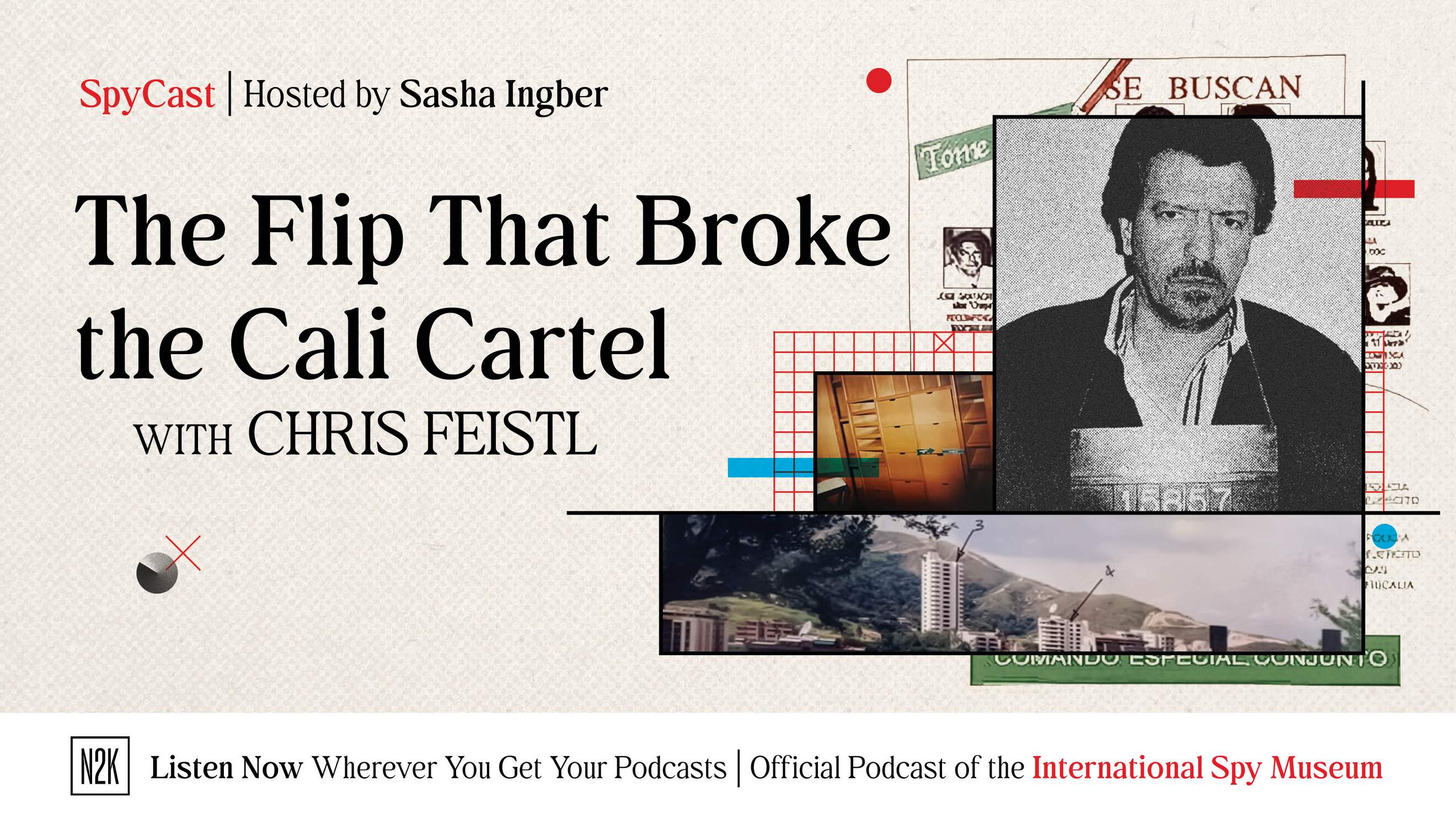


The Flip That Broke the Cali Cartel










Sasha Ingber: Welcome to Spycast, the official podcast of the International Spy Museum. I'm your host, Sasha Ingber, and each week I take you into the shadows of espionage, intelligence, and covert operations across the globe.
As part of his 26 years at the Drug Enforcement Administration, retired special agent, Chris Feistl was on a team that brought the demise of the Cali cartel in Columbia, one of the world's biggest crime syndicates.It earned billions each year from selling marijuana in the 1970s, to harder drugs in the decades that followed. The so-called godfathers of Cali bribed judges, lawmakers, police commanders and military officers, they used Boeing 727s to haul drugs outside of Columbia, and they even funneled millions to a candidate who won the 1994 presidential election effectively, buying the race. The details are told in Chris's book, After Escobar, and season three of Narcos. Chris sat down with me to discuss Cali's intelligence tactics and capabilities and how he brought it all down.
Hey, Chris, welcome to Spycast.
Chris Feistl: Hi, good afternoon. It's great to be with you.
Sasha Ingber: So let's start in the eighties and the nineties.
This is a time when the Cali cartel is fighting with Medellín and Pablo Escobar specifically. They realize that intelligence could be useful for them, and they ultimately get this nickname called the Cali KGB. Can you tell me more about what that really meant?
Chris Feistl: Sure. So at the time, Cali's intelligence and counterintelligence arm was so advanced and so sophisticated that the DEA and the CIA started referring to them as the Cali KGB, and part of the reason that they did that was because the Cali cartel was able to corrupt a great many people. On one of the raids that we went on, we found a list of 2,800 corrupt officials and there were thousands more. And because of that, they were able to insulate themselves with all of these corrupt officials and they offered them some sort of protection from, uh, enforcement action by the Colombian government.
And just to give you an example, there was, you know, a six year investigation by the Colombian government. And during that time, they found 36,925 checks from 90 different bank accounts that had moved $500 million. So you can see how well insulated they were.
Sasha Ingber: Wow. One list, 2,800 names, millions of dollars per year.
And also there was a US raid in 1994, which found a computer worth one and a half million dollars. What was on it that was notable?
Chris Feistl: So at the time, this seizure of this computer was the most advanced and sophisticated technology that the US government had seized from drug traffickers, and it was an IBM AS/400 mainframe computer.
It was about seven feet high, four feet wide, had an incalculable amount of storage, and there were only about four or five of these in the world at the time. And what they did is they stored all of their technology and their information on here. So it was sent to the US and after about three weeks, the US was able to crack that technology, and they found that the Cali cartel had the ability to wiretap over 400 telephones a month. They had this computer during the war with Escobar, so as a way to try to find informants or people who were cooperating with Medellín or the US government. So any individual who was calling Medellín or calling the US Embassy, and then they were able to wiretap the phone of that person, and if they were an informant, they would immediately be killed.
But that was because they had these contacts in the phone company that allowed them to intercept 400 telephones a month.
Sasha Ingber: And then there were the taxi drivers, so many different types of people who were recruited. They also used these low power walkie talkies, which were hard to trace and burner phones where they would throw them out before the judges issued search warrants, there was a modified Cessna aircraft.
Who taught them about all of these things that allowed them to be able to conduct counterintelligence and intelligence operations of this nature?
Chris Feistl: Well, the Cali Cartel used a lot of different individuals to get this expertise, which was able to help them in the war with the Medellín cartel, as well as against the US government and the Colombian government.
They used the Spanish, the ETA. Which is a Basque separatist terrorist group. They were the ones that taught them how to use remote control car bombs. They used the British, the SAS, the Special Air Service, the Special boat service, as well as people from the French foreign leg to come in and train them on combat weaponry, surveillance, things like that.
There's also stories where you hear that some of the Israeli groups were coming in to train not only the Medellín Cartel, but the Cali Cartel as well. And plus, you also had a lot of very sophisticated and highly trained Colombian military officials because at the time, they're fighting these left wing gorilla groups such as the FARC, the Revolutionary Armed Forces of Columbia, and right wing paramilitary groups, the AUC.
So they had a very well-rounded network of people that they could rely on.
Sasha Ingber: Then when Pablo Escobar is killed in a shootout in the mid 1990s, now Cali really is able to exert power here, buying more officials, as you had described, from government to law enforcement. And I'm wondering what it was like for you knowing that law enforcement in Columbia could be compromised and how much more difficult it would be to then try to arrest the Cali leader, Miguel Rodríguez.
Chris Feistl: Well, it was very difficult at first, and when myself and my partner Dave Mitchell, we first got to Cali, we were assigned to work with the police and the military search blocks, which were designed to go after the biggest and the baddest narcos at the time.
And we had very strict rules and protocols in what we can do and what we couldn't do as far as rules of engagement. So initially when we got there, we were never allowed to leave the police or military base without an escort, and we weren't allowed to conduct any kind of unilateral activity. But after time on the ground there, we found out that all of the operations that we were doing with the search blocks were compromised.
So we figured, and we suspected that many of the people that we were working with and dealing with were corrupt.
Sasha Ingber: Had you ever been in a dynamic quite like that? At what point were you in your career?
Chris Feistl: No, I was, uh, six years removed from the DEA academy. Uh, I was young. I had just turned, uh, 30 by the time I had got there.
Uh, I had never worked in an environment like that. Columbia, at the time, was the most dangerous country in the world. And plus, let me add one other thing, myself and my partner. I'm six, I'm a good six two. My partner's a good six three, and at the time there was no Americans in Cali at, at all because of the danger and the security.
So it was very difficult for us to move around to operate. We had to do stuff at night. So we had a lot of challenges when we first got there. So we had to eventually remove ourselves from the, the, the search block we had to establish safe houses where we lived on our own. We had to get our own vehicles.
We had to do our own surveillances. We had to do our own reconnaissance missions. We had to plan and coordinate our own operations, and we had to do everything at night under the cover of darkness because we couldn't be seen during the day talking with some of our assets, because if that was the case, then they would immediately be identified as assets for the US government and killed.
So it was very difficult and challenging for us to do our job.
Sasha Ingber: You ultimately ended up working with a specific police unit that had been attached to the CIA. Can you tell us about who they were?
Chris Feistl: Sure. So after almost about a year on the ground and operation after operation being compromised, so we developed intelligence.
The only way that we could do that was to utilize a very small covert group from Bogota that was attached to the CIA. This group was trained in the United States by the agency. They were polygraphed, they were drug tested. They had worked on a number of sensitive investigations, and we figured that that was the best shot that we had to circumvent the corruption at the search block because the search block was a quick reactionary force designed to overpower their targets with speed and, you know, overwhelming firepower.
That's not what we needed. We needed a covert surveillance unit. And the only one that we could utilize was the one attached to the CIA.
Sasha Ingber: Does the day and night blend, are you collecting exhaustion day by day as you continue to hunt down Miguel and ultimately his brother, Gilberto Rodríguez, who are both in charge of the cartel?
Chris Feistl: we weren't sleeping a lot.
Our circadian rhythms were completely destroyed. We had lost a lot of weight. We weren't eating properly, so we were always coming and going at all hours of the night. Uh, just depending on what we needed to do. But yeah, a lot of times night day, they, they all blended together.
Sasha Ingber: And the big break in this case came with Jorge Salcedo.
Uh, that's a name that people might know if they watched season three of Narcos. He is the head of Cali's Security. Tell me more about him.
Chris Feistl: So, Jorge Salcedo was an engineer by trade. He was recruited into the Cali Cartel in 1989. He worked as a reserve officer in the Columbian military. His father was a very, you know, famous general in Columbia.
He had spent time in the United States at Fort Benning. So he, he spoke English. He was highly trained.
Sasha Ingber: He lived in Kansas for two years while his father attended an army college. Correct?
Chris Feistl: Right. He did. He lived in Georgia and as well as Kansas, uh, I believe as well. So he, he had a lot of the qualities that the Cali Cartel was looking for.
He was you know, an experienced military operative, he had an intelligence and counterintelligence background. He spoke English. He had contacts with British mercenaries. So while he was a captain in the reserves for the Columbia military, he had come in contact with a lot of these, uh, mercenaries from, uh, from the United Kingdom.
So they saw him as a valuable commodity, so they recruited him into the cartel to utilize those mercenaries to go after Pablo Escobar. But, you know, he realized he didn't have much of a choice. The, the cartel had told him his plan. He realized he couldn't say no, he would've never walked outta that room.
So he said that he would help them, uh, provided that after Escobar was killed, he would no longer be part of the cartel. He would be free to leave. Of course, that didn't happen and he was stuck in the cartel.
Sasha Ingber: So his army background and his mercenary connections were what made him valuable to Cali and his dissatisfaction with having to stay in Cali is what made him valuable to the DEA.
Tell me more about what happened on that first approach.
Chris Feistl: So, and I was finally able to get a telephone number for Jorge Salcedo, and we called him one morning and I basically said, Hey, I'm a, a friend of Eddie Kacerosky, who was a customs agent in, in Miami. I said, I think we should talk. There's, I think a few things where we may be able to help each other out.
So we set up a meeting later that afternoon, uh, at three o'clock. To discuss what it is that he could potentially do for us and then what we could do to help him.
Sasha Ingber: Okay. But we just talked about how Cali had phone tapping. They were keeping a close watch on everybody. So how did you know that you would be able to make this call?
Chris Feistl: We had arranged to have the conversation in advance. So what he did, because he's the head of security, he knows the capabilities of the Cali KGB. He went to a business, like a public business, which he had, uh, was kind of a friend of his, an associate where he knew that the cartel or the police weren't listening or intercepting that phone call.
We knew that he knew exactly who we were anyway, just because of all the spies reporting back to him that we were the only DEA agents working in Cali at the time.
Sasha Ingber: So it sounds like he's going to work with you. What is that first meeting like and where does it happen?
Chris Feistl: So our first meeting, it's probably one of the most surreal meetings that I've ever had in my life in in law enforcement.
During the phone call, he says that I will meet you at three o'clock at sea, which is a joint agricultural center, about an hour from where we were. It's basically in the middle of nowhere. It's surrounded by sugar cane fields. There's nothing else out there. So when he said that I, I immediately had visions of being kidnapped, killed, tortured, because why would we be meeting in such a remote area an hour from Cali?
So it started to set off a lot of alarm bells and it only got worse the conversation to set this meeting up because then he tells me I would have to come alone. And I said, I'm absolutely not coming alone. We need to meet somewhere closer to the city. I need to bring my partner because we need a little bit more protection and cover.
And he, he says a few things that really almost start to terrify me at that point. He says, well, if we're seen together, then it's not gonna end well for either one of us. So by this time I'm thinking like, is he trying to talk me out of this meeting or what? Because he, he's putting all these roadblocks and these red flags up and, uh.
I said, no, I have to come with my partner. He finally agreed to that, but then he said, no Colombians, because he was the one that was paying a lot of the Colombian officials, the spies, so he didn't trust them. So he wanted to see two Americans that he could easily identify as being from the US Embassy.
Sasha Ingber: So you're driving to this remote area, to these sugarcane fields.
It's an hour long drive. What are you and your partner talking about in the car?
Chris Feistl: So we got there to the meeting three hours early. We were very, very heavily armed. You know, we had rifles, pistols, backup weapons. We were very heavily armed, but no vests, no recording. We found a good strategic spot for us where we can surveil the entire area and see everything.
And we said if we're there early enough, we'll be able to notice if it's a trap or an ambush. So, you know, Cali is, is extremely hot. We were sitting in the sun just waiting and we didn't see anything. And then finally the, you know, at exactly three o'clock, he, he pulled down the road and through our binoculars we were able to determine as best we could, that there was one occupant in the vehicle. So he showed up. We searched his car real quick. We searched him real quick. Nobody in the vehicle, he didn't have any weapons. And you know, there it was. We were, we were meeting with the head of security for the Cali cartel.
Sasha Ingber: So what happened after that? You're standing there with him. What do you say to him?
What does he say back?
Chris Feistl: Well, the first thing we said to him was after we, you know, researched him, we said. Jorge, are we American enough looking for you? And, uh, it kind of broke the tension because, you know, I'm not gonna lie to you. It was, it was very high stress. We were, we were very nervous. We just kept looking over our shoulder, waiting for, for something to happen.
So, uh, you know, he laughed, broke the ice a little bit, and then we got him into our car and the first thing he said was, Hey, this is a one-time meeting. It's not gonna last long. I'll try to help you find, uh, Miguel Rodríguez . I'm not interested in the Colombian reward, and I'll pass you some information and you know, the only thing I want is safe passage for me and my family to the US.
He was a seasoned professional, right? He's in his, you know, late forties, probably early fifties at that time. Here we are two kids, basically in Columbia trying to bring down the, the biggest drug trafficker in the world at the time. So he was a little bit concerned about our youth, about our experience in Cali and working in Columbia.
Over time, we were vetting each other. We proved our bonuses. He was asking us questions. We responded with the right answers. And what turned into a quick one-time meeting lasted three hours. We got a credible amount of information and intelligence. We got more in three hours than we did in a year on the ground, and he agreed to keep meeting with us to help us go after Miguel Rodríguez .
So it was a very productive meeting that first one.
Sasha Ingber: And then you did meet him again and he ended up having to think on his feet and made up quite the story.
Chris Feistl: Uh, he, he did. Just as they were getting ready to leave a, a police vehicle comes down, lights flashing, they come out, they, they pull uzis on us.
Salcedo out of nowhere, probably our best undercover acting of my career finally says to the, the Columbia police officers, Hey, please just leave us alone. We're gay. The police officers, like they looked at me because of course I had long hair and you know, they were kind of shaking their head at me and ultimately we’re able to bribe the police officers to leave us alone because they bought the story that we were just out in the middle of a dark sugar cane field because we were gay.
Sasha Ingber: How much did Salcedo give you in that first meeting?
Chris Feistl: he gave us as the head of security, he gave us all kinds of intelligence that we didn't know anything about. He gave us intelligence about the, the security apparatus where they would be set up, Miguel's habits, how he liked to stay up until very, very early in the morning talking on the phone to, you know, Italian mafia, Russian organized crime figures.
Uh, he told us the general area where Miguel Rodríguez was living at the time. So all of this information that we obtained during that time was very helpful for us on all of the raids that we did. And especially that next raid, that first raid that we did to try to capture Miguel Rodríguez because what he told us to do was go up into the hills and watch the area and whatever lights stayed on last was where he was most likely at because he stayed up till four or five o'clock in the morning.
So that's exactly what we did. We did surveillance. We were able to isolate apartments that had their lights on until four or five in the morning. We were able to drive by with the assistance of him and pinpoint the apartment and launch a raid.
Sasha Ingber: When we come back, Chris describes the raid that led to the capture of Cali Cartel leader Miguel Rodríguez .
Just a few days into working with Salcedo, you attempt to arrest Miguel Rodríguez and it ultimately doesn't work out. What happened that first time.
Chris Feistl: So because of some of the intel that Ceto gave us and the surveillance that we did, we were able to pinpoint two apartments that we thought Miguel Rodríguez was living in at the time.
So what we did is we coordinated a, an operation. We brought troops over land from Bogota, which included the, the CIA vetted unit. Uh, because we wanted to circumvent the corruption at the search block, but we had to use the search block at some point because they needed to secure the perimeter. So once we get to the, uh, to the target location, we secured it.
And then we called the search block and we started our search. We went into the apartment. Salcedo told us a bunch of things to look for to make sure that we were in the right place. Miguel only drove Mazda 626s. We found one in the garage. He told us about this relay station that he had to transfer phone calls.
We found that that set up. That he only had ate certain kinds of food because he was hypoglycemic. We found that. So, uh, the, his executive assistant was there, so we knew we were in the right place, but we had to try to find them and we knew that they utilized sophisticated, what they call caletas, secret hiding spots, and we knew there was one there.
We couldn't find it. We were in the apartment for about 10 hours that day. Uh, finally after that, we were able to locate, uh, a hidden passage in the bathroom wall. We started to drill into the wall with, uh, with a drill, with a sledgehammer. Uh, we found the compartment. We were just getting ready to extract Miguel because we, we didn't see him, but we knew he was there.
And a corrupt prosecutor came in from the regional office and basically told us, you are to cease and desist immediately. You're conducting an illegal operation. You're damaging Colombian property. It didn't say anything about that in the warrant. So they basically shut the operation down. We got arrested and we got removed from the apartment, and part of the reason that it happened was because of our liaison at the search block who was a corrupt captain.
He was there on the raid. He was feeding intelligence back to the cartel. So the minute that we started to get close to where Miguel was at, they sent in their reinforcements and basically shut down the raid.
Sasha Ingber: Oh that must have been a really, really painful moment for you, Chris.
Chris Feistl: It was the lowest point in my career because we let Salcedo down, right?
He put his life in our hands, and then we found out afterwards that the police went back in after we had left, and they shut the raid down. They went back in several hours later and they found that hidden compartment broken open. And they found the compartment. They found bloody clothing. They found oxygen mask.
They found the um, but the corrupt captain went back into the apartment, removed Miguel from the hiding place, walked him down into the garage, put him in the trunk of his car, drove him out, and they relocated him to a new safe house. So our initial thoughts were that Salcedo would be identified as the informant. That he was gonna be killed.
Sasha Ingber: Why wasn't he suspected?
Chris Feistl: Well, he was by some people. There were four or five people, maybe even more, that thought he was one of the people that could be responsible for the raid. But the only vote that mattered at that time was the head of the Cali Cartel, Miguel Rodríguez.
And he didn't believe Salcedo could be the spy because Salcedo at the time, he didn't know the exact apartment that Miguel was staying in. He didn't know anything about the compartment in the wall in the bathroom, and he didn't know anything about the secret compartment in the desk where we seized those documents, the 2,800 names.
So in Miguel's mind that he didn't know any of this information, how could he possibly have led the DEA in Colombian security forces to the apartment?
Sasha Ingber: Now it's August of 1995, and this is when Miguel Rodríguez is ultimately captured. Can you tell us about that?
Chris Feistl: So, after we go back to Bogota, after the first raid, we don't hear from Salcedo for at least five days.
So in our minds, we're thinking that, that he was killed, right? Because the cartel, if, if they don't know exactly who was the spy, they suspect four or five people. Oftentimes they'll kill all five people just to be safe. So we thought that that was probably what was gonna happen. So ultimately we're able to reconnect with him.
He told us that he was under suspicion by the cartel. Some of his, uh, security duties were, uh, were lightened. So he didn't know exactly where Miguel was staying. He knew the area. Ultimately, he was able to, because of everything that we had talked about, the location, the one way in backed up to the mountain, he was able to determine a certain area.
He sent us a couple photographs of two apartment buildings in downtown Cali. So after that, my partner, Dave Mitchell and I, we went back to Cali and we started working completely unilaterally without anybody, just me and him. We were out doing surveillances. We were at a statue with binoculars watching these two apartment buildings waiting to see which lights went out last. Salcedo had told us that he had cleaned house, he had got rid of his executive assistant, he had got rid of his domestic staff that he hired two, uh, new Afro Colombian maids. One morning, uh, in early August, I was looking through binoculars at one o'clock in the morning, and I happened to see two maids working in the kitchen preparing meals for Miguel because he was hypoglycemic.
So as a result of that, we thought that we had identified the location, we brought the troops back over land, and we launched a hillside, almost like commando operation down the mountain to come in. So we were able to knock the door down and one of the equivalent of the Columbia Navy Seals was able to get in there and actually grab him as he was entering the hidden compartment.
Sasha Ingber: He is grabbed. Does he fight back? Does he say something?
Chris Feistl: He's in complete shock because imagine it's 4:30 in the morning, you're sound asleep. If someone breaks your door down, he's in a t-shirt and boxer shorts. He's, he's running around, he's frantic. He's trying to get into the compartment to hide so that his, uh, his ex-wife can put the drawers in and seal him back up.
And as he's getting in, he gets grabbed and he's, you can see on his face that he went through three stages of emotions very, very quickly. He, the first one was he was trying to figure out what was going on. He, he's like, he was awoke from sleep. He didn't know exactly what was happening and then he figured out, and it was just the rage.
You can see in his eyes that, you know, he had the worst like thousand yard stare you've ever seen, where you look into his eyes, you go, yeah, that guy's killed a lot of people. Um, and I told him in Spanish, I said, like, it's over. It's, there's nothing you can do. Now it's over. Then the third stage, he realized there was nothing he could do
Sasha Ingber: that is remarkable.
So ultimately, what becomes of him,
Chris Feistl: he's arrested, he's transported back to Bogota. Him and his brother plead guilty to drug trafficking and money laundering charges in Columbia because at the time there was no extradition of Columbia nationals to the United States. So in their minds, they thought, let's plead guilty.
If extradition does come about, we're safe. But as they're spending time in prison, they're continuing to run the cartel from prison. They develop new charges in the United States. Extradition is re-implemented in Columbia, and ultimately both Miguel and Gilberto Rodríguez are extradited to the United States in 2004 and 2005.
They get sentenced to 30 years in prison.
Sasha Ingber: So now the clock is ticking and you know that you need to get out Salcedo, but when you tell him that he's going to be exfiltrated, he comes back with something you, I think, didn't expect. Can you tell us what that is?
Chris Feistl: The, the plan always was, even after the first raid, we offered to exfiltrate him because we thought he would be suspected of cooperating.
He said, no. The plan was, is that if we captured Miguel, this was the last chance. Either we captured him or we didn't, Salcedo was gonna be taken out of the country. So when we approached him, immediately afterwards, I called him on the phone and I said, Hey, we got him start making plans. And he said, not yet.
And we're like, what do, what do you mean not yet? That's just a plan. You, you have to get outta here. And he, he said, no, I want to help you. Try to recruit and exfiltrate Guillermo Pallomari, who was the chief accountant for the Cali cartel. And he said that in order to keep these guys in prison, and in order to completely dismantle their financial infrastructure, you need to have Guillermo Pallomari on board.
And Pallomari was in hiding. He was under threat by the cartel. Uh, they knew that they, he, they were trying to kill him. So we thought, okay, we have a chance to possibly approach Guillermo Pallomari, recruit him and do the same thing with him, get him to the states, put him into witness security, and then in exchange for his cooperation to tell us everything he knows about the Cali Cartel and their financial infrastructure, as well as the millions of dollars that they donated to the 1994 presidential campaign of Ernesto Samper.
Sasha Ingber: So let's talk about getting Pallomari, recruiting him, exfiltrating him, how all that went down.
Chris Feistl: So Salcedo told us that Pallomari's wife, Patricia Pallomari, worked at a computer networking business downtown. And he said if you approach her, try to get a message to her to relate to Guillermo Pallomari, there's a good chance that he'll cooperate.
So we had known about his wife for some time, but the problem was, is that the cartel was surveilling Pallomari's wife in hopes that they would lead, she would lead them to him because they were trying to kill him and they didn't know where he was at. So meeting with Patricia Pallomari was very risky because she was under surveillance by the cartel.
So ultimately we were able to, to go to her business, we were able to talk to her. She came to the embassy. We told her everything that we knew about the, the plot to kill her husband. You know, what she can expect as far as witness protection. And ultimately she was able to get a message to Guillermo Pallomari.
He agreed to cooperate with us, but he was under threat. The cartel had, uh, an assassin by the name of Caesar Yusti, who had located Pallomari's apartment building. He had located his apartment. They tapped his phone and they were actually gonna try to kill him the night that we were gonna extract him. So it was a very, very dangerous operation to try to get him outta Cali.
Ultimately, we were able to secure Guillermo Pallomari, march him past the police at the Cali International Airport in disguise, take him to Bogota, and then ultimately get him out of the country.
Sasha Ingber: Okay, but. Not a happy ending for Pallomari in that his wife ended up ultimately not making it out.
Chris Feistl: Correct. And that's one of the tragedies of the story, what happened in Columbia.
What happened with her was that, uh, when she came to the embassy, she said that she had to go back to Cali to sell some of her properties, to close out her accounts and, uh, sell some stuff so that she could be ready to leave the country. But in the meantime, she dropped off her children to us in Bogota.
She flew from Cali to Bogota with her children. We thought at that point in time that we were gonna take her to her husband. We were gonna reunite with everybody, but she said, no, I need to return back to Cali. I still have stuff I need to do. And we sat in the airport in Bogota for well over an hour trying to convince her that if she returned to Cali, she'd most likely be killed.
We were basically pleading with her not to go back, but she said she had to get her children's passport, she had to sell CDs. She returned to Cali. We took the children to reunite them with uh, Guillermo Pallomari, and ultimately she went back to her business. The cartel was surveilling her just as we told her they were.
And, uh, they kidnapped her as well as another family friend. And, uh, you know, they tortured and, and killed her. She was, her body's never been found.
Sasha Ingber: Very sad, very sad. Salcedo, how was he exfiltrated and are, are we talking about covert action here?
Chris Feistl: Both of them were, were kind of covert action. I can't get into all the details with that 'cause a lot of it is still classified.
Ultimately we were able to, to fly into Cali on a DEA aircraft, pick up Salcedo and his family at a military installation, fly them back to Bogota. Once in Bogota, we had to make plans to ultimately get them to the United States, and ultimately we were able to get, uh, Jorge Salcedo onto a private aircraft and fly him out of Columbia into the United States.
Sasha Ingber: What ultimately led to the cartel's demise? Was it the grabbing of Palari? Was it the fact that now Rodríguez is sitting behind bars?
Chris Feistl: Yeah, I think it's a, it's a good question. You know, after Gilberto gets arrested in June of 95, and then Miguel gets arrested in August 95, he's the day-to-day manager of everything that's going on.
Uh, Pallomari is extracted. They're starting to provide this information against a cartel. Numerous properties are being seized. Thousands of 'em, by the way, you know, millions of dollars are, are being seized. Uh, corrupt officials are starting to be arrested. So it was kind of like the perfect storm that once Gilberto and Miguel were arrested. Everything kind of imploded after that.
Sasha Ingber: after Salcedo made it to the United States, he's in witness protection program clearly. Do you ever hear from him?
Chris Feistl: I have. Every so often I would get a, a Christmas card or something sent to the, the DEA office where I was working at.
I finally got to see him about 17 years later where. We were contacted by This American Life, a radio show, and they asked if me and him would be available to, to do an interview. So, uh, we met out in California, we did that interview, and then a few years later, during the making of Narcos season three, he was brought in, uh, for a surprise like Q&A as well as with me.
So I wasn't aware that he was gonna be there, but I did meet him the, the last time, probably in 2017. So I have seen him only twice. Uh, I have no idea where he's at, don't know what name he's going by. Uh, and I have not heard from him now in probably eight or nine years.
Sasha Ingber: So. When Cali falls, a new cartel forms in its place, we're basically talking about not just a game of whack-a-mole, but a situation where what forms in its place is sometimes even more sophisticated, more complicated to break down.
So what does it mean to have essentially ended Cali.
Chris Feistl: Well, I mean that's, that's what we were sent to Columbia to do. That's what our job was as the DEA was to work in conjunction with Columbian security forces to go after these cartels. But you know, the cartels are all about succession and there's always someone else waiting in the wings to, to take their place.
So when Medellín went down, you saw Cali come to the forefront, and when Cali went down, you saw the North Valley Cartel rise up. You know, it was a good feeling to have 'em taken down, but we knew that there was gonna be another one come up and we were gonna be just as busy trying to to work to take them down as well.
Sasha Ingber: Chris, thank you so much for taking the time to share what you did down in Columbia.
Chris Feistl: Oh, thank you. It was a pleasure talking to you and uh, I always enjoy the conversation. You have very great questions.
Sasha Ingber: Thanks for listening to this episode of spycast. If you like the episode, give us a follow on Apple, Spotify, or wherever you get your podcasts, and leave us a rating or review, it really helps. If you have any feedback or you wanna hear about a particular topic, you can reach us by email at spycast@spymuseum.org. I'm your host, Sasha Ingber, and the show is brought to you by N2K Networks. Goat Rodeo and the International Spy Museum in Washington, DC.



