
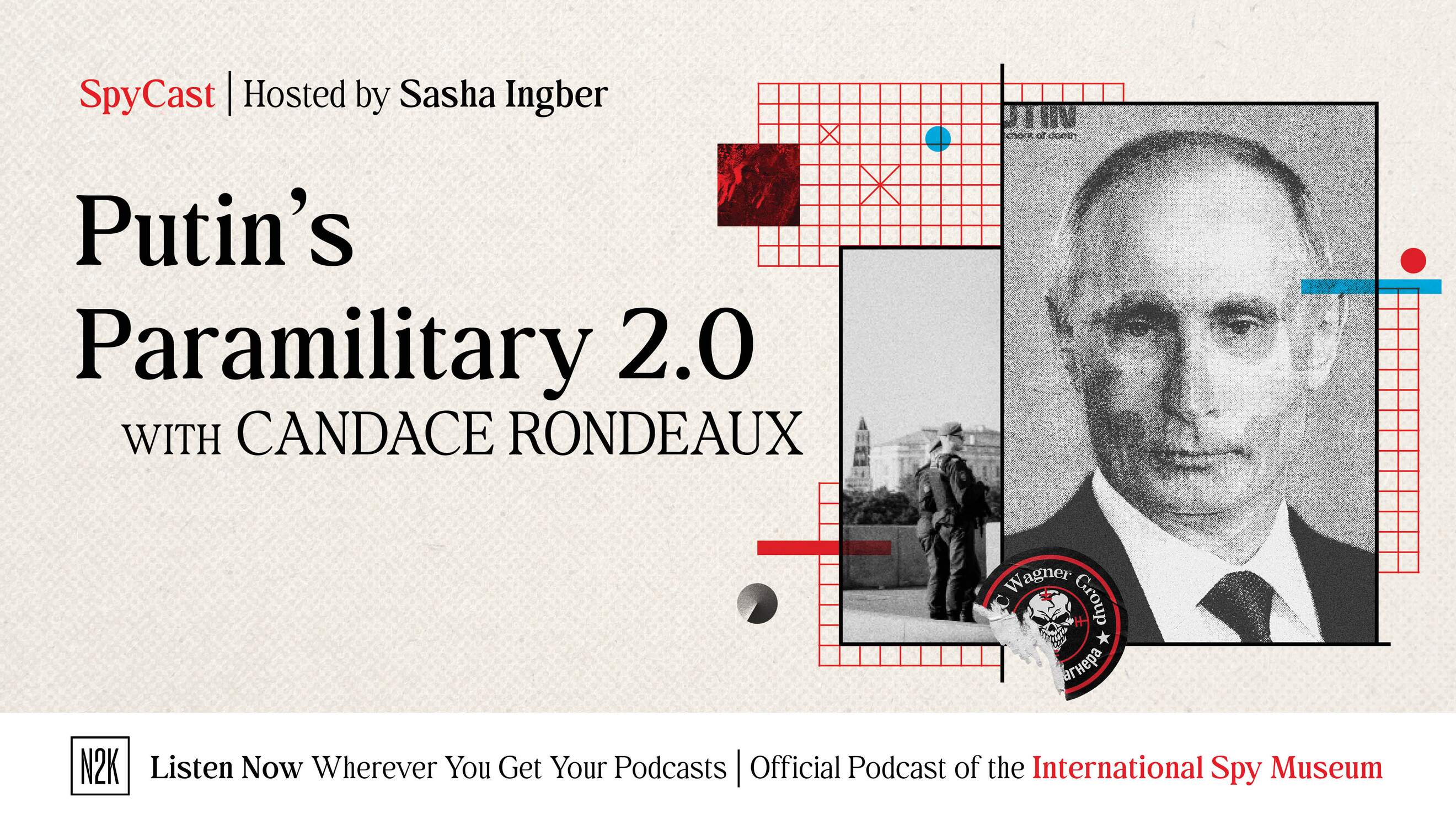


Putin’s Paramilitary 2.0










Sasha Ingber: Welcome to SpyCast, the official podcast of the International Spy Museum. I'm your host, Sasha Ingber, and each week, I take you into the shadows of espionage, intelligence, and covert operations across the globe. Since its emergence in 2014, the Wagner Group operated as the Kremlin's shadow army, deploying mercenaries across Africa and the Middle East. It gave Vladimir Putin plausible deniability, expanding Moscow's geopolitical influence by propping up leaders through military assistance and securing Moscow's economic interest through weapons deals and access to natural resources. UN experts and human rights organizations accused the mercenaries of disappearances, torture, executions, mass graves, rape, pillaging.
And this week, three years ago, its financier and leader, Yevgeny Prigozhin, launched a failed rebellion. Then he died an untimely death, and Putin's security services moved to assert direct control of the paramilitary. I spoke with expert Candace Rondeaux about Wagner's successor, Africa Corps, which has kept the expeditionary force in Africa and Ukraine.
The author of Putin's Sledgehammer: The Wagner Group and Russia's Collapse into Mercenary Chaos, Candace discusses Africa Corps' struggles and conquests as it helps to keep Putin's war machine churning.
Candace, good to see you.
Candace Rondeaux: Good to be here. Thanks for having me.
Sasha Ingber: So let's start by talking about what's happened since 2023 when Yevgeny Prigozhin, the financier and leader of the Wagner Group, dies in this plane explosion after sending his troops toward Moscow in a rebellion.
Since then, how has the GRU and the SVR, Russia's military and overseas intelligence services, sliced and diced what became of the Wagner forces?
Candace Rondeaux: A lot has happened in those three years. I think the first thing to understand is the Wagner Group didn't collapse. It just consolidated really. Of course, after Prigozhin died, everybody was sort of like, "What's gonna happen to these guys?"
And some were funneled into units associated with Rosgvardiya, which is the National Guard of Russia. This was the first volunteer corps. These were largely guys who had sort of distinguished themselves on the battlefield in places like Bakhmut. And then we had a branch that went to Belarus, and their primary mission was to train the special forces of Belarus.
Um, they also serve as training and sort of support forces for deployments out to Africa, and that's, I think, the thing that everybody kind of has paid attention to is Wagner 2.0 in Africa, basically, which is this Africa Corps expeditionary force that falls now very tightly under the remit of the Ministry of Defense, and it's the GRU military intelligence services that is responsible for managing the operations.
SVR, the foreign intelligence service, kind of like our CIA essentially, their remit was to take over a lot of the propaganda operations, all the information operations. So where under Prigozhin it had been sort of one big enterprise, plausible deniability and propaganda and so forth, now it's sort of a division of labor between the GRU that does a lot of the operational combat-related stuff and then the SVR that mostly stays in the information operations.
Sasha Ingber: Now, this is a marked shift from what we saw with the Wagner Group. Putin enjoyed the fact that he had this plausible deniability in so far as these mercenaries were doing his dirty work. In speaking before we sat down, I remember you told me that this was sort of like an experiment that had a Frankenstein quality by summer of 2023 when Prigozhin's plane suddenly explodes in the sky.
But under this new name, Africa Corps, what are some of the most significant similarities and differences?
Candace Rondeaux: So the similarities are, I mean, I, I really would cast this as Wagner 2.0 in Africa. In many ways, you have the same military detachment structures. Um, it's still a brigade size force. So you have guys who are electronic warfare specialists.
You have, you know, people who are doing air defense. You have drone specialists. This is a serious military enterprise. It's not just some, you know, private military company on the small scale. And in some cases, you even have some of the same commanders in charge of detachments that were there before Prigozhin.
And I think the kind of, this idea that it's a special force, that it's unique, it's different than the conventional forces, it's sort of maybe even more elite, maybe more entrepreneurial, that branding is still there in terms of thinking about the Africa Corps. It's kind of held up as this cool thing, right?
So that is the same. The difference is it is, you know, as we mentioned, much more tightly controlled by the Ministry of Defense, and specifically the GRU. And the middleman, the kind of the middle management layer, um, there's a guy named Konstantin Mirzayants, who had been Prigozhin's kind of rival, and he is now-
Sasha Ingber: Was he also once selling hotdogs-
Candace Rondeaux: No
Sasha Ingber: as Prigozhin did?
Candace Rondeaux: Not nearly as talented. He's actually a former VDV specialist. So he's a guy who came up in the military, unlike Prigozhin, who had no military experience. Um-
Sasha Ingber: And was known as Putin's chef.
Candace Rondeaux: That's right, known as Putin's chef for all of his catering expertise. Um-
Sasha Ingber: As one would want for a paramilitary
Candace Rondeaux: Well, you know, it's funny because just before he died actually, he's, you know, Prigozhin said, "They shouldn't have called me Putin's chef, they should've called me Putin's butcher."
Sasha Ingber: Wow.
Candace Rondeaux: Yeah. He was a, he was an interesting character. Yeah. But this middle manager, Mirzayants, is much less interesting. In fact, like he's sort of reviled, I would say, by the, uh, the rank and file because he's just such an ordinary, uh, military guy.
But he is largely sort of in charge of making sure things go on the ground.
Sasha Ingber: Mm-hmm.
Candace Rondeaux: And the other big difference, I would say, is now, um, I think the social contract that Prigozhin offered under the guise of Wagner, it seems like it's been broken on some level. It seems that you're hearing a lot of complaints about sort of how things are being run on the ground. So it's not the same force that it was. It's still powerful.
Sasha Ingber: Obviously, it has gained money and influence on the African continent, but Wagner, I mean, gained some prestige from fighting the long and bloody Battle of Bakhmut in Eastern Ukraine. So when we talk about Africa Corps, what is the tug of war like between what's happening in terms of its operations in Africa versus Ukraine?
Candace Rondeaux: We've seen this tension, this dilemma that the Kremlin has had to wrestle with play out over the last two years. Put simply, Russia needs markets. It needs markets for its oil, um, for its engineering expertise. It has, as a result of this war, lost access to a lot of the world markets, and so Africa became this kind of interesting substitution mechanism for finding new ways to new markets.
The question is, you know, how many do you wanna put in Ukraine, and then how many do you wanna put in Africa?
Sasha Ingber: And I think part of this conversation is actually going to be about the way Ukraine and Africa blend, both on the Russian side and on the Ukrainian side. So if we start in Ukraine, are you seeing these guys in a meat grinder? Are you seeing a pipeline of people who were recruited in Africa now being put on the battlefield in Ukraine?
Candace Rondeaux: Absolutely. I mean, that's been one of the stranger sort of developments I'd say in the last 18 months to two years, is this progressive recruitment of African nationals from Kenya, from South Africa even.
People have been sort of bamboozled into thinking that they're going to get private military security training or be bodyguards, so they're sent off to Moscow, right? And suddenly they find themselves deployed to the front in Ukraine. Um, and we saw a trickle, couple hundred here and there. Now according to figures from Ukraine's special forces, there's about 3,000 Africans.
What this tells us is that Russia's really having a manpower problem, right? If you have to go as far afield as Africa or North Korea to, to fill your ranks, um, it means there's something a little bit wrong with your strategy. You got a manpower problem.
Sasha Ingber: And I do wanna ask, what can we learn from the defectors?
Candace Rondeaux: There was one case in particular that, that I found very striking because this young man, probably in his 20s, you know, late 20s, um, he, like many young men, couldn't find work, thought he would sign up for Africa Corps, right? Um, because you have all these recruitment ads everywhere, on Telegram, around on bus stations, and the offer is pretty simple.
Not only will we pay you a big sign-on bonus, it's about, like, 1 million rubles, uh, which is a lot of money, and then, you know, about 240,000 rubles, so about $2,500 a month. That's a lot of money, too, for a regular Russian. Um, and we will pay off any loans or debts that you have. And, you know, a lot of folks have big debt because they haven't been able to work.
So this guy, he signs up, and he's, he's thinking, "I'm gonna go to Africa Corps. I'm gonna have a soft job, IT." That's what he wants to do in the rear, right? Turns out he's actually deployed into the front line, into, into Donbas, into Ukraine. And of course, that's not at all what he was expecting. Not an IT job.
Instead, it's a human wave meat grinder job, basically, and he defects, and he tells his story. And we, we have learned a lot from what's going on inside Africa Corps, inside the Wagner Group, from these defectors about kind of the way the post-Prigozhin era seems to have kind of broken the social contract, as I mentioned.
Sasha Ingber: And speaking of, uh, the Africa Corps forces who have felt deceived, can we talk about Mali? This is a location where things have gotten pretty dicey for Africa Corps
Candace Rondeaux: I would say Mali is almost like the bellwether, right? It's telling us a lot about where we are right now with the Africa Corps in terms of its development.
Um, just to kind of recap the history very briefly, um, really the deployment started in 2021. This was when Assimi Goïta, who was this military colonel, he and his colleagues mounted a coup, and they were looking to also push the French forces out at the time, and they were having real problems with jihadist insurgency, and they turned to the Russians for support.
And the Russians happened to be the Wagner Group at that time in 2021. So this is just before the start of the war in Ukraine, when for the most part, Prigozhin and friends think that, okay, that's their job. Um, it turns out that actually almost within six months of this new engagement in Mali, the war opens.
And so right away, you have this tension over deployment either in Ukraine or deployment in Mali in the field. And what we see happen is, you know, an escalation of force. Uh, of course, we hear a lot about these massacres, uh, that occur while Russian forces are in the field with Malian forces in places like Moura, very famously, hundreds, of course, massacred there.
And so that's the starting point for thinking about, like, what we've seen unfold in the last six months or so, which of course has been a total disaster for Russian forces.
Sasha Ingber: Because you have been following a little rebellion inside Africa Corps in Mali.
Candace Rondeaux: Yeah. We're fast-forwarding, and Prigozhin's dead. You know, all this house cleaning has happened. Um, GRU intelligence forces are now in charge of everything. And then in the summer of 2024, July, there's this encounter in Tin Zaouatine, which is kind of this remote part of Mali, and Russian forces are schwacked. I mean, there were about eighty guys, eighty-four, I think was the totals of the, uh, casualty count for that.
Um, one of their most notorious commanders was killed, a guy who had been running, uh, a Wagner Group telegram channel that was very famous for many, many years. And this was a moment when I think people on the ground in Wagner, in the Africa Corps, started to realize that maybe the MOD didn't care about them nearly as much.
Um, there were complaints about bodies being in refrigeration for weeks and months before they were sent back home for burial. There was a lot of problems about, you know, hostage-taking apparently. There were a couple guys who were still captive after that confrontation. So that 2024 incident kind of sparked this beginning of decline of morale and I think distrust.
And then fast-forward a little bit further, 2025, I mean, now things are getting very heated. And what's happening on the other side is important to mention, which is that the jihadist forces are getting really good at drone warfare, and where Wagner entered with, you know, pretty much command of the airspace, um, now it's starting to kind of even out.
Sasha Ingber: And we're, we're speaking specifically of the Azawad rebels-
Candace Rondeaux:That's right.
Sasha Ingber: I think, who may, it seems, have support from Ukrainian special forces. And let me just take you back into a moment that I lived in 2024, sitting in an office with a Ukrainian official who, in the middle of our conversation on the intelligence community, has to pick up the phone and talk to someone who's on the ground in Africa about an operation that is having some obstacles, and spends a few minutes very frantically talking to this person, in Ukrainian mind you, and then gets back to me in the midst of our conversation
Candace Rondeaux: We heard, of course, much later from Ukrainian officials themselves saying, "Well, you know, we helped out a little bit with the intelligence.
We gave the Azawad forces the information that they needed to get the job done," was how it was phrased. So it seemed like there were two elements that were perhaps given as support for either that operation or others. One was the drone operations, but two was Starlink. Uh, and as we all know, you know, the Ukrainians are just masters of this technology, kind of combining it all together.
And so there was this idea that maybe, uh, there was Ukrainian special forces on the ground in a place that maybe Russia didn't expect.
Sasha Ingber: This is what I mean by the blending of all of these different groups and locations between Ukraine and Africa. So Africa Corps really has its eyes opened, seeing some losses because of, uh, opposing force in Mali, uh, the fact that the Ministry of Defense is not bringing back corpses swiftly uh, that the hostages are not being negotiated for. That has effect on morale. How does this rebellion take place, and what happens?
Candace Rondeaux: So, um, not that long a- after that, this is now, I'm gonna say early 2025, you know, there are several detachments that are deployed. One detachment, it was the fourth detachment, we don't know a lot, but what we do know is, um, that there was a detachment that refused to fight, basically.
There were complaints about having to pay for food, right? So I think something like $450 a month comes out of your, your salary for food. That was never the case under Wagner. It was kind of a given that you would have food, that you would get your kit, uh, your uniforms, all that would be kind of given to you.
That's part of the contract, basically. Um, now under MOD, there seems to be some shortchanging on that score, so there was complaints about that. Um, there was the combat issue, and it was essentially, it wasn't like an, you know, a shooting war per se, but it was a sort of like, "We're not going out to the field" scenario.
Candace Rondeaux: Um, almost like a mini mutiny, and it lasted probably a few weeks. Um-
Sasha Ingber: I'm sure Prigozhin is looking on with a, a smile on his face.
Candace Rondeaux: Sure. Exactly. Well, he ruled with an iron fist. I mean, one thing that was, I think, a contrast was they had these special security services essentially spying on their own guys, um, and they were very iron-handed about their discipline.
Sasha Ingber: Did these guys get to continue their work? Were they punished? Are they still alive?
Candace Rondeaux: Well, that's a tricky question because I think we don't, we honestly don't know. Um, I know that some were deployed back home, um, but we don't really know s- a lot of the specifics about sort of what the punishment was.
That's one thing that hasn't changed is kind of the, this ultra-paranoid secrecy culture of, of Russia.
Sasha Ingber: So where in Africa is Africa Corps doing well with its hosts?
Candace Rondeaux: Well, it's doing very well in Central African Republic. Um, but that's because that is, I guess, by far, it's almost like the, the very first McDonald's, is the best way, you know, if you think about it, is like this is where we had our very first McDonald's store. Uh, because that's really where Wagner kind of built its muscle, it built its brand.
Sasha Ingber: Back to the food analogies.
Candace Rondeaux: Yes. Mm-hmm.
Sasha Ingber: This whole episode is really just all about-
Candace Rondeaux: It's all about food ...
Sasha Ingber: hot dogs- ... chefs, caterers, and McDonald's.
Candace Rondeaux: That's right.
Sasha Ingber: I mean, this is-
Candace Rondeaux: But it is a franchise. It was always a franchise model. Right. So I think the, the Central African Re- Republic was an interesting franchise because it blended all of the things that worked really well.
Sasha Ingber: Now, we've talked about Africa Corps in Ukraine, in Africa, but they're also in the water. And this comes down to a history that traces back to security firms that helped to traverse waters that were riddled with piracy back in the '90s, the early 2000s. So let's fast-forward to today and the fact that Africa Corps mercenaries have been reportedly found on ships in part of Russia's shadow fleet, which is essentially this armada of old tankers that are secretly carrying oil and gas to evade international sanctions.
What are you looking at? What's important when we think about vessels or routes that are being taken and the nexus between the shadow fleet and Africa Corps?
Candace Rondeaux: Yeah. So this is really important to understand, which is we almost have a conveyor belt effect. We have Russian forces in Africa, right, affiliated with the Africa Corps.
Many of them are former Wagner guys. Then we have Russian forces in Ukraine on the eastern side. Um, again, many of them affiliates of the Prigozhin-era Wagner. Um, and then of course, we see increasingly these interdictions, right? So you might remember there was this incident with the Bella One, which was this big oil tanker that moved- And
Sasha Ingber: this was in early January of this year.
Candace Rondeaux: Right. This was early January of 2026. Um, it was actually over the Christmas holiday, um, that this kind of all unfolded basically, and this ship was moving from Venezuela. It was loitering there. There were a few Russian ships, and then as part of the sort of US interdiction there, US forces, Coast Guard chased this boat, um, all the way up to near Iceland, this kind of far reach of Iceland and, and Scottish waters, and boarded the ship.
And it turned out that a few of the guys on board might have worked for Moran Security Group, which was a predecessor of what we know today as the Wagner Group. Moran Security Group is a legitimate private military company. Um, they're technically registered in Hong Kong, but they are basically an arm of the Russian state.
They're always deployed with, um, big energy companies, big shipping companies. So then they take the captain, um, you know, into custody, and the first mate. They discover that most of the crew are Russian and Ukrainian. They discover, after interviewing all the crew members, that the first mate and the captain had been basically on the phone the entire time getting directions from a guy named Kirill uh, we don't know who Kirill is, but the assumption is that he was a GRU contact that was basically telling the shipmate, "Look, keep moving."
And of course, very famously, they paint a flag on the side because they don't have a flag
Sasha Ingber: And this, the vessel even changes names
Candace Rondeaux: Changes names, changes ownership. Um, turns out that it had been also working as a tanker for the IRGC, the Iranian, uh, Revolutionary Guard Corps even before, so it was just sort of a weird story.
But of course, we later learn a lot of these oil tankers, there's just a lot of crossover between the Iranian brokers who deal in shadow fleet oil and Russian brokers And that's why I think we're starting to see now in France we've had an interdiction where a couple of Moran security guys were found on board.
I think in Sweden there have been three or four interdictions in the last month or so. So we are starting to see kind of an escalation of force at sea, and of course, the Ukrainians are right there, too.
Sasha Ingber: What exactly is it that they're doing on these ships as they are helping to transport these illicit goods?
Candace Rondeaux: It's important to understand that these are lifers. Okay? These are guys who entered the Wagner Group probably in their 20s. They might have been in the special forces even before that. So these are guys who really, they're in the life, so to speak, and they do a tour in Wagner, and then all of this political, you know, um, shenanigans happens, and then it becomes Africa Corps.
They do a tour with Africa Corps, and eventually, you know, they run out of work. Um, or for whatever reasons, they deploy home, and when they want to deploy again, they're deployed out now to the Shadow Fleet under the guise of this contract with the Moran Security Group, providing top cover security for Russian shipping operations for decades now.
So this is sort of a natural... It's, it's a little bit of a pipeline situation. They're kind of like onboard, uh, inside spies, and then, um, there has been some intimation that they've been running surveillance and sabotage operations, particularly in the Baltic region. And so the mission is threefold: spy on their own guys, spy on the targets in NATO, and report back, basically.
Sasha Ingber: And of course, there's also the allegations of cable cutting that we've seen from, um, was it the Eagle S?
Candace Rondeaux: That's right, the Eagle S in Finland. Now, that case was very curious because ultimately, they held the crew and the ship, um, for a good six, seven months, and they decided that they couldn't really find evidence of direct intent to cut the cable.So it was a little bit confusing.
Sasha Ingber: It also led to, uh, a Helsinki district court ruling that they didn't have jurisdiction.
Candace Rondeaux:That's right.
Sasha Ingber: And then according to a report I read, the Finnish state then had to pay the defendant's legal fees.
Candace Rondeaux: That's right. I mean, this is one of the challenges with what's happening now with the Shadow Fleet, which is if you interdict a tanker, let's say you board it because it's flying a false flag or something's wrong with it that, uh, you know, that might be a challenge for the environment, or it's, you know, going too close to something, um, you have to be ready for what comes after that.
You, you, you board the ship, and maybe you take the guys off the ship, and maybe they're in the clink for a little while in prison, but then what do you do with the ship? Right? It's really expensive to keep a big oil tanker that's in pretty poor condition just sort of in your, in your ports. And so I think one of the challenges, not just for the Finns, but I mean, for everybody in the Baltic, is, well, what do we do with this?
We have now, as an example, three of these, uh, ships, including the Bella 1, now in Port- in Puerto Rico, that are just sort of sitting there, um, waiting for some disposition from the courts as to, like, whose property is this?
Sasha Ingber: At the same time, we see the Ukrainians are taking matters into their own hands when it comes to the shadow fleet. Um, Ukrainians in Libya attacking a Russian tanker in the Mediterranean back in March.
Candace Rondeaux: Yeah. What's important to understand about the Ukrainians that I don't think really has come through as clearly as it needs to, for the Ukrainians, this is a world war. They see Russia, um, as a superpower, um, and you know, it's maybe a second degree superpower, but it is nonetheless a great power, and they're hitting Russia at every point that they can inside Russia, right? We've been seeing, of course, the attacks on the energy infrastructure, on the military industrial complex, incr- increasingly much more successful long range attacks. And then we've seen the targeting of oil tankers in the Mediterranean, very unusual cases.
Sasha Ingber: And what exactly are they doing in these cases?
Candace Rondeaux: In these cases, I mean, what has become very clear is that initially there seems to have been some coordination with US intelligence and the Ukrainians targeting these ships, uh-
Sasha Ingber: With drones.
Candace Rondeaux: With drones. With underwater drones, and sometimes over, right? Um, we've seen at least six or seven now oil tankers taken out. Now, initially, um, some of this was in the Baltic region, nothing unusual, or in the Black Sea. Again, that's kind of like within bounds, right? But it was when we started to see two, three ships being taken out in the eastern Mediterranean, that's when you knew that this level of coordination between the US and the Ukrainians was happening in a, in a kind of new way, and that the Ukrainians understood, um, in a way that the, the gloves were coming off.
Sasha Ingber: So when we think about the former Africa Corps Wagner guys on these vessels, are they taking that into account? How much awareness do they have and, and preparation do we think they take when it comes to the threat that the Ukrainians are posing, which goes beyond what the Finns and, and the US and so many others have done, which is chase you, board you, and bring you to court?
Candace Rondeaux: Well, you, you have to imagine, as I said, that anybody who's on board working for the Moran Security Group now has probably a multi-fold mission, right? Some of it is dealing with these Western interdictions, um, but some of it is reporting back to Moscow what, what they're seeing and what they're hearing.
Um, and of course, when you go on these long missions, these tankers run for months at a time, right? That's one piece. But as you might know, we have seen, I'd say in the last three months, four months, a lot more naval escorts from Russia, especially in the Baltic. Um, and this is where it's getting really dicey, and I, I can only imagine that essentially one role that these ex-Wagner guys have is communicating to, you know, the naval support escorts that are, um, trailing behind for some of these oil shipments.
Now, the question is, is it just oil shipments, or is there something else on board?
Sasha Ingber: I would like to know that. What do you think?
Candace Rondeaux: Curious minds would like to know. Um, I think there's a lot of supposition that there are valuable things on board, potentially weapons, as an example. We've seen some reporting about sort of uranium, for instance, being, um, transited And importantly, gold.
Um, I think that's one thing that probably bears watching is to what extent are we seeing more than just oil, uh, on some of these ships? And of course, there are cargo ships that have been escorted as well, not just oil tankers, but, you know, real cargo ships moving in and around even English territory w- waters, um, that have seen naval escorts from Russia deployed.
Sasha Ingber: When you talk about uranium and the alliances with the Iranians and the fact that the Islamic Revolutionary Guard Corps has links to Russia's shadow fleet, that, that is particularly concerning. But of course, all of the natural resources and what it can provide to these, uh, governments is of concern.
When we come back, where the paramilitary is expanding and what Putin may think of Africa Corps
Behind the scenes, do you think that Putin is grateful for what Africa Corps is doing, or he's frustrated that they've run into challenges in places like Mali?
Candace Rondeaux: I don't think he's frustrated. I think, um, If you really think about the African experiment, it started in 2016. Uh, so it's been, it's a decade now of, you know, progressive penetration of the African continent for the purpose of power projection, for the purpose of, you know, opening markets, um, making a more durable relationship.
It's for sanctions evasion. I, I don't think Putin is the kind of guy to be troubled by a few stumbles on the battlefield, 'cause if he were, I mean, we'd be in a different situation when it comes to Ukraine.
Sasha Ingber: But what about the Russian people?
Candace Rondeaux: Well, that's an interesting question. You know, the Russian people now are much more engaged with the conversation about, I think, what's happening in Ukraine than they were a year ago, um, because of course, Ukraine has been very successful in sort of these pinprick, uh, attacks deep inside of Russia on military targets, on energy infrastructure.
I think they're more fixed on that than they are Africa Corps. Those though with family members who are in the military, and there are a lot of them, they may have a different view. I mean, we did hear, um, especially after that 2024 engagement, a lot of complaints from family members. They're concerned that maybe Africa Corps was being kind of, um, deceptively sold as this kind of, this soft means of doing military service.
But I don't think it's front of mind for a lot of people necessarily.
Sasha Ingber: And that leads me to the next question of whether or not US intelligence agencies are keeping watch of what Africa Corps is up to.
Candace Rondeaux: I don't think so. I think that this administration, the Trump administration, has completely depleted the capacity of our US intelligence forces to do any work on the Russia file, frankly, and has done so purposely.
And at every level, Russian specialists have been taken out, um, or sidelined or isolated or fired, and that's a huge loss of expertise, and frankly, it doesn't seem to be a priority for this administration.
Sasha Ingber: But when we talk about how US intelligence is aiding Ukrainian forces in some of these operations to sabotage Africa Corps or Russia's shadow fleet, the CIA still works on Russia.
Candace Rondeaux: That's true. I mean, I do think that what's interesting is, as with all wars, right, as with all sort of military engagements that go on, you tend to see the intelligence services and, and security services more generally, they have internal kind of camps, right?
Those who are kind of like pro-hawk, um, those who are like lean back, and I do think we see that playing out a little. There's a lot of things that we just don't know. What I do think is that there are some elements within our intelligence services that fully understand that the adversarial nature of the relationship between Russia and Iran and the United States is increasingly more integrated.
Um, I think that there are people in the Pentagon who understand that even if it's not lockstep coordination between Tehran and Moscow, or Beijing for that matter, that there are mixed incentives that keep everybody kind of moving in the same direction. You see a mutual incentive between Iran and Russia, um, and increasingly China, and of course North Korea.
And I do think that our security forces, our intelligence forces fully understand that that is a problem that they need to address. Whether they have permission from the top, you know, from the White House to really do it and go at the problem, I think that's anybody's guess.
Sasha Ingber: So if the United States intelligence community isn't prioritizing Russia's paramilitaries or, or Russia at all does Africa Corps get degraded country by country when civilians or new leadership decides that it's had enough?
Where do you see all of this going?
Candace Rondeaux: Yeah, that's a great question. It- it's been interesting because the ambition of Africa Corps has always been to kind of grow to about 20,000 to 40,000, right? That's big. That's a couple brigades, basically. Um, maybe a division essentially. But it hasn't reached that. It's only 5,000, 6,000 maybe maximum.
And I would argue that while the war in Ukraine continues, it will be very hard for Russia to achieve the scale that they originally had in mind for the Africa Corps. They're having manpower problems at every level. They can't even really staff their own factories. They've got to import people from Africa, um, to build their drones, as an example.
Sasha Ingber: It's like a really kind of sad silver lining to the war in Ukraine, and it leads to the question of when that war does conclude someday-
Candace Rondeaux: Mm ...
Sasha Ingber: what comes next?
Candace Rondeaux: Yeah. Well, you know, we're seeing it play out. If you read, you know, the local daily news of St. Petersburg or Moscow or, you know, Vladivostok, you, you're hearing these tremendously terrible stories about Wagner guys who are either deployed in Eastern Ukraine, uh, in places like Bakhmut, the meat grinder, or in Africa, coming back.
They've got extreme PTSD. Some of them are former prisoners. So this is, this is not exactly the, you know, the cream of the crop socially. From the start, you're dealing with some pretty rough talent, and then they go and have these really traumatic experiences on the battlefield. I mean, really extreme.
They come back home, and guess what happens? Um, maybe they don't find work or maybe they do, but they're drinking a lot. You're hearing awful stories about, you know, domestic violence, fights in the street, assassinations. What's interesting about it is this is exactly what happened after Afghanistan, and it is exactly those guys from the Afghanistan days back in the '70s and '80s who are redeploying back, extreme PTSD, and guess who became the new leaders of the Wagner Group?
It was those guys. And so I think what we're gonna see is kind of a repeat cycle, rinse, wash, repeat. But many wars go like this. You get tens of thousands of guys who go through really traumatic experiences. They come back. There's no social services for them. Um, then you have to deal with the violence that comes after.
Sasha Ingber: The violence with the corruption of the, uh, regime and where does that lead, but it all goes full circle.
Candace Rondeaux: Yep.
Sasha Ingber: Candace, it's been a really fascinating conversation, incredibly educational conversation. Thank you so much.
Candace Rondeaux: Thanks for having me, Sasha.
Sasha Ingber: Thanks for listening to this episode of SpyCast. If you like the episode, give us a follow on Apple, Spotify, or wherever you get your podcasts, and leave us a rating or review.It really helps. If you have any feedback or you wanna hear about a particular topic, you can reach us by email at spycast@spymuseum.org. I'm your host, Sasha Ingber, and this show is brought to you by N2K Networks, Goat Rodeo, and the International Spy Museum in Washington, DC.



