
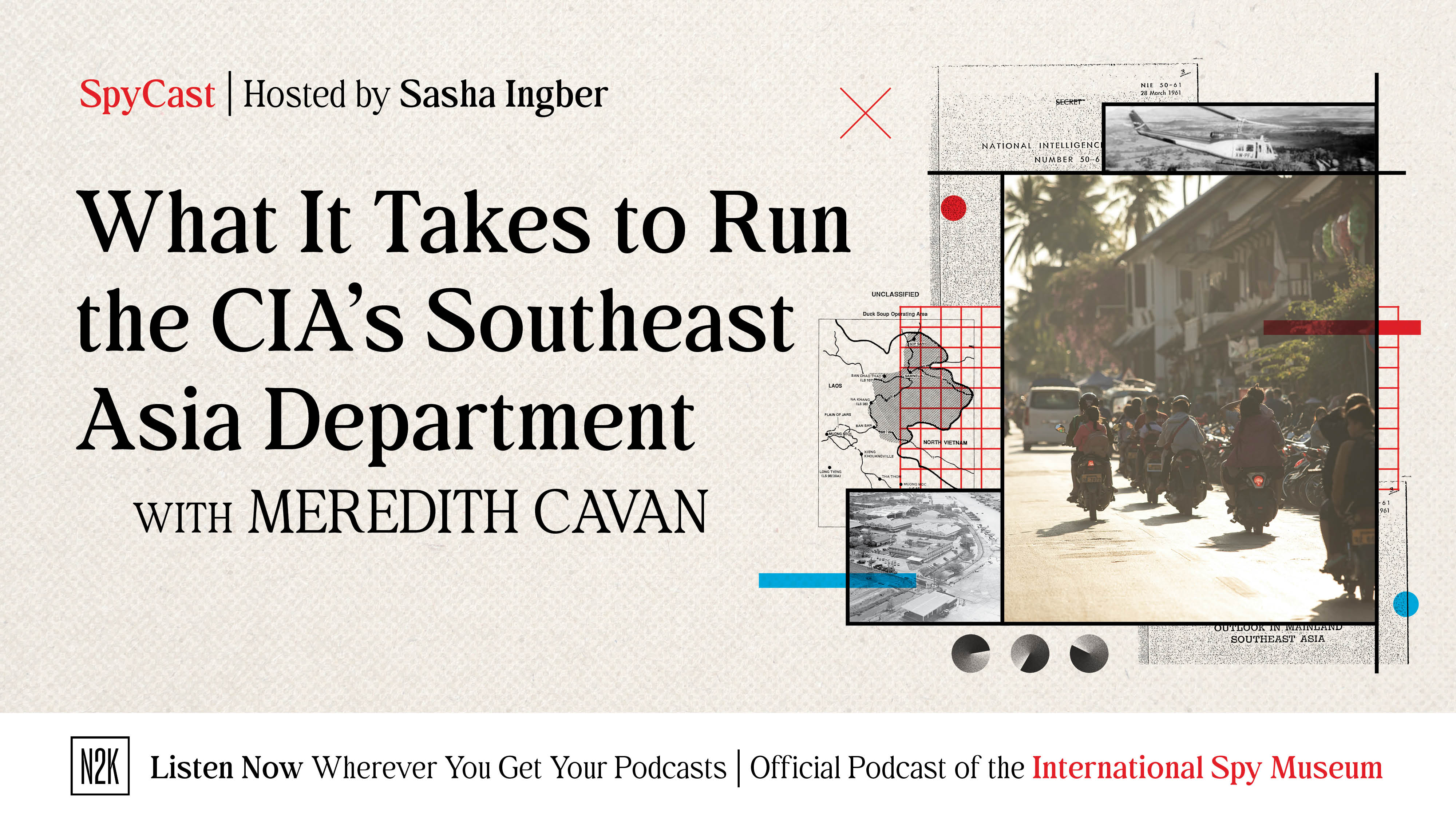


What It Takes to Run the CIA's Southeast Asia Department










Sasha Ingber: Welcome to SpyCast, the official podcast of the International Spy Museum. I'm your host, Sasha Ingber, and each week, I take you into the shadows of espionage, intelligence, and covert operations across the globe.
You might find Meredith Cavin performing in an Irish pub. But long before her first album dropped, she clocked more than 20 years in the CIA. One of those jobs was as Southeast Asia Department chief, where she oversaw covert action, intelligence operations, and analysis across 30 countries. We're talking about the years 2021 to 2023. Terrorism was taking a backseat to strategic competition, and her priority was trying to thwart China's influence and infrastructure in its most consequential playground.
Meredith, thank you for coming on.
Meredith Cavan: Thanks for having me. I'm excited to be here today.
Sasha Ingber: I'm excited to have you. So before we get into this incredibly important job that you had leading the Southeast Asia division, how did you get into the intelligence community?
Meredith Cavan: It's kind of funny. I was a religion major at the College of William & Mary, and thought I wanted to be a social worker or a musician.
And I was walking through a career fair, and there was this cool table that had glow-in-the-dark bouncy globe balls, and I decided that I was going to get as much merch as I could get at the career fair. Um, and a big picture of satellites and tanks, and I stole the toy. Trying to escape, the guy makes eye contact with me, starts talking to me.
I felt a little guilty because I stole his toy. So I proceeded to, like, politely have conversation with him, and he asked me, like, "Had, did you ever studied overseas, studied foreign languages?" And I was like, "Yeah, I just studied abroad in the Palestinian territories, spoke some Arabic." He's like, "Give me your resume."
So I did, 'cause I felt guilty that I stole his toy. Didn't think anything of it for a couple months. Couple months later, get an interview to be an imagery analyst, which, for an organization called the National Imagery and Mapping Agency. It was the precursor to the National Geospatial-Intelligence Agency.
And I went to the interview and answered some questions, and couple months later, again, right before I graduated in the spring of 2001, I get this FedEx envelope delivered to my sorority house, um, a- at William & Mary that says, "We're offering you a GS-8 government job as an imagery analyst, um, and you could start in a couple months."
And I called my war-protesting hippie dad and was like, "I shouldn't go work for the intelligence community, should I?" And he paused for, like, a really long amount of time, and then looks up at me and says, "As far as I'm tracking, it's the only job offer that you have."
Sasha Ingber: And it all started because of a stolen toy.
Meredith Cavan: Stolen toy. Yes.
Sasha Ingber: That is so, such a fun story. So then as much as your career matters and all of its twists and turns, you're here to talk about leading the premier intelligence agency's Southeast Asia department. What is a day like in that job?
Meredith Cavan: It's a fascinating job because you get to see all aspects of the intelligence cycle, so from the collection side to the policy side and the analysis side.
So I would start the day, you know, reading the latest analysis from that morning. So what did my analysts write the day before about these current developments in our region? Then I would often be the one that CIA would send to represent us at policy meetings at the White House and the National Security Council.
So I would go, um, and be the CIA representative at the table with folks from State Department, DOD, other policy agencies as our decision-makers were making big decisions on, should we engage with this country? Should we give money here? Should we be demarching someone? What, what's the, the next steps in the policy?
And my role in those meetings was to provide the intelligence update and our context and our analytic contributions. To help them make better decisions and give them that decision-making advantage. And so then I could go back to our analysts and say, "These are the questions that they really need answered."
But sometimes the analysts themselves don't have the information they need to answer those key intelligence questions, and so that's when m- my job switched more to the driving collection, and what kind of resources do we need to understand this better, whether it's we need SIGINT, signals intelligence from NSA, we need better open-source information, or we need more clandestine reporting from our spies in the field to give us the information that we need.
And then all of our overseas case officers who were collecting that information, they also fell under our department. So then to really shape the, the operational collection of w- who do we need to recruit? Who out there has this information, and how do we get access to them? And then how do we convince them to give us this information?
And sometimes then the covert action side as well, and the support side, these case officers need places to work from. Uh, and so we're looking at 30 countries, so at any given day, too, we could be talking about a Pacific island. We could be talking about Australia and New Zealand, uh, were under my department as well.
So everything from our allied partners to tiny countries in the Pacific.
Sasha Ingber: Now, one of the main responsibilities of this role was identifying gaps in intelligence. Were you seeing many gaps, and if so, why?
Meredith Cavan: Yeah, so I would say yes. Uh, and it's key role in the job, and one of the things, after 9/11, we went all in on counterterrorism in Southeast Asia, like we did across the rest of the world.
And so when I got to the job in, in 2021, at that point, you know, counterterrorism was still important, but we were realizing that great power competition and the rise of China was really the critical national security issue in that region at this point. And Southeast Asia was the playground for all of that to happen.
It was where the Chinese were operating, where we were operating, and the policymakers wanted to know, what is China doing? What are other players in the region doing? And a lot of our infrastructure was still counterterrorism-focused, and so we really had to look and see, how do we change our posture in the region to really go after what is the, the critical threat and the critical intelligence question of our time?
Sasha Ingber: So what you're saying is that the agency had prioritized counterterrorism, and so the region had to really shift priority to the threat of China. And I'm interested in understanding whether there were growing pains in doing that because you ended up establishing some new CIA bases in the region.
Meredith Cavan: Yeah, so one of the things that we realized was especially in the Pacific Islands area, that was an area where China was v- very interested in operating and investing economically, expanding military presence.
And for a long time, this was an area that we did not pay much attention to. These are tiny, bitty countries in the middle of the ocean. There was not a counterterrorism angle to them as much, but we realized that especially when you start looking at war plans and how we would fight in a conflict vis-à-vis China, that Pacific area was really important.
And when you start thinking about, how do you get to these places, and how do you build the relationships there, and how does the US get a foothold in there with our partners, we realized that doing that from afar and via our allied partners and going every now and then and visiting on trips was not going to be enough, that we needed a physical presence in the area.
And so one of the things that we started to do when I was in that role was think about, how do we build out a new posture in that area, and how do we build out new offices in some of these Pacific Islands countries and create places on the ground there for us to operate out of?
Sasha Ingber: So what does that entail?
And I do note the distinction between the way the US military perceived these islands versus the CIA in those years before.
Meredith Cavan: A lot of it entails relationship building and logistics. It was, you know, working with these host countries to say, "How do we better support you from an intelligence perspective? What kind of information do you need? What kind of partnerships do you need with us to understand the threat in your area?" But it also involves a lot of logistical wrangling of everything from budgets to how do you build out a facility in a place that you've never had a facility before, to what kind of airplane could go from island to island, and how do you get one of those airplanes, and how do you fuel it but keep it small?
And so it was all of a sudden, as someone that grew up in our Directorate of Analysis, I got a crash course in, "So you wanna build a new CIA office." Like, how do you do that, and especially how do you do that on a itty-bitty island that has flights going to it three days a week
Sasha Ingber: And, and what is the outreach like?
I mean, are you just making a phone call? "By the way, um, we would like to create a CIA post here."
Meredith Cavan: Most of it was, um, we, we had established relationships, and so I think a lot of it was working with the established relationships we had, but rather than, you know, meeting with partners once a year or seeing them in kind of group settings, it was, "Okay, what do we really need?"
Like, like, if, if you're going to understand this threat, if we're going to partner more closely in your area, what does that look like, and what kind of capabilities can we help you with? And, you know-
Sasha Ingber: And did they always want this relationship to proceed by the fact that there would be a physical presence on the ground in the form of a building or real infrastructure?
Were there some places where they didn't really want the CIA to have an established presence?
Meredith Cavan: There were places that were more receptive, and there were places that were less receptive. We ended up going to the places that were more receptive, so this was a situation where we really truly wanted to partner in the region.
And so we worked with partners that were receptive to us being there and could really see an advantage to what we could bring to the table. In terms of their visibility of what was happening in the region, if you look, like, this is like vast maritime areas, and we brought maritime domain awareness. We brought training.
We brought the ability for them to really understand at a deeper level what was going on there, and we brought resources and experts. And so for the most part, our partners were very receptive to this.
Sasha Ingber: Because they saw the value in countering China.
Meredith Cavan: Exactly
Sasha Ingber: And I'm thinking about the US Embassy in Moscow, which the Soviets had bugged.
How difficult was it to make sure that the materials coming in, the labor to construct these facilities was sound? Did you ever wake up at night wondering if it was really being done right?
Meredith Cavan: Well, it was the first time I really gave it much thought. You know, like other than going to the museum here, you could see at the CIA Museum the seal that the, they put behind the-
Sasha Ingber: I want the HGTV, like, spy-like show where they're establishing a base. I want that show.
Meredith Cavan: Yeah. Like the, the, the, what, what kind of insulation and soundproofing do you need on the walls, and how do you get that soundproofing to an island in the middle of the Pacific? Um, and…
Sasha Ingber: Right. You bring in, bring in your glass, your special glass
Meredith Cavan: We have experts that do everything from the how do you soundproof, how do you get the right music to play so that the things are soundproof?
How do you get this materiel and the construction people needed that are cleared, that are able to do this kind of work? So there is a whole leg of logistics that is involved in this that I think even just the average person at the CIA does not know that happens. And I say this about across our directorate of support, you know, everything that you need to make an organization run, whether it's HR professionals or accountants or firefighters or building security people, we have all of those, too.
All of those lines of work that any big organization needs, we have those people, except that their jobs are, like, 10 times harder because oftentimes they have to do it secretly. They have to do it where the supply chain is not tracked back to us. They have to do it where no one knows what the final destination is, and thinking about the suppliers, they have to keep identities of people hidden.
And so if you just, like, take any one of those jobs I just mentioned or any other dozens of other roles that we take for granted often, it requires a lot of creativity and a lot of really fancy problem-solving and people that are willing to take unusual approaches to certain issues like that.
Sasha Ingber: What about when you have operatives on the ground now that these locations are up and running?
Did you see the results of that in the time that you were in this role or thereafter? Because, of course, the issue at play are not just the Chinese security agreements, but the potential military access, undersea cables, their political influence, information operations
Meredith Cavan: Our increased focus on the region certainly has paid dividends.
When I left the job in 2023, it was still taking off at that point, but already just the in- increase in relationships as you're partnering with these countries in general to build out the spaces and to build, to bring people there. Already you're having a lot more dialogue than you would've had beforehand, and I think our situational understanding and our ability to answer the policymaker questions about what was going on was informed substantially just by the fact that we were on the ground a lot more and more engaged in the region.
Sasha Ingber: When we come back, how Meredith built relationships with countries in the region, and China's recent long-range missile test in the South Pacific.
So what did it look like to try to stem Chinese influence, the growing number of ports that we now know exist today, the technology that they were trying to have other countries invest in?
Meredith Cavan: So across the region, especially in Southeast Asia, but we see it worldwide, the, the Chinese are using their economic power, their military capabilities, their willingness to finance if- infrastructure projects to gain footholds and influence across Southeast Asia.
And one of the things that we did, especially at the CIA and especially in this region, is something called intelligence diplomacy, where we were able to provide intelligence analysis to senior levels of these governments across the region quietly. So not, this is not a formal State Department briefing.
It's not military to military, but to quietly go and meet with the highest government officials and show them our intelligence and show them, "This is what the Chinese may be saying to you about what's happening, but this is what we're actually seeing on the ground, and this is, from our intelligence reporting, what the true picture of what's happening is."
And that intelligence diplomacy proved to be really effective at opening eyes and providing evidence to things that oftentimes were just said in big, broad terms, the Chinese influence, they're trying to do this. Everything from, you know, Huawei technology. At that time, the Chinese were rolling out 5G across the region with Huawei and offering really good deals and, "We'll pay for all of your 5G infrastructure."
But there's a huge tale to that and a massive security and privacy and counterintelligence implications to that. And so that was one of the examples where we were able to go and talk to these governments about what are the implications of taking the Chinese offers on Huawei, and what does that look like, and what does that mean for your security and your country down the line?
Sasha Ingber: If we're talking about places that the CIA did not pay close attention to, and you're meeting with a president, a prime minister, maybe a defense minister or an intel chief, how do you decide what intelligence you are going to share with them? We're not talking about the Five Eyes here.
Meredith Cavan: Anytime you're doing intelligence releases or on a one-on-one liaison foreign partner capacity, you're balancing, like, what is the minimal amount of information that we could give that's going to convey the point with the level of clarity that it needs to be conveyed with the, how do we protect our sources and methods for the future?
And so that is always how we balance it. And oftentimes, you just need the analytic judgment. You don't necessarily need to show that evidence that might be derived from HUMINT reporting or SIGINT reporting, and you could just say, "Based on intelligence reporting, this is what our judgment is." Sometimes that's not enough, and you have to know who you're briefing and who the customer is and what you're trying to get them to do.
If it-- If you're talking to the prime minister and they're making a big decision that is based off of this, they're probably gonna wanna see more evidence. And then in that case, is it, do you show them satellite imagery? Do you show them things that could be based off of more exquisite information, but the evidence that you're showing Is less sensitive than that exquisite information, but still enough to make the case.
And so the declassification process is an art, but you do want to be able to show enough that your case is compelling.
Sasha Ingber: Did you find, since we started out this conversation by talking about 9/11, that it was harder to get these countries to believe what you were sharing with them when the United States entered Iraq based on faulty intelligence?
Meredith Cavan: There's been a lot of retrospect thinking, uh, since the, the Iraq WMD situation, and we've changed a lot of the way that we do intelligence analysis and collection based off of that. But that is, it's a cloud over our intelligence analysis. I think it-
Sasha Ingber: It was over these islands in the South Pacific?
Meredith Cavan: I, I didn't see that as much.
We'd send our best analysts. We would get the best person with the most expertise and credibility, uh, to do, to do this, especially for these high-level briefings.
Sasha Ingber: And how often would you have to go back to the same person or the same place to make your case? You had brought up Huawei, China's giant telecommunications firm that did have surveillance, counterintelligence, and all kinds of other problems, threats attached to it.
Was it difficult once you provided the intelligence to really get the recipients to believe you? Because there are countries in the region who have purchased Huawei, and they have made agreements with the Chinese, and they have, uh, pushed back on recognizing Taiwan.
Meredith Cavan: Yeah. It's a constant conversation. I think the way you'd love it to happen is you go in, you fly in, you give one fantastic briefing that is so compelling, and then all of a sudden overnight a country changes its mind on a major policy in favor of what we would like them to do, and that is the end.
In reality, it is a series of conversations, or it's a, "Hey, you brief this one person in the government," and they say, "Well, the real decision-maker is this person. So-and-so also needs to hear this briefing." Or it buys you time, or you may not get everything that you are recommending or want, but it will change the way that they think about it, or if they're about to engage with the Chinese anyway.
A lot of these countries really didn't have other options. It wasn't go with Huawei or go with a similar priced thing that was available to you right now that you can implement, but it allowed them to write better contracts, ask better questions. You know, if, if the Chinese wanted to establish a commercial port in your country, these are the questions that you should be asking them before you let the Chinese establish even a small commercial presence.
Because we've seen in other countries how a small commercial presence turns into a naval base. And so as you're deciding a contract or as you're asking these questions, as you're negotiating, keep these things in mind. So oftentimes that was a realistic expectation for how those meetings went.
Sasha Ingber: Now, some of this work also involved wining and dining Southeast Asian officials.
I know that you have this Irish band. You're a fan of karaoke. Let's get your best story.
Meredith Cavan: Yes. So i- in the Southeast Asia department, I was responsible for managing our liaison-based relationships, mostly in Washington, but also when I would travel overseas. And you'd bring in these foreign partners for some very official meetings, and you'd give them the briefings in our headquarters, and they all went fine.
I feel like most of the real work happened after the fact. And again, these are Southeast Asian partners. Southeast Asians and Meredith both love karaoke very much. And we would do a lot of karaoke where a lot more business would happen. And as you mentioned, I'm in this Irish band, which is made up of three spies and a high school Spanish teacher.
Sasha Ingber: Of course it is.
Meredith Cavan: Of course it is. And I, I was always-
Sasha Ingber: The Spanish teacher was definitely a NOC, but-
Meredith Cavan: Yes. No, no one believes her that she's just a Spanish teacher
Sasha Ingber: Right. And that's non-official cover for all of the people who-
Meredith Cavan: But because I, I have no shame, I'm willing to pick up that microphone. I was always the one that was like, "Meredith, you need to get...
We can't leave until we sing some songs, or we c- " And so I, I have sung Like a Virgin with an 80-year-old head of a Southeast Asian intelligence service. I've, you know, s- like, t- uh, had a bunch of people holding my hand singing We Are the World together. And so it would be these very awkward situations.
Generally, I was often the only woman in the room, but I, I feel like people let their... Like, when you're singing karaoke, you're vulnerable. You're all-- you're singing Madonna with, you know- someone that has no business singing Madonna. And, and all of a sudden, people's inhibitions aren't there, and their willingness to just kind of look at things from a different perspective.
And so whether it was We Are the World or the Dirty Dancing, "Now I've had the time of your life," it's a great duet. Always draws people in. And so that's where a lot of the work happened.
Sasha Ingber: You know, I'm remembering this, uh, article that I read years ago about the, uh, My Way killings, when people, uh, would sing a Frank Sinatra song.
Meredith Cavan: They all love My Way.
Sasha Ingber: I mean, it's, it's, it's a real thing.
Meredith Cavan: And, and, and there's a whole world about who gets to sing My Way, if that's what you're referring to. Because generally everyone wants to sing My Way, and generally it's, like, the seniormost guy gets first dibs at singing My Way.
Sasha Ingber: Right. And there were a string of killings in the Philippines over disagreements having to do with this song- reportedly. So, I mean, my memory of karaoke and being vulnerable is singing My Humps in Berlin- ... except they called it Mein Schwanz- ... which means tail, and I'm still scarred. I don't know if I've done karaoke since then, so you're right, it does create some vulnerability, and but I wasn't necessarily countering China when I was doing it.
Meredith Cavan: No, I was doing it for such a, an important purpose for our country, and the one thing I would always roll out with My Way is that my grandmother grew up next door to Frank Sinatra, and my great-grandmother was the person who actually delivered him when his mother went into labor.
Sasha Ingber: I mean- why didn't...
Why, why aren't you related to him then?
Meredith Cavan: Right. You know, I... Like, he and my grandmother knew each other, so I would always, when they had their little My Way fights, always roll out, "Well, like, let me tell you, like, my great-grandmother pulled Frank Sinatra out." Because they couldn't get a midwife in time, so they needed someone to deliver the baby.
Sasha Ingber: So when we think about these different cultures, there are w- countries within this mix, whether we're singing My Way or Like a Virgin or not, where there have been tensions. I think about Myanmar and the military coup in 2021, or when Rodrigo Duterte was leading the Philippines. Not only did he turn the country toward China, but there were also the extrajudicial killings, which were incredibly controversial, of course.
Was it hard to build trust with these officials? And did the trust go both ways?
Meredith Cavan: Yes, it's hard to build trust, but there's always areas where you do need to cooperate, whether it's counterterrorism or infectious disease, or you might not like each other on anything else, but you agree that China's a threat.
And so one of the beauties of the CIA is because we're quiet, because we're able to engage behind the scenes, we're often able to keep the channels open and the discussions happening even with partners that are politically untenable to have as diplomatic partners. And y- it still allows the United States to have lines of communication open on issues of mutual interest, and I think that's really important.
And it, because it's quiet, because it's not out there, both countries are more willing to have these kinds of discussions. And it doesn't mean that you necessarily agree on every policy that leader is espousing, but it allows us to work on things of mutual interest.
Sasha Ingber: And i- in building these relationships, how did that translate to building capacity for countries that have a stake in the South China Sea?
Meredith Cavan: So I think it's really important, I think these countries realizing that from a sovereignty perspective, what the Chinese government was doing and that with their Navy and their Coast Guard, it was really a threat to these countries' sovereignty. And I think one of the things that we were able to do was the situational awareness, so to tell them what the Chinese are doing, where the Chinese are, but it's also to share with them best practices or sometimes training on, okay, if you have Coast Guard vessels approaching a ship, these are some best practices, or if we could help provide maritime domain awareness.
We can help tell these countries, "Look, this Chinese patrol is probably going to be in your region," or taking-
Sasha Ingber: Or these maybe are not fishermen
Meredith Cavan: These are not fishermen. And so a lot of these countries may not wanting to be seen, like, publicly working with us, or not at the point where they want to do joint DOD exercises with the Americans or anything like that.
This is a region where we do have allied partners that work very publicly with us all of the time, but where there's also other countries that have to hedge their bets more, that, like, they, they, they are in China's backyard. China's right there. And they're,
Sasha Ingber: and they're small,
Meredith Cavan: And they're small, and China's big
Sasha Ingber: and they don't have, and they don't have the resources. They may not have the expertise. They might not have any experience in this whatsoever. Now, before you led the Southeast Asia Department, you were working on North Korean matters. This was at a time of heightened tension between President Trump and Kim Jong Un, the president calling Kim Little Rocket Man.
There's a North Korean official, senior official, who had been part of a nuclear negotiations team, who was quoted as saying that Trump was a heedless and erratic old man. What was it like being in this role and helping to plan the very first meeting between Trump and Kim in 2018 in Singapore?
Meredith Cavan: It was a crazy time to be the chief of Korea analysis at the CIA.
Um
Sasha Ingber: Yeah, I, I bet.
Meredith Cavan: Because we went from fire and fury, where on any given day at 3:00 in the morning our time, when they launched some missile or did some test, where it was like, "Is this what's going to set us off?" We were on the brink. We're... You know, you're looking at war plans. You're looking at, is this gonna be the time where this all blows up?
At the same time- we had been quietly working with the North Koreans on this very specific channel where Pompeo, as the CIA director at the time- The CIA director, Mike Pompeo, um, met with the North Koreans. This was ahead of the meetings that President Trump had with Kim Jong Un. And that came about because, as I mentioned, CIA is in this unique position where we can facilitate quiet conversations even between sworn enemies because having lines of communication open is always important.
Any sort of miscalculation on either end could have catastrophic consequences, and so there needed to be some way where the United States could communicate with them and have, have quiet conversations to, to, to sort things out or to prevent misunderstandings. And so when it was looking like the president wanted to meet with Kim Jong Un and to have that level of engagement, the CIA was naturally an organization that was poised to arrange for that to happen.
And again, it started with that conversation with Mike Pompeo, our former director. And so it was incredible because our analysis at the time, we are, you know, analyzing North Korean provocations and the missile launches and the nuclear tests and going to meetings at the Pentagon about war planning. At the same time, we're quietly supporting these back-channel discussions about everything from the logistics of how to make that work and how to keep that quiet to, okay, so if the CIA director is going to meet with the North Koreans, what should he be talking about?
What are the North Koreans most likely to bring up at this conversation? What are they hoping to get out of it from a leadership perspective on their end? What are red lines that they're not going to cross? And so it was... You know, I had half my analysts dealing with fire and fury, and the other half quietly supporting this other effort, so it was a fascinating time.
And then that, as everyone knows, laid the groundwork for those historic meetings between President Trump and Kim Jong Un i- in Vietnam and in Singapore in the following months.
Sasha Ingber: No agreement came from the meeting in Singapore, the meeting in Vietnam. What did you come away thinking? And did it change CIA's strategy?
Meredith Cavan: I think what it did, it, it-- Like, there, there was no massive nuclear deal. There was no, um-
Sasha Ingber: I don't remember that happening.
Meredith Cavan: It did not happen. But what it did was it did ratchet down the tensions. You know, it was a time, you know, it's, it's hard to remember at that point where it really did feel like this could happen, like these are two nuclear powers that are going at it, and this could be very dangerous.
And what it did was allow everyone to take a bit of a collective breath and restart even though, you know, all of the perennial issues w- regarding North Koreans' nuclear program, their willingness to keep testing, all of that, like, there, there wasn't necessarily new agreements or anything like that, but it did ratchet down the tensions.
I'm a believer that talking is always a, a good thing rather than using your nuclear weap-
Sasha Ingber: Or singing
Meredith Cavan: Or singing. You know, I don't know if they did karaoke there. I would highly recommend it. Maybe things would-
Sasha Ingber: I feel like Kim would probably do karaoke ...
Meredith Cavan: We Are the World might have been an excellent song for them to sing together, just, just saying.
Um- I,
Sasha Ingber: I have so many songs that I could suggest- ... but I'm, I'm gonna censor myself. Were the Chinese in any way helpful, as you talk about these sort of quiet relationships and trying to find areas of common ground?
Meredith Cavan: China plays a big part in, in everything that North Korea does. North Korea relies on them economically.
They're a member of the Six-Party Talks. China always has a, a role and a voice in, in these particular situations. That was mostly just a bilateral, um, discussion between the United States and the North Koreans.
Sasha Ingber: When I think about where we are today, we have just seen in the last few days that China has tested a long-range ballistic missile in the South Pacific.
This came hours after Australia signed a security agreement with Fiji, and reportedly this had been planned in advance, but the timing is still notable. So from your perspective, what does this look like to you, and does this create an escalation or room for some kind of misinterpretation?
Meredith Cavan: So yeah, a- as you mentioned, China launched an SLBM.
This is the first time that this happened into open waters. There's debate about whether this is a, a JL-2 or JL-3 missile, but what it could mean is that from inside the First Island Chain, so from within China's area where they're pretty much control the waters or that they could launch a missile that might be able to hit the c- continental United States.
So this is a, a very bold and aggressive move. I think o- one of the things that they're trying to show here is, "We are a nuclear power, and we are acting like a nuclear power acts." So they did notably give notice to the Australians, New Zealanders, Filipinos, us last minute, but they were trying to signal that this is what nuclear powers do.
We test our weapons. It was certainly a provocative test. The timing, lots of things. As you mentioned, it was the, the Australia-Fiji meeting, the... It was also when RIMPAC exercises were getting started out in Indo-Pacific Command, these big Asia exercises that the United States participates in. These tests, though, having watched a lot of missile tests and a lot of nuclear tests in my day at the agency, the tests often require months of preparation and months of planning.
And so it's always easy to look at one of these things, and then look at the calendar, see what else is happening, and make instant conclusions. But either way, it is a provocative signal. It's an escalation when it looks at what their capabilities are and how are they demonstrating them.
Sasha Ingber: Does this leave room for misinterpretation and escalation as the years move forward?
Meredith Cavan: I think it does. I think any time that there are nuclear tests that, where you're showing new technology, when you're showing that, um, you now have a capability that is actively threatening another country, um, that these weapons could reach this distance, I think that is an escalation. I think part of it goes back to the keeping those lines of communication open.
The US got very little warning of this test. I think it's really important going forward that on both sides of this, and any nuclear power should be acting like a responsible power where they're communicate- overcommunicating, in some ways, what the intentions are because it does just raise the possibility of escalation.
Sasha Ingber: When you think about what you accomplished as head of the Southeast Asia Department at the CIA, does it make you feel better going to bed at night? Do you think that more probably needs to be done inside the agency? We are so focused right now on the war in Iran, a lot of focus on what's happening between Russia and Ukraine.
It seems like China has taken a bit of a backseat here.
Meredith Cavan: I'm proud of what we did. I think we've accomplished a lot. I think there's a lot more to do. I think kind of as in the decades past, there's always something that is very pressing that is a conflict that we're actively engaged in that is going to take a lot of the attention away, whether, again, that's the Middle East, Iran, Russia.
B- but China's still operating in the background. Those other countries in Southeast Asia are still having to do that balance, and I think maintaining those relationships, keeping that trust so even if we can't necessarily give the amount of attention that we're giving to some of these other areas, don't squander the trust.
Keep the dialogue open. And this is why partners are important because the United States can't be everywhere, and we can't be doing all of the things at once. And so it's building those relationships, building partner capacity so that they're able to carry this water for themselves rather than us having to necessarily be there doing the work with them on a daily basis.
Sasha Ingber: Meredith, what a pleasure to speak with you. Thank you for this conversation.
Meredith Cavan: Absolutely. It was my pleasure.
Sasha Ingber: Thanks for listening to this episode of SpyCast. If you like the episode, give us a follow on Apple, Spotify, or wherever you get your podcasts, and leave us a rating or review. It really helps. If you have any feedback or you wanna hear about a particular topic, you can reach us by email at spycast@spymuseum.org. I'm your host, Sasha Ingber, and this show is brought to you by N2K Networks, Goat Rodeo, and the International Spy Museum in Washington, DC.



