
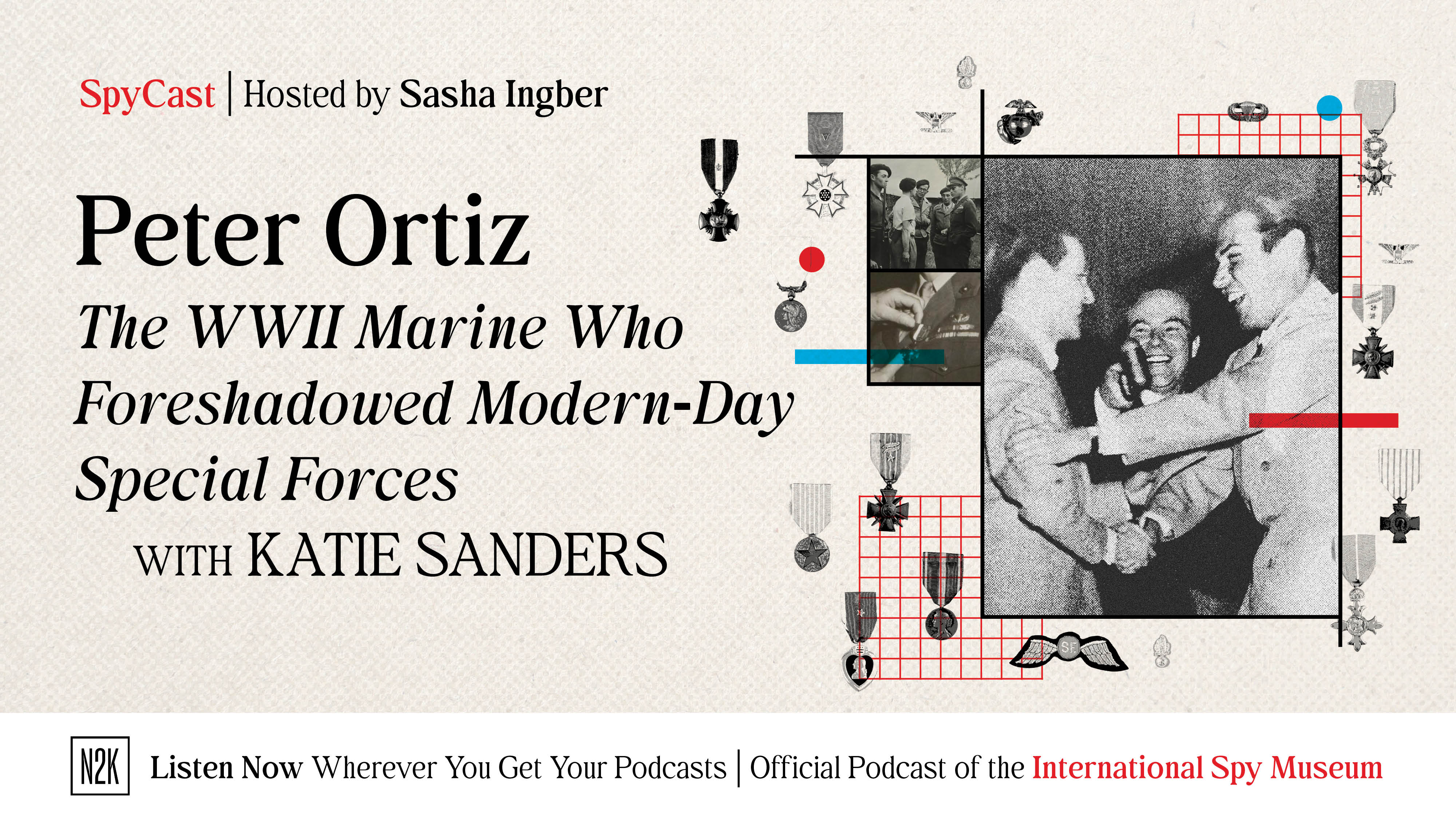


Peter Ortiz: The WWII Marine Who Foreshadowed Modern-Day Special Forces










SpyCast Katie Sanders Gold Cut
Sasha Ingber: Welcome to SpyCast, the official podcast of the International Spy Museum. I'm your host, Sasha Ingber, and each week, I take you into the shadows of espionage, intelligence, and covert operations across the globe.
In 2017, journalist Katie Sanders discovered an episode of a radio program called This Is Your Life.
This is Your Life: This Is Your Life
Sasha Ingber: It was a scratchy recording from 1949, and she heard the voice of Second Lieutenant Murray Simon, her grandfather, for the first time. In the episode, he was reunited with a man named Peter Ortiz, who had rescued Murray after his plane crashed over Nazi-occupied France in 1944. Ortiz became one of the most decorated Marine officers of World War II, undertaking missions now reserved for the likes of the Navy SEALs and the Green Berets.
Katie and Nicholas Reynolds, a former CIA historian, went on to write Ortiz's War.
Welcome, Katie.
Katie Sanders: Thanks, Sasha. Good to be here.
Sasha Ingber: And you're coming from Boston, right?
Katie Sanders: That's right.
Sasha Ingber: How much did you know about your grandfather before you embarked on this book?
Katie Sanders: You know, not all too much, Sasha. He had died of lung cancer years before I was born.
No, thankfully, I'd known he had survived a World War II plane crash. It was really cigarettes that killed him. I joke that, uh, smoking in the Air Force, the habit that he picked up, was more dangerous to his health in the end than getting shot down as a Jewish kid over Nazi-occupied France. But I did grow up with a piece of his plane in our attic, not really knowing or actually really asking too much of the story until I became a journalist.
Sasha Ingber: Now, can we go back into World War II? He is a 23-year-old pilot flying, as you describe, over Nazi-occupied France as part of Operation Carpetbagger. Can you tell us more about what he was doing and, of course, about the operation?
Katie Sanders: Yeah, so this is before D-Day, and we have this huge Allied invasion coming, and no one knows quite exactly when or how, but everyone's waiting, and the French Resistance is there, ready to act in support and is, you know, desperately trying to stave off the Nazis at this point and survive the occupation.
And so Operation Carpetbagger was this initiative, uh, as an inter-Allied operation between the Office of Strategic Services, and then you have the British equivalent. And they're really working to drop... instead of, you know, you think of bombers during World War II dropping bombs, of course, these B-24s that were retrofitted to fly late and low and solo, you know, not in formation, really dangerous missions, pa- planes were painted black, they were dropping agents and supplies.
And so my grandfather was piloting these. He wasn't supposed to know who he was flying. The agents would get on at the very end. They were sometimes dropping carrier pigeons and bikes and medicine, and really anything, cash, a lot of propaganda that would support the Resistance ahead of, and then for the other Carpetbaggers after the Allied invasion that becomes known as D-Day on June 6th.
Sasha Ingber: Right. And the French Resistance, known as the Maquis, were incredibly important in the Allied effort. And you had previously told me that for your grandfather, he had initially said on that first flight that it was 10% fear, 90% adrenaline, and over time, this became the inverse, where it was 90% fear, 10% adrenaline.
And this is a month before D-Day that his plane is now shot down. Can you take us into that moment from what you were able to piece together?
Katie Sanders: Yeah, absolutely. Well, you're in this plane. You're flying on this very secret moonlit mission. It's hard to see. It's hard to identify what you're flying over, the rivers, the outlines.
You are at risk of hitting mountains, you were that low. And so all of a sudden, you know, things are going okay, but it's after midnight, and there's this sound that feels... The tail gunner describes it as like a baseball bat slamming the aluminum. And from there, it only gets worse and worse. They've been hit.
You know, fire is coming into the ship. And here they are, these eight American airmen. My grandfather was in the cockpit surveying the damage, orders everyone, when he realizes that the plane is doomed, and they're in a death spiral, uh, to bail out. And he's still there trying to steer the plane as close as they can to the drop zone, knowing that, you know, the people who they're coming to drop supplies to, who know they're coming through secret messages that have been transmitted, are going to be their best hope at getting home.
And then, you know, he counts the chutes open, and he leaps out of the burning plane just in time, ends up in a forest in a tiny village called Mably that's outside of Rouen, France, and the plane explodes and comes barreling into the ground
Sasha Ingber: What an extraordinary moment for him. It sounds utterly terrifying.
And you mentioned that your grandfather acquired a piece of that plane.
Katie Sanders: Yeah, absolutely. I, uh, keep this in my office as a reminder of how things don't always have to end badly that have horrible moments. I keep a picture of the crash as it was shown by these children who were checking out what was left of The Liberator.
These are French children who were actually involved in the resistance as well, and I had the chance to, to meet one of them 75 years later and understand what they saw and felt too.
Sasha Ingber: Now, what happened to him and his crew when they crashed down?
Katie Sanders: Yeah, so they parachuted out. These were, um, guys who had, had signed up for this really harrowing mission and were told, "If you get shot down, you might be tortured and, uh, shot as a spy because you're on this, you know, covert delivery mission."
So the advice was, "Don't get shot down." They were all separated from each other. A few did end up sort of reuniting. One actually ends up embedding with the French Resistance. In my grandfather's case, he's brought into the home of a doctor in the French Resistance, secretly a Bulgarian-born Jew, who has a pregnant wife and a nine-month-old baby in the house and feeds my grandpa their last two eggs.
Sasha Ingber: So he's taken in by this Bulgarian-born Jewish doctor, Dr. Madjar, who is ultimately the one to introduce him to French Resistance. But he also asks your grandfather to make a prediction. An incredibly important and prescient prediction. Can you tell us about that?
Katie Sanders: Yeah, sure. Well, Dr. Madjar is in the Maquis and formerly in the French Army.
He's a doctor. He's secretly a Jew. He's not someone who wants to be caught with a Jewish airman in their house. But he also is so desperately awaiting D-Day, and he's pretty bold and audacious. And my grandfather, of course, has no grounds to make a prediction as to when the Allied invasion, that's top secret, far beyond his pay grade is, but he sees the desperation in this man who's helping him and bringing him home to his family.
And Dr. Madjar's pretty unrelenting, and so my grandfather says, "The invasion will be in one month," of course, not knowing that what would become D-Day was, in fact, on June 6th, one month later. So he said it was the best prediction he ever made when he was later asked about it.
Sasha Ingber: Remarkable. And Dr. Madjar and the resistance network ultimately lead Murray to meeting this Marine major, Peter Ortiz, codename Chamberlain.
Tell us more about who he is, how he grew up, what kind of person he is.
Katie Sanders: This was a rare person in so many ways. You wouldn't expect a, a Marine major to be undercover in Nazi-occupied France, nor would you expect him to be so worldly. His real name was Pierre. Uh, he was born in New York City on the Upper East Side in 1913.
His father, um, you know, with DuPont blood, moved back to, uh, France to help found Vogue Paris as an editor, and his mother was in La Jolla, California. Again, so it was sort of a, a kid who straddled cultures and who, you know, had a knack for languages, though he didn't like sitting in a classroom to learn them by any means.
There's a later Marine assessment of him as not a good candidate for a desk job ever. So again- ... really athletic. His widow liked to say he might have been in the Olympics if in 1936 they hadn't been foiled by Hitler and the war. And you have this guy who is just really bold, and he joins the French Foreign Legion as a teenager. He runs away and uses, as was common practice, um, a fake name. He makes his Polish girlfriend and uses her last name, actually incorrectly, to enlist in the French Foreign Legion, so his papers still reflect that. And he really went into combat. Um, he was in North Africa. He would later, um, you know, be in France in 1940.
He was- Someone who sought to be there in the action, in the thick of things, and to do the right thing whenever he could.
Sasha Ingber: And yet his character has these other layers to it, ultimately working as a race car driver, a lion tamer. He ultimately becomes a Hollywood stuntman and actor, a varied background.
Katie Sanders: Yeah, and a- again, thrill-seeking, adventure-seeking. He's at a dude ranch. I mean, there's some questionable, um, you know, crowds he's hanging out with, groupies, in, in some of the circus context that you mentioned, but his race car driver skills would come into play again when he had his stolen Gestapo staff car fleet in, in France, and, you know, for that I'm grateful.
I was driving to Pete Jr.'s house, and I hate driving, and I kept telling myself, “All right, if they could do it in this context, I can get over the bridge to Virginia."
Sasha Ingber: That would be true. And we're talking about Peter Jr., as in Peter Ortiz's son. Now, Ortiz, by this point, was known to the Gestapo, and before meeting your grandfather, he had helped pilots fresh off of another mission.
This was all part of Operation Union, where he was evaluating the strength of the resistance fighters. And the Allies weren't quite sure of how strong they were and how much they were going to be able to help in an invasion. Can you say more about what he had been doing?
Katie Sanders: Yeah. Ortiz was, was always one to interpret job descriptions and sort of expand, uh, what he, uh, felt his, his duties in the space he was in were.
And so while he was doing exactly what you said, evaluating and arming and training these kind of, at that time, embryonic resistance movements, he was also, um, you know, doing, uh, a good deal of, of spying. Um, he would go undercover in local pubs and actually kind of fraternize with, with Nazis, and then, you know, listen and report back through secret radio transmissions.
He would blow up Axis infrastructure with these resistance, and he was really, um, getting under the Nazis' skin. It was like, "Who is this guy who is sometimes Jean-Pierre?" And sometimes he was a dress designer from Paris who, you know, used his dad's fashion background to tell these believable stories that informed his cover.
And so he was doing a lot of stuff that really aggravated the Nazis, and had built a pretty big reward on his head. And he was bold enough to wear his Marine uniform out in the field at times, which he felt was really important to give the resistance hope, but probably also didn't help his case in being undiscovered.
When it comes to these, these pilots, imagine being shot down over Nazi-occupied France, and you're looking for help in languages you don't speak, and trying to, you know, maybe use your Army-issued language card to, to say a phrase to someone, hoping they're not gonna turn you over to the Gestapo or be the Gestapo.
And in this case, Peter Ortiz, or Chamberlin, had developed this reputation for helping downed Allied airmen. He had done so for four RAF flyers weeks earlier, and was fresh from coming back from helping an amazing fighter pilot named Fred Glover, who was shot down just before my grandfather. And the timing worked out quite nicely that as Ortiz was recalled to go back to the Office of Strategic Services headquarters in, in England, he said, "No, I'm gonna make my own way out."
And at that point, the resistance knew to come get him and say, "Look, we have another stranded American airman. Please come help."
Sasha Ingber: And that bravery, that audacity is really demonstrated in this moment where he meets Murray in Valence at this safe house in a moment where other safe houses have been blown. His radio operator, who has been transmitting these covert messages, has been exposed and will essentially be killed in a matter of weeks, and now Ortiz has been ordered back to London, and he refuses to go on those terms.
So can you share details about that first meeting between Ortiz and Murray, and the escape plan that they essentially hatched together?
Katie Sanders: Yeah, so Ortiz, again, he has his own plans for things. He, he certainly responds to being recalled as saying, "I will come back," but he says, "I'm gonna do it my own way." And so he positions to my grandfather, "Look, this is, this safe house is blown. We're... It's only a matter of time until, you know, if we stay here. Not gonna end well. We will be caught. If you come with me, you might be caught. You'll probably be killed twice, once for, uh, you know, being a down American airman, another time for being with me.”
But, you know, he radiates this confidence and he radiates a, a sense of somebody who, who knows this terrain and, um, has, you know, the ability to, and the network to make it out.
And so my grandfather, um, you know, sees this as his best option, and, um, you know, it turns out it really was. He was the first one home from the crew.
Sasha Ingber: So your grandfather gets disguised as this deaf, mute Frenchman because he only speaks Yiddish. Tell us more about how this all really went down with Ortiz.
Katie Sanders: Yeah. You know, um, the, the brave people in the French Resistance, they were working behind the scenes in all the ways and helping people have covers. I think my grandfather became Maurice Simone. Um, certainly not a Jew from Queens anymore.
Sasha Ingber: Maurice Simon to Maurice Simone. Okay
Katie Sanders: Which he could not respond to-
if they said Maurice Simon, because he's deaf, mute, remember? Uh, I, every time I, like, clap, uh, you know, I think, "Well, wouldn't that have made you react?" So I, I think a lot of these guys, you said, are they shell-shocked? And just they were doing their best to make these covers work. Um, but again, the idea was, "Don't get caught. Um, and if you do, stay with me, and we will evade together."
Um, and Ortiz was, was much more armed. Ortiz was much more trained in this type of irregular warfare. Um, and Ortiz was, was ready, uh, to, you know, react to anything.
Sasha Ingber: And as they're winding through one stressful situation after the next where anything could go awry, there's no sense of security.
There are no guarantees. They eventually do end up in Spain, where they're told that they are still not safe, and they ultimately get to a US base in Gibraltar.
Katie Sanders: By the time they're in Gibraltar, you know, you're, um, a few days off from, from D-Day. Um, and I think the, the Office of Strategic Services headquarters is very happy to hear that, uh, their operative, who's decided to make his own way out, will be taking a little, you know, ferry hopper plane back to England.
And Ortiz and my grandfather, you know, shake hands, part ways. Ortiz at this point is in his early 30s. He's a Marine major. My grandfather is a, a 23-year-old from, from Queens who telegrams his mother, my poor great-grandmother, back home in Queens, says, "Mom, I'm safe. Back. No need to worry. Write to my old address. Love, Murray." And so for him, the, the journey is over. For the rest of his crew, it's, it's ongoing. Um, but he gets back, and D-Day is four days later.
Sasha Ingber: So a happy ending for Murray, and Ortiz does not stop with his rescue. He actually goes back to London, and then decides that he's going to go back again into France, planning Operation Union II.
And what makes this different is that he's now training the Maquis on new weapons, on ambush tactics, harassment. Say more on what Ortiz is now doing.
Katie Sanders: This is post-D-Day now, right. And so Ortiz is, is knowing that, uh, you know, this long-awaited invasion is coming. But you have to remember that that didn't mean that France was all of a sudden liberated.
This is a, a huge process, and there's the invasion in the south as well. And so you have a lot of work that needs to happen to leverage the Maquis, who, you know, Eisenhower later says play a huge role in the success of, you know, D-Day and the ensuing campaign to liberate France. So, uh, Ortiz, again, he knows the territory, especially in the southeast.
He can't, you know, fathom the idea of not going back. There are people who he thinks he can really jump back into the Alps and help. And to do so, uh, the Office of Strategic Services agrees to let him recruit his own team. He recruits a couple fellow Marines who he runs into, again, rare Marines in, who are working as training paratroopers in London.
And then he recruits also Thomas Jefferson's great-great-great grandson, Francis Coolidge, who is also an American kind of blue blood who had served in the French Foreign Legion and was also in London working for the OSS. So he's got this team of commandos, and with them, he says on August 1st, in, in parallel with a huge, huge, huge supply drop, these agents are actually gonna jump in this time out of B-17 bombers in daylight in what will obviously be a huge stir.
Everyone will see, so they're not gonna have the, the cloak of darkness or anything. They're just dropping things in, knowing that the resistance will hopefully come en masse much before the, the Germans react, and that they'll use that equipment and the paratroopers who are going to jump in to hopefully make a big difference in the southeast and support the liberation
Sasha Ingber: And in the midst of this work, he ultimately chooses to surrender in the French town of Centron.
This is at a point where the Nazis could treat the civilians and the town as it did another location where, at least in a document that I read, a sergeant major is quoted saying, "They burned the place down. They killed them all." So Ortiz essentially sacrifices himself for the betterment of this town, Centron.
Katie Sanders: Yeah, so for anyone who's maybe heard of Peter Ortiz, oftentimes this is sort of a climactic moment where he, uh, you know, has felt he's had his career as a, a Marine, and meanwhile is leading this operation. Th- things have gone awry. You know, it's been a tough couple weeks in the French Alps with the Maquis.
They're really outnumbered, and these German convoys have their machine guns right there and are outnumbering them. And so, um, this is horrible for everyone, but really for the civilians of these small towns that have been, um, you know, trying to survive the occupation for four years now, and this is the end.
And so the town you were referencing, Montgeron, is a village that sees a horrible fate when, uh, the, y- basically Allies were moving through the town. There were these horrible reprisals. And so Ortiz, knowing that this is likely what will be happen if he escapes through the town, he makes a decision, and he decides that he's going to negotiate his own surrender.
Um, he doesn't impose that on the two other OSS Marines with him, but he tells them, "I'm gonna walk out, you know, really under fire, and try to find the German commander in charge and say, 'I surrender on the sole condition that you spare this village. I will not pass through, and you will not raze it.'" And again, this, this plan sounds wild, and it really is.
The two Marines who are with him say, "Major, you're a Marine. We're Marines. What you do, we do." And so they surrender with him. But here he is shouting in French, German, and English. You know, again, uh, the machine gun fire is still coming at his feet, kicking up dirt as he walks towards this Nazi in charge, and gets there.
And I think there are a lot of surprises that come next. It doesn't end how he thinks it's going to end, thankfully for him.
Sasha Ingber: When we come back, the sacrifices Ortiz made for strangers during and after the war.
Now the Germans put Ortiz and the other men who decide to take this same action with him in a POW camp. Until the war ends, he's there. Do we know about what that time was like for him, and what ultimately happens to Ortiz when the war is over?
Katie Sanders: Yeah. Thankfully, Sasha, we know quite a bit from, uh, the two other Marines he was with, John Bodnar and Jack Risler, what, what they experienced.
They also had with them a, a member of the French Resistance who was wearing the uniform of one of the dead Union 2 operatives who had parachuted, died on his parachute drop in, and he's pretending to be a shell-shocked American-Canadian soldier. And so the four of them are moved from camp to camp. Again, this is the end of the occupation where the Germans are, you know, having to adapt to wherever they're being caught, and they move on to the next place and, and maintain camps.
Um, so you have, uh, several of the traditional camps. They're moving through Stalag North and Stalag, and more or less they follow the rules of, of war, the Nazis, uh, when they're maintaining the camps. And they don't give Ortiz the hard time that he anticipates getting or, you know, they don't kill him off this, on the spot.
He tries to escape relentlessly because that's his personality and, uh, that's... He at one point even does escape, but they're so far off from food and water that they have no choice but to turn back. Um, and at a couple of points he's in solitary. Um, he's clearly a, a pain in most officers' neck, but at the same time I think there's a lot of respect for this man who has a reputation at this point of literally surrendering and negotiating his own surrender to save villagers
Sasha Ingber: And then after the war ends, he moves on to other stages.
The Office of Strategic Services gives way to the CIA. What level of involvement does Ortiz have?
Katie Sanders: Not much that we know of. Uh, a- again, you have a couple years where Wild Bill Donovan, he's the credited, America's first spymaster, and founder of the OSS, and sort of credited as the founding father of the CIA.
But there was a lot of tension between, uh, the transition, and Truman, President Truman disbanding the OSS. Uh, Ortiz was very much the old guard. He appeared in some Hollywood movies with his buddy John Ford, who would of course become probably the most famous director of the 20th century. And so you have Ortiz in Hollywood often sharing war stories.
These were popular movies like Thirteen Room Madland, and Operation Secret, uh, Cornel Wilde. You see some of this in Hollywood, but at the same time, they weren't really supposed to, to go around talking about it unless it was, you know, a, a very specific approved project.
Sasha Ingber: A job that he had would probably make it a lot harder to adjust to civilian life, but there are also some accounts, uh, where he potentially showed up with bags of cash to help the CIA.
Katie Sanders: Yeah. This is a, I'd say the CIA would, would say, "We don't know what you're talking about," or, "We can't confirm or deny any of that." My grandfather later in life would, uh, you know, uh, keep in touch with Peter Ortiz and he would disappear for, you know, periods of time. Um, yeah, there were bags of cash involved.
He was the kind of guy who if you, as his son would say, if you wanted to call the house when he was living out in Arizona, you call once, hang up, call again. Real sort of classic, uh, agent stuff, and he was a real operator, um, who gravitated towards the field, and had a gravitational pull towards conflict.
Even when he was living in Mexico later in life, he would just take it upon himself to go to hurricane aid victims, and then offer first aid. So he was, again, a guy who really, whether he was directly wearing a uniform or not, um- had a, a sense of his nobility obligating him to, to be helpful.
Sasha Ingber: And following on with that, you also found that he wrote a letter in 1985 where he again offered to sacrifice himself.
Katie Sanders: Yeah. You're seeing a theme here. So he writes this letter to then Secretary of State George Shultz, essentially offering himself... This is during the, the Lebanese hostage crisis, which for anyone who's alive in the '80s might remember the, the headlines and what a terrible time, where there were 100 essentially Western of allied nations hostages, innocent hostages taken and connected back to Hezbollah and, and really terrorism activity.
And here you have this, again, at this point long retired Marine saying, "Well, I'm an old man. I'm dying of cancer. I- my time is up. Let me offer myself." And, you know, to write this letter, and then he wrote a follow-up letter when he didn't get an answer at first, is just, I think, really telling of his character and the, the, the sense of, of just duty that he, that he felt he had up until, you know, in 1988, he does die of cancer.
Sasha Ingber: And you actually sent me the letter that he wrote in 1985. I wanted to read a portion of it, where Ortiz writes on a typewriter, "I would suggest that it could be arranged, and I do in fact hereby propose and volunteer for, that I unreservedly and unconditionally place myself under the physical control of the quote-unquote jihad, contingent only upon the release of one, anyone, regardless of nationality, of the presently held hostages. As I would be voluntarily, deliberately, and of my own initiative substituting myself for one of the hostages, the US would bear no responsibility for me."
Can we talk about the tribute to his life that we saw at Arlington ceremony, and even in that town of Centron, which has honored him?
Katie Sanders: Yeah. When someone who has been involved in covert warfare dies, doesn't always, uh, net out to people coming out to honor them, but in this case it really does.
Ortiz never went back to Centron, but come his funeral, there was, you know, representation at, at Arlington from three nations that were very grateful, um, with, you know, the, the full honors that are endowed upon someone who, uh, was a true American hero. Um, and in a lot of ways- I think the word understated doesn't necessarily describe Ortiz in some context, but in the sense that, again, he didn't feel compelled to, to go back to the anniversary ceremonies.
Fortunately, for the historical record, John Bodnar and, uh, Jack Risler, the other OSS Marines he surrendered with did. And, you know, to this day, 82 years later, the, the village of Centron has renamed their town plaza, Plaza Peter Ortiz. And you have, um, these ceremonies every year. I'll get to experience my first one this summer, and it's...
You know, there's an incredible sense of this is someone who put their own life, um, who, who really offered to give up their own life so that we could survive. Um, people who were children then remember the scene now and, and, you know, it, it stays, uh, you know, very strong in their memories too.
Sasha Ingber: Your grandfather was reunited with Ortiz in 1949.
Did they keep in touch, and was Murray aware of the depth of what Ortiz had done in those years?
Katie Sanders: It's a great question. I wish I could ask him. But I, I know from his scrapbook alone that, you know, he was aware of the heroism of Ortiz. There are magazine articles written about him that my grandfather had cut out, and simply kind of labeled Peter Ortiz, but there he was receiving his second Navy Cross.
So I think Grandpa Murray knew that this was, you know, in his words, "A real-life Knight of the Round Table." That 1949, uh, reunion you asked about is, um, one of my favorite moments, and in a lot of ways my entry point to this story because my grandfather at this point, post-war, selling tools in, in Brooklyn, New York, back home, civilian life.
And he gets a, a call and finds out that NBC wants to fly him to Los Angeles to be a guest on the then radio show, This Is Your Life, where the host, Ralph Edwards, would sort of surprise a cool person of the day and recreate their story. And who better to surprise than, uh, you know, a World War II secret agent who, uh, you know, was Peter Ortiz.
Sasha Ingber: And I know that in working on this book, you actually went to Murray's crash site. Can you talk about what it was like to be there all of those decades later?
Katie Sanders: Uh, jarring, not only because of the, the feel of just, uh, you know, walking where he walked and, and the plane crashed, but because there are literally four giant craters in the ground where trees don't quite grow in that part of the forest, which a really lovely gentleman who hosted me now owns.
And so he showed me exactly where the plane crashed, and you could still, 75 years later, I kid you not, pick out pieces of aluminum. I have one right here that for the 75th anniversary I went back, and these, uh, you know, locals who were children at the time had recovered. And you think about everything that happened, you know, to get all of these airmen home, and, uh, there are just, uh, few circumstances in life that could replicate that feeling of, of being somewhere where someone almost died, and then, you know, courage saved them, and you sort of have your existence to thank for that too.
Sasha Ingber: And as a journalist, I'm sure that you're accustomed to telling other people's stories. So what was it like sifting through all of these documents and conducting interviews that essentially were part of your own family's story?
Katie Sanders: Really interesting and different. Uh, again, for me, the historical part of it, I love sharing stories of resistance and courage, and I think it's probably comes as no surprise that I'm, in a lot of ways, a, a product of one.
And I think this, every time I would find a newspaper article or a, a historical document, a telegram, a, a letter, I just felt so grateful to have those, you know, primary records and pieces of the puzzle. A big difference here was that, you know, I, here I am showing up at, uh, Ortiz's only son, Pete Jr.’s door, and being embraced as family.
The Ortiz's visited my grandfather in Philadelphia, and Pete Jr. at that point was at the Naval Academy as a cadet, and my grandfather flew him back to the Naval Academy for spring break. So again, Pete said to me the moment I walked in, like, "You know, you're family now, you know that?" And here he is, he's a m- retired Marine aviator and history teacher.
And, um, I think just reflecting on the ways we're delicately interconnected, um, has been wild. Uh, and there's nothing really like, uh, unearthing your own family history.
Sasha Ingber: And his son told you that Peter Ortiz died with one regret. Can you share what that was?
Katie Sanders: Yeah. You know, this was something that Pete Jr, who's again, been such a, a wonderful source of support and full of humility himself, a- as someone who's served in conflict for this country, he said that his dad over the years, you know- had expressed regretting not taking a stand against McCarthyism.
Like, at this time when, uh, of course, Ortiz is working in Hollywood, and you have all of these, you know, accusations and, and people being witch-hunted. And I think, again, from what Pete observed, this idea that, um, you know, his dad was someone to stand up for what was right and say, like, "Hey, what you're doing to the Jews, you're gonna have to try to do to me."
That McCarthyism was, was one where he always felt his dad might have itched to take more of a stand.
Sasha Ingber: Did writing this book make you feel closer to the grandfather that you never met?
Katie Sanders: Oh, yeah. I mean, we joke now with AI. I know you can animate someone's, uh, face, but for me it's, um, it really comes through in some of, you know, the escape and evasion report, the little pieces of almost grandfatherly advice that come through in text he wrote as a 23-year-old, or letters he wrote to my mom.
I was able to have her share things with me that I wouldn't have otherwise known. Um, she said when he was dying of cancer, on his deathbed, he said to my mom, um, "Look, Jane, I should have died a long time ago, you know, when I was shot down over France. It's all okay. The rest has been a gift. It's okay." And so I think moments like that, that are just windows into his character and his perspective, um, much easier for me to look on the bright side when I think of how he lived.
Sasha Ingber: Katie, really appreciate you sitting down with me today.
Katie Sanders: Yeah. Thank you so much for having me, Sasha. It's great to talk about Ortiz's War. And, uh, if you're interested in learning more about Ortiz, read about his life, in Nick Reynolds, my coauthor is a retired Marine colonel, and we're honored to, to share the story of one of our heroes.
Sasha Ingber: Thanks for listening to this episode of SpyCast. If you like the episode, give us a follow on Apple, Spotify, or wherever you get your podcasts, and leave us a rating or review. It really helps. If you have any feedback or you wanna hear about a particular topic, you can reach us by email at spycast@spymuseum.org.
I'm your host, Sasha Ingber, and this show is brought to you by N2K Networks, Goat Rodeo, and the International Spy Museum in Washington, DC.



