
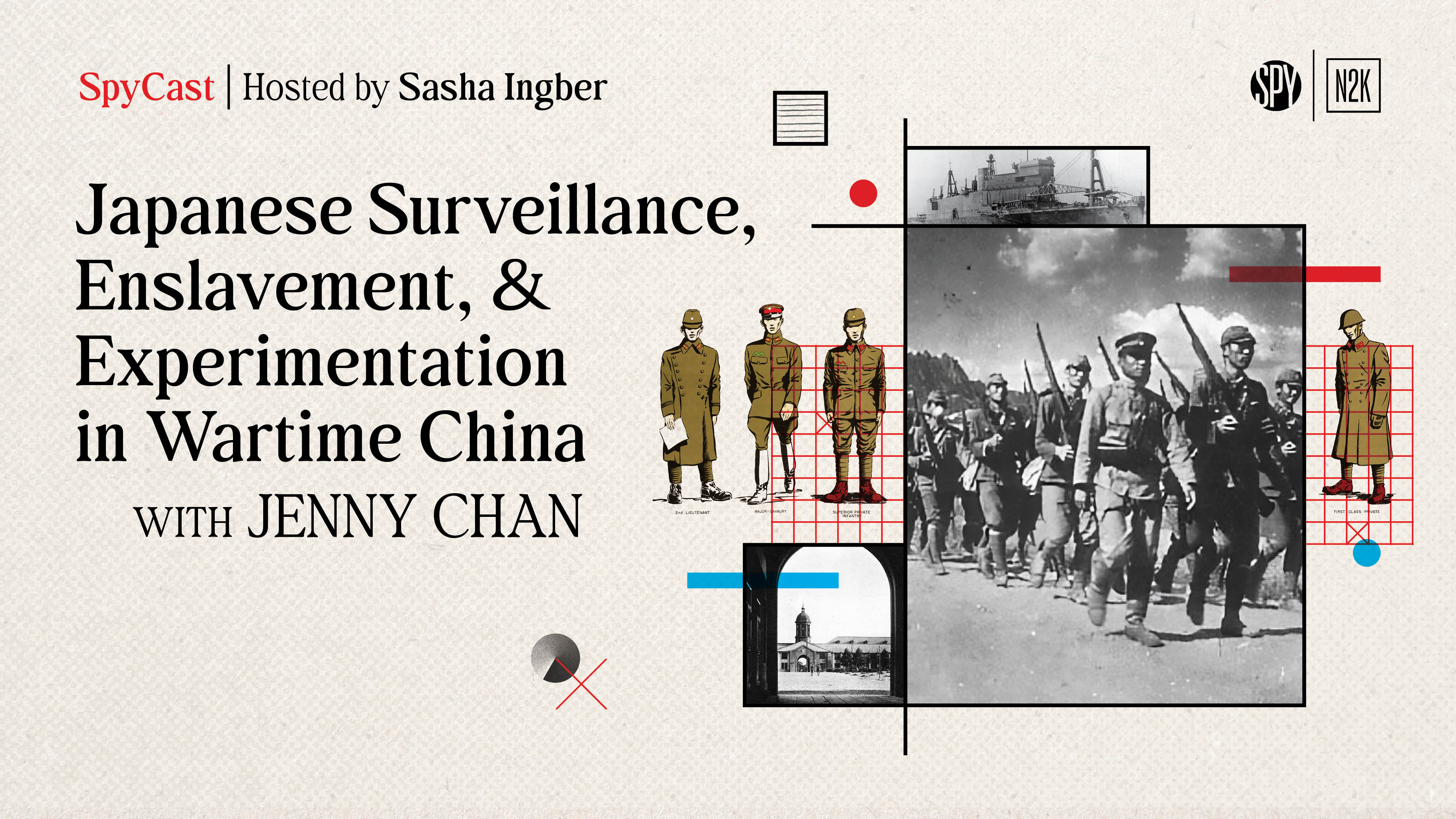


Japanese Surveillance, Enslavement, and Experimentation in Wartime China










Sasha Ingber: Welcome to SpyCast, the official podcast of the International Spy Museum. I'm your host, Sasha Ingber, and each week, I take you into the shadows of espionage, intelligence, and covert operations across the globe.
During World War II, the Asia-Pacific Theater saw its own scenes of brutality, but many of us don't know about them. Jenny Chan co-founded Pacific Atrocities Education to raise awareness on these lesser-known horrors. Our conversation focused on the Imperial Japanese Army, which occupied parts of China between 1937 and 1945 as part of the Second Sino-Japanese War. Jenny uncovered new details that showed how intelligence-gathering and covert research enabled war crimes.
And a note of caution, some of this episode focuses on sexual enslavement and medical experimentation.
Jenny, welcome to SpyCast.
Jenny Chan: Thank you so much for having me.
Sasha Ingber: So your research journey begins in 2013, two years after your grandmother passes away in Hong Kong. Can you talk to us about what happened?
Jenny Chan: Yeah.
So I grew up in Hong Kong, and when I was growing up, I loved Japanese anime, and my grandma would get very triggered whenever I was watching anime, and she was upset because she was telling me, "Oh, these people who make anime are evil." And I never really got to understand why that was when I was a kid until she passed away in 2011, that we find, like, a box of her belongings from World War II.
And I was actually very surprised because I've never seen these items before, like military yen, rice rationing coupon, and I was wondering what they were. So I was then looking more into what had happened to her during World War II, and I then realized that she has survived through the occupation of Hong Kong, which happened 10 hours after Pearl Harbor.
I was reading more into, like, The Rising Sun by John Toland and also other books about what had happened to people like my grandma during Japanese occupation. I started trying to see what had happened to my grandma, but once I started examining more of the wartime stories and wartime documents, I started going to the National Archives to scan these documents related to Japanese war crimes, and I have now scanned over, like, a million pages on our digital archives.
I started out with, like, a family question and a family story, but I started realizing that these individuals suffering was like what my grandma had went through during the war was really produced by enormous bureaucratic systems like military police, informant networks, and also transportation systems and military medicine and intelligence gathering.
Sasha Ingber: Why don't we know much about this time? You described how little you knew back in 2011, but why do we know so little about this situation of the Japanese occupying China and some of these war crimes?
Jenny Chan: Yeah, that's a great question. I think it had to do with post-war politics. A lot of the documents also were not declassified until late 1990s when people started asking questions.
I think Dianne Feinstein was the one in 1999 who actually then brought it up to the Senate floor to actually declassify a lot of the Japanese war crime material with the International Working Group at the National Archives. So it's within the last 20 years or so that these documents were declassified.
Sasha Ingber: So let's move back in time now to the 1940s when Japan has now invaded China largely for economic reasons. Explain how the First Army had this blockhouse surveillance system, how that worked in this mountainous province called Shanxi, which is known as the cradle of Chinese civilization.
Jenny Chan: Yeah. So the blockhouse system by the First Army, who was actually in North China in 1937 after the full invasion, the blockhouse was actually used to attempt to solve this very specific intelligence problem, because Shanxi was actually dominated by this regional ruler, Yan Xishan, and the nationalist government was working with him.
But then there were also guerrilla fighters who were communists, who were also a part of the resistance to the Japanese. And because this province is so mountainous, and it's hard to rule a mountainous network like in a rural area because there's not that kind of infrastructure. So of course, they can control Taiyuan, which is like the major city, because it's actually easier to control major city.
But once you move into the mountainous rural area, it's a lot harder to do so. And so the First Army actually used this kind of physical occupation with population surveillance and rapid punitive action. So then there's registration and checkpoints that track movements, village officials and collaborators with the Japanese military police, and informants would then supply local knowledge.
And once information reach a post, then the troops could actually seal routes, and surround the village, and conduct arrests or interrogations. And of course, in these kind of environment, right, like if a local villager kind of feed the guerrilla fighters and whatnot, an informant could then later tell on them just because of personal grievance or because of incentive.
So then once those report reach the blockhouse, I think soldiers don't really need to search the entire province. It's very efficient, and then they can just close the nearby routes, and summon a mobile patrol, and surround a village. And that's how, like, system converted, like, everyday information of who came, who left, who provided food into military action.
Sasha Ingber: And so they've developed this complex system to gather intelligence. But then at the same time, there are these military-run brothels, which are called comfort stations euphemistically, because for the women there, it was anything but. Can you explain how they ended up there and what the purpose was?
Jenny Chan: Comfort stations were first established after 1932 when Japan had an incident in Shanghai, and a lot of their soldiers ended up getting STDs. And so then they had to come up with a system to kind of control this virus that they were all contracting. And so then they came up with this idea of having a comfort station where they can have physician to control more of the women in these comfort station.
Supposedly, they were supposed to reduce contact with local civilians, uh, limit opportunities also for soldiers to reveal military information as well, because they're not out there in the field trying to capture women and interact with other women. They're in, like, more contained area to control, and also to basically reduce the use of unregulated brothels, which other officials and officers feared that they could contain spies.
And they were able to, using this blockhouse system that, like, monitor people's movement, they were able to basically gather intelligence of, you know, who has what in the villages and who's coming, who's going. So then they were also able to figure out which household had women, and so that's how they were able to track the women into going to, into comfort stations.
Sasha Ingber: And let's talk about some of the women that you ended up interviewing. Who were they, and how were they captured?
Jenny Chan: Yeah. So one of the women that I interviewed, her name was Zhang Xian Tu and she was captured when she was 16. She's a Chinese woman. She was living in Shanxi, and one day they had a roundup where the Japanese soldiers were basically telling all the villagers to go to this area so then they can basically examine everyone and see who's in w- which household.
And so everyone in the village went to this area, and then when she went back home, moments later, she got captured. The soldiers then went to her house and captured her. She was 16 at the time, but I think people in that part of China in, like, 1930s, they married very young, and so she was already married at 16.
A- and so then her life as a farm worker in, like, rural China just changed overnight. She was then captured into the, this comfort station, where she was basically raped day and night, like sometimes, you know, five, 10 times a day. And until her father tried to work with, like, a local military informant to actually release her
Sasha Ingber: And was she able to leave that way, or did she ultimately escape?
Jenny Chan: She was able to leave that way. I think her father was able to bribe someone who actually let her go. So she was able to leave that way, and her family never talked about it. A lot of these women don't talk about it until, like, decades later because it's a taboo topic, and I think that's also part of the reason why a lot of the memories started fading away from World War II in China because people don't want to talk about that kind of shameful experience, and they just move on, and I think that's how we know so little about it.
Sasha Ingber: Was it hard for her to talk about it even all those years later?
Jenny Chan: Yeah. I think when I was interviewing her in 2014, it was hard for her to talk about it e- even decades later because it's just so traumatic. She's passed away, but she was also one of the Chinese survivors from these kind of military system that actually sued the Japanese government.
Sasha Ingber: Right. Yeah, that happened in 1998. I'm curious to know, in the midst of these horrific days, were the Allies ever tasked with learning from these women? Did they ever try to gain intelligence from them because these women were there against their will?
Jenny Chan: Not in rural China, unfortunately, because it was just very out there.
But I think the Ally soldiers did relieve a lot of the comfort women from photographs and from records that we've seen. And I'm sure that they have also gathered intelligence from these women who were leaving comfort stations.
Sasha Ingber: And what did the other women say? Was there a common thread that you found from the ones who survived by the time you found them in 2014?
Jenny Chan: Yeah. I find that the women who survive are the women who have the will to survive. They're very strong, and I have ne- never really seen, like, rural Chinese women until I visited them. And they're... I have to say that they're much stronger than what I had imagined. And of course, I had read, like, documents about them and also historical account before meeting these people, but then interviewing them really changed my understanding of humanity and what it takes to survive something like that, like that horrible.
Sasha Ingber: And some ended up getting pregnant.
Jenny Chan: Yes. One of the women that I interviewed was pregnant after the war, and because of social pressure and rejection already of her experience and all the expectation that she didn't want to carry that kind of shame with her, that's like kind of trading in her future.
And so she kept her pregnancy a secret, and later after the war, she buried her child in a rural cave near her home.
Sasha Ingber: What a horrific, horrific image. And some of these women ended up being involved in Unit 731. This is the Imperial Japanese Army's covert biological and chemical warfare research unit, which operated out of Manchuria, now China's northeast.
It's estimated some 3,000 people were experimented on here. Who was there other than these comfort women?
Jenny Chan: So the same blockhouse surveillance system also worked the same way in recruiting these civilians as well into Unit 731, and Unit 731 ultimately did human experimentation on them. A lot of the victims were Russians and Koreans as well because of how Northeast China were actually pretty close to Korea and Russia.
But most of them were actually Chinese civilians. They were also monitoring the streets to see, like, "Hey, if th- this is a homeless guy, and he doesn't seem like any family member's looking for him, then let's capture him so we can experiment on him, and no one would ever know," or suspected resistance fighters.
And so inside Unit 731, these prisoners were stripped of their identities and reduced to experimental materials. Scientists and the personnel that were working in Unit 731 often referred to their victims as “maruta” or “logs”. Logs as in wooden logs, because then they don't have to see them as human when they're doing vivisection.
Sasha Ingber: And you found that the age range of the subjects of these experiments, who you say were called logs very inhumanely, the range was just staggering.
Jenny Chan: Yeah, they range from, like, three-year-old to 80-year-old
Sasha Ingber: A three-year-old? What, what on earth?
Jenny Chan: Yes, and to see how deadly diseases were working on children, as well as working on adults or working on older people.
Sasha Ingber: So now let's talk more about exactly what these experiments were and the logic in, in doing them.
Jenny Chan: Yeah, so these experiments include pathogens such as plague, bubonic plague, cholera, typhoid, anthrax, glanders, and also methods of dissemination. Also, they were trying to figure out frostbite because Manchuria is very cold, so they were able to expose some victims outside the field and see how human skin would react to frostbite.
Also, to battlefield injuries, and also effect of how diseases would work on living bodies. And the aim is not just some kind of abstract medical knowledge, but also to, like, military application and how it works with civilians and also once diseases were spread into a local population. They also had an entire testing ground.
They were testing, like, how to make biological weapons. For example, they had a ceramic bomb that they made filled with fleas in there, filled with bubonic plague, and then they would tie the victim to the stakes, and they would then drop the ceramic bomb from the plane to see how these victims would react to these biological weapons that they have produced.
Sasha Ingber: We've heard about the brutality of the Japanese during World War II, but this takes it to a completely different level. And you ended up finding a man who had been a janitor on the grounds. Can you explain what he shared?
Jenny Chan: Yeah, so he was actually a part of the youth corps in Unit 731. He was actually dragging victims who were vivisected outside of rooms and transported to the incinerator to erase that person, basically.
What he remember, because after a vivisection was completed, then the scientist would order him or another youth corps member, he's also a teenager at the time, to take care of the remains. And then they would remove the human body from the vivisection room, from the surgical table, and drag them away and put them into the incinerator.
Sasha Ingber: Did any of these people who, as you describe, were so horrifically experimented on escape? Were there survivors who could talk about some of these atrocities?
Jenny Chan: There were no survivors from Unit 731 complex itself, but there were people who actually were-- because Unit 731 was ultimately developing weapons, so there were people, like an American missionary named Archie Crouch, who survived a bubonic plague incident that was from a biological weapon dropped from the plane, and he survived that at Ningbo in 1940
Sasha Ingber: Wow.
What did he have to say about it?
Jenny Chan: So he actually wrote a whole memoir, and at that point of the war, he was already very used to air raids because Ningbo was very close to occupied Shanghai, which were then sending airplanes and air raids into, into Ningbo. And he had a child toddler, and they were trying to hide in the cemetery just to hide from the plane and whatnot.
And the child had thought that they were playing hide and seek. And when the plague actually was dropped, he saw a plane with white plumes, and he didn't know what it was because it wasn't a plane. Normally, planes would come in three, six, and nines and drop bombs. But the one time that they actually had dropped bubonic plague, they didn't know what it was.
Afterward, people started dying, and eventually there were contaminated areas. The city officials of Ningbo actually burned down the areas that they suspected were contaminated with bubonic plague.
Sasha Ingber: An entirely different kind of weapon. Absolutely gruesome to think about. Now, Unit 731 was led by Lieutenant General Shirō Ishii, a Japanese microbiologist and Army medical officer.
Uh, can you tell us more about who he was and why he concocted this complex?
Jenny Chan: Yes. So he was a Japanese Army physician, microbiologist, and really highly effective institutional entrepreneur, I believe. I think his real talent was not merely microbiology, it's also persuading a modern state to fund his vision.
He first started making a water filter because during Russo-Japanese War, he noticed that a lot of J- Japanese soldiers actually perish from unclean water instead of weapons on the ground. And also, he had done this whole study abroad trip, and he had read about the Geneva Convention, and he was thinking that if the germs are so powerful that nation states are writing laws about it, then he needs to basically weaponize it for Japan.
And so he convinced military leaders that biological warfare could actually give Japan a strategic advantage, particularly since pathogen could kill populations and leaving infrastructure intact, like what we had talked about at Ningbo. And one of his important early patrons was Shikahiko Koizumi, who was a senior army physician who later served as Japan's Minister of Health and Welfare during the war.
And Koizumi actually helped Ishii institutional credibility and access to military funding. He even set up the meeting between Ishii and the emperor where Ishii actually peed into his water filter and show the emperor that it's drinkable water being filtered by his water filter. And so his program grew because of institutional funding and also because of physicians and government officials that were willing to support it, finance it, and place authority of medicine behind it.
Sasha Ingber: To have created such a demonstration and then used it to conduct these kinds of experiments, I mean, you just, you can't make that up. So ultimately, what happened to General Ishii after the war ended?
Jenny Chan: Ishii ordered Unit 731 personnel to destroy Pingfang complex and killing the remaining prisoners and concealing their wartime affiliations, and basically telling them to take the unit's secret to the grave.
He then tried to disappear. He even planted a f- a false report in the local newspaper claiming that he had been shot and killed. His friends staged a full funeral for him in Chiba in November 1945. And so he attempted to turn himself into a dead man before investigators could get to him.
Sasha Ingber: When we come back, how the US gave Japan's military scientists immunity in exchange for intelligence.
Meanwhile, the US has now occupied Japan after the war, and so begins the Tokyo War Crime Tribunal to, quote, "Try and punish Far Eastern war criminals." But notably, military scientists are not actually involved. They're not on trial. Why is that? I understand the evidence is destroyed, but why are they excluded from this?
Jenny Chan: Yes. So after Ishii had pretended that he died, when the American investigators reached him, he was actually able to negotiate a immunity deal for himself.
Sasha Ingber: And how did they reach him?
Jenny Chan: So there were counterintelligence and investigators that were actually working to establish where he was. They were getting details from the Communist Party members in Japan at the time, and they located him in January of 1946.
And when the American investigators finally reached him, you know, he was not a dead general, but actually a man living privately. And during later interrogations at his home, Ishii's daughter re- recalling his family pet playing with the visiting American officers. And it's really a surreal domestic image if you think about it, a man who was responsible for mass human experimentations being questioned in the comfort of his own home, and his family and his pet moved around him.
So then the investigation soon became a negotiation, and American military and scientific officials wanted access to Japan's biological warfare research, especially findings that would derive from experiments that could have never been legally condu- been conducted in the United States. They also fear that Soviet Union might obtain the information first, so then they were sending investigators to actually reach this group of scientists first.
And Ishii, being the very well institutional entrepreneur that he was, he understood that his knowledge would give him leverage. So he was remaining evasive, and released information gradually, and made clear that the full cooperation depended on protection from prosecution. So ultimately, the United States decided to shield him and his key associates from war crimes proceeding in exchange for access to the reports, testimony, experimental findings.
Sasha Ingber: So these military scientists, including Ishii himself, were given immunity in exchange for the results of these medical experiments. Did the US military, or the CIA for that matter, actually end up finding this intelligence useful?
Jenny Chan: Yes and no. I think that they obtained interviews, experimental summaries, pathological findings, microscopic slides, and also, like, detailed reports on how biological agents were tested on human prisoners.
The most significant material included, like, three large studies on-- They, they were called Report A, G, and Q. Report A were with anthrax, which is about 406 pages long, and examined how anthrax infection could affect the human body. The Report G concerned glander and how, like, this bacterial disease normally associated with horses were also capable of infecting humans.
The report was documenting also the progression of diseases through human organs and tissues. Then there was also Report Q, which concerned the plague, which is the largest report that they got from them, and it examined how the plague infection in the human subject, including the pathological changes and produced as the disease progressed through the body.
A-and also frostbite report on how to actually f-treat fro-frostbite was also handed over to the United States. Some historians did argue that they're not really useful, but I think they were pretty much useful information given that the United States actually traded for it. And also, like, the reports, if you think about it, reduced really these murder prisoners into case studies, like organ samples, charts, and microscopic observations.
These subjects on these reports are not identifiable by names. Part of the reason why we don't really know the amount of people being subjected to experimentation is because of how those prisoners were being labeled. They were experimented from, like, zero to one thousand, and then they would start again from zero to one thousand, and then they would be sent to the incinerator.
So there might have been internal tabs, but maybe the evidence was also destroyed after the war.
Sasha Ingber: And meanwhile, you can look at what the Soviets did, because they did have a trial in the Far East. 12 officers linked to Unit 731, and while it did expose some of what the program entailed, it was then also used as propaganda against the United States in the Cold War.
Jenny Chan: Correct. And I wouldn't also be on the Soviet side, because in the 1980s, they also had an anthrax spill, so they were actually also working on biological weapons. And they could have been obtained by Unit 731 as well, because they had that trial, and they had access to some of the scientists who were actually captured by the Soviet Union.
Sasha Ingber: And so in, in any of these instances, did these military scientists ever get what we would all want to be coming to them, which is to be living out the rest of their days behind bars?
Jenny Chan: No. They... Some of them became CEO of big pharmaceutical companies. They became politicians, and they never really faced justice in a traditional sense.
Sasha Ingber: What about the victims? If there was no justice for the perpetrators, did the victims ever even receive an apology, let alone a shred of, of reparations?
Jenny Chan: No, I think many families didn't even know exactly what happened to the relatives who disappeared until probably later, decades later. And there are some civil cases that help place the facts into public record, but their legal recognition doesn't mean reparation or apologies.
Sasha Ingber: There was a Japanese politician who just in June passed away, Yōhei Kōno, who was behind what was known as the Kono Statement in 1993, admitting to these comfort stations, but it seems like there was debate on whether or not these women were even forced into it, that the intentionality piece still ended up being seen as debatable.
Jenny Chan: Right. He issued the 1993 statement acknowledging that the Japanese military was directly or indirectly involved, but then in many cases they were recruited against their will through coercion and deception, and he did express apology and remorse. And that is one of the most official acknowledgement, but then it also adds complexity because later politicians and commentators and activists challenge or narrowed or undermined his meaning.
And so then you kind of have survivors that encounter a cycle of which government, one government expressed remorse, and then other influential voices would then cast doubt on the historical record. So it's very internally contradictory.
Sasha Ingber: And that would be very confusing and upsetting for the victims, I would imagine.
What about on the part of the United States? If we're talking about what the US military agreed to and what the intelligence community made a deal for, has there been any apology, any semblance of an, "We're sorry, we probably shouldn't have done this"?
Jenny Chan: Well, the United States government eventually did declassify substantial amount of records so that we can reconstruct the decision-making process and whatnot, but I think disclosure is not the same as apology, right?
An archival release doesn't really repair the original denial of justice. And so I think that United States had acknowledged the documentary history through declassification, but h- it hasn't undertake the kind of victim-centered reckoning that would constitute a meaningful apology that had happened to those people.
Sasha Ingber: So you're hoping that the United States steps up and does more
Jenny Chan: Or acknowledge that it had happened, and we can actually piece it together better. And also, a lot of these declassified documents are not in the best shape, so we can only piece together from the declassified documents.
Sasha Ingber: You described how many records were destroyed, evidence was destroyed. Of what does exist, you're saying that some of it isn't in good shape. What questions do you still have, having spent more than a decade now doing this research?
Jenny Chan: Yes. I actually have a lot more questions about post-war. Camp Detrick, for example, like in detail what those reports were.
Sasha Ingber: Because it was scientists from Camp Detrick who ultimately made contact with General Ishii, right?
Jenny Chan: Yes, and also they basically obtained the reports from Unit 731. I then wonder what kind of weapons were produced from these reports as well.
Sasha Ingber: Yeah, and that also goes into conspiracy theories about what the United States was ultimately doing, and even now there are questions about bioweapons labs, which end up ultimately, at least in terms of labs that are in Ukraine, are really about public health and not bioweapons.
So in the fact that you co-founded this nonprofit, and you've spent so much time exploring this very, very bleak era, do people ever tell you to let go of the past, that it's just behind us
Jenny Chan: Yes, a lot of people ask also, like, don't we already know what had happened in World War II? But there's actually a lot of questions that we still have, especially with post-war justice.
And also, since a lot of the documents were declassified, like, in the 2000s as well, there is actually a lot of things that we're still uncovering from World War II up to this day.
Sasha Ingber: What about the questions that you still have on your grandmother who passed away in Hong Kong?
Jenny Chan: Yes, I still have a lot of questions as to how she endured the occupation and what she was doing day to day, but I guess these kind of questions I will never be able to ask since she passed away.
Sasha Ingber: Jenny, really appreciate you sharing your research. It's incredibly grim, but something that people ought to face. So thank you.
Jenny Chan: Thank you so much for having me today.
Sasha Ingber: Thanks for listening to this episode of SpyCast. If you like the episode, give us a follow on Apple, Spotify, or wherever you get your podcasts, and leave us a rating or review.
It really helps. If you have any feedback or you wanna hear about a particular topic, you can reach us by email at spycast@spymuseum.org. I'm your host, Sasha Ingber, and this show is brought to you by N2K Networks, Goat Rodeo, and the International Spy Museum in Washington, DC.



