
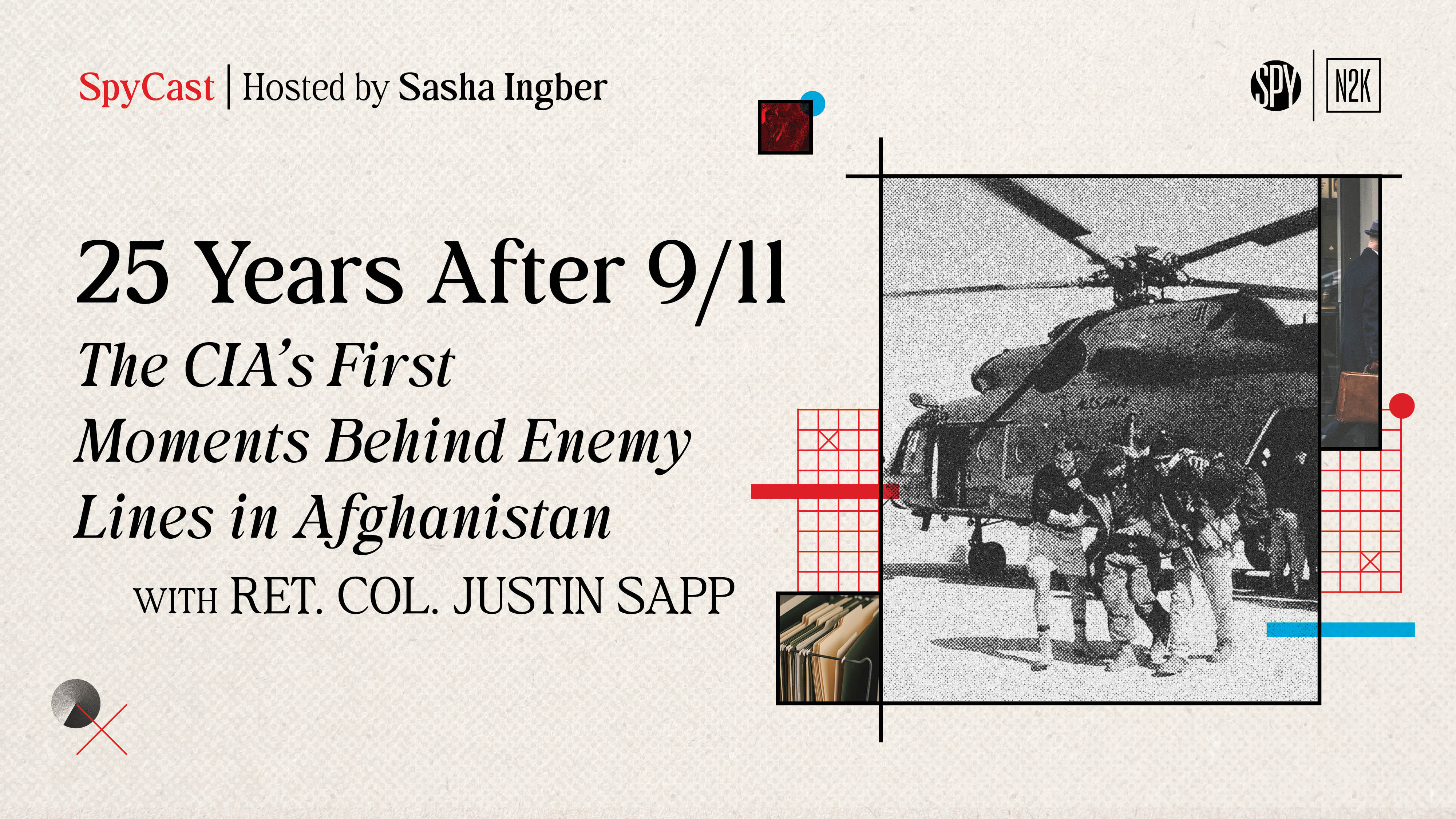


25 Years After 9/11: The CIA's First Moments Behind Enemy Lines in Afghanistan










SASHA INGBER: Welcome to SpyCast, the official podcast of the International Spy Museum. I'm your host, Sasha Ingber, and each week, I take you into the shadows of espionage, intelligence, and covert operations across the globe.
Retired Colonel Justin Sapp was a Green Beret detailed to the CIA after the September 11th terrorist attacks. He was part of Team Alpha, the first eight Americans to drop into the mountains of Afghanistan to avenge the United States, behind enemy lines. At 29, Justin was its youngest member. There was no time to onboard him, and he was told he was leaving the next day, departing from the DC area to a base in Uzbekistan, then touching down in northern Afghanistan on a Black Hawk helicopter.
Justin would go on to clear the way for follow-on forces to land, secure alliances with warlords to oust the Taliban, interrogate enemy fighters who had been captured, and tragically lose his colleague, Johnny “Mike” Spann. Justin takes us back into that historic mission 25 years later.
Hey, Justin. Welcome to SpyCast.
Justin Sapp: Thank you. Pleasure to be here.
SASHA INGBER: So what were you doing on 9/11?
Justin Sapp: On 9/11, I was actually in training down in Florida, in Key West, Florida. I was going to what they call the Combat Divers Course, which is a Special Forces underwater operations course, and I was in about the fourth or fifth week of training when 9/11 happened.
SASHA INGBER: What was that moment like for you when you found out what had happened to your country?
Justin Sapp: So it was a little delayed. We were actually underwater, so we would do multiple dives a day, and we were coming off a morning dive. And I recall coming out of the water. It's probably sometime around 9:30 AM, somewhere in there, and I heard one of the instructors talking about a terrorist attack, and we were cleaning our equipment.
He mentioned a terrorist attack, and I thought it was something, um, you know, overseas. And I ask him, and he goes, "Well, you haven't heard? Well, you're gonna find out soon enough." And then maybe 10 minutes later they said, "Everybody get up in the classroom." So we went up into the classroom, and then one of the instructors had a VHS cassette that he had recorded that morning, I- presumably at home, and it showed the plane hitting the second tower.
And he said, "This happened this morning. Our nation is under attack. We are convinced it's a terrorist attack." And it was surreal. And then he took the tape out, and then he said, "We're gonna suspend training, and we're gonna guard the base." And so we spent about a day and a half or two days basically guarding this peninsula in the Keys from some potential attack.
I had just been in Uzbekistan training their military for dealing with the Islamic movement of Uzbekistan, which was coming out of Afghanistan, and I knew it was bin Laden because I just knew enough about the area. And then we went back, and then of course a couple days later, it became apparent that it was Al-Qaeda, and bin Laden was, you know, the mastermind of the whole thing.
SASHA INGBER: And then a few days later, essentially, you were detailed to the CIA. So let's get into the actual early days on the ground. The country was reeling. The Taliban had harbored Al-Qaeda, and its leader, Mullah Omar, was not giving up Osama bin Laden. So the thinking was ultimately to destroy the Taliban to then get to Al-Qaeda and eventually bin Laden himself.
How much intelligence did you have before this mission began?
Justin Sapp: We had some, but I was at CIA headquarters shortly, you know, a couple days later. So arguably, you're in the best place in the world for that kind of information. However, it was a bit patchy because it was clear that we didn't know exactly where Osama bin Laden was.
We knew he had been at Tarnak Farms near Kandahar. But other than that, the assumption was he had left that area and gone into hiding somewhere, anticipating, you know, an attack from us. The important thing was, in terms of the strategy... They figured out pretty early on that we had to get the Taliban to surrender or defeat them to get at Al-Qaeda, because they were pretty much, you know, working hand-in-hand obviously.
But we really didn't know exactly where they were, and there was different elements. You know, you had Al-Qaeda core, who were mostly, you know, Bin Laden's close affiliates and mostly of Arab, you know, origin. And then you had the Al-Ansar brigades who were fighting with the Taliban, who were international people from all over the world who had come to Afghanistan to participate in jihad.
Some were Arabs, some were Indonesian, some were Americans, Australians, Chechens.
SASHA INGBER: So in the rush and in this chaos, I heard that there was a, a quick shopping spree, that, uh, one of the surrounding areas by the agency and REI suddenly became a very popular location with people checking others out, thinking, "Why is everyone going out camping right now?"
Can you talk about some of the chaos and that preparation?
Justin Sapp: Yeah, I mean, that's a very accurate portrayal. So what happened was when I got there, the CIA folks said, "Look, you can't really bring your military gear." Of course, we had tons of great military gear, but this was a covert operation. We didn't wanna signal our affiliation with the military to government.
So it was decided that we had to go and get civilian equivalents to what we had, which of course, it's not perfect. So they gave us, I, I wanna say it was somewhere between $3500 and $5,000, and we went out in one afternoon and evening, and mainly at REI. Went there and we kept the place open 30 minutes after closing.
Of course, they were happy to oblige, and then we walked out of there with two big bags full of REI camping gear. You know, all the stuff you can imagine, sleeping bags and cold weather gear, boots, all that kind of stuff. And that was what we outfitted ourselves with before we departed to Afghanistan.
SASHA INGBER: I'm curious to know what you, as a 29-year-old, were leaving behind.
Justin Sapp: Well, I didn't have a lot to tie me down in terms of family. My dad was a retired CIA officer. I met him in DC briefly before we left, and of course, he had figured out what was going on. I had a buddy who was also being detailed, and we were both captains, and my dad just looked at him and said, "So which of you two are going to the Panjshir Valley?"
Which is the valley in northeastern Afghanistan, where Ahmad Shah Massoud was.
SASHA INGBER: And that's the head of the Northern Alliance, which was providing the resistance to the Taliban, and therefore, also Al-Qaeda.
Justin Sapp: Yes. Of course, he had been killed about two days prior by Bin Laden, by terrorists, two days prior to 9/11.
That had been the bastion of resistance against the Taliban, against the Soviets, and so that was the natural place to go.
SASHA INGBER: Now, you were under tremendous pressure at the agency. There had been a team that had previously been fired. Uh, what was it like for you in that moment, especially as you were integrating in?
And can you talk about those horsemen whose mission had been axed?
Justin Sapp: So the pressure was twofold. One, it was just the unknown, right? "Hey, you're gonna go, you're gonna be detailed with the CIA, you're gonna go in with them, you're gonna set the conditions for the Special Forces teams coming in." That, that was, those were the broad parameters.
But there was a lot of stuff we didn't know. For example, we didn't know, or at least I didn't know which warlord we were going to support. And so you just had to deal with that lack of information and roll with it.
SASHA INGBER: And not question.
Justin Sapp: You que- question, like, "Hey, can we get this and that?" And they would give you something.
Like, they had these very nifty, like, 3D satellite pictures of Afghanistan, but they were of southern Afghanistan where bin Laden had been. In the end, that was really cool, but not very relevant to where we went, because we went to northern Afghanistan. So that was an example of like, you know, just a lot of gaps in, in the information.
Now, when we got to Uzbekistan, the pieces of the puzzle started to come together more and more. The team that was fired actually got fired about a week later, actually in Uzbekistan. So there was tremendous pressure, but it wasn't pressure as in, "Hey, you know, someone's breathing down your neck." It was just the sort of chaos, because you could feel that the National Command Authority knew in broad terms what they wanted to achieve, but operationalizing it had not coalesced yet.
So that was the concern. Do we have the right equipment? Do we know what we're doing? We didn't fully know the details of the mission, so that was stressful. We had to get the radios ready and the fills for the radio, all this kind of technical stuff. We had to do that, and it was just a mad scramble. It's like rushing to go on a, a trip somewhere.
You don't know exactly where you're going, but you have to prepare the best you can. It was sort of like riding, surfing a wave, and you just didn't wanna wipe out. You knew there's tremendous momentum behind you, and all you were focused on is doing everything you could not to get fired
SASHA INGBER: So now you're in this van heading to the airport in the vicinity of DC.
You're getting to know your fellow paramilitary officers. Between that ride and a stopover in Europe that then takes you into Uzbekistan, what were the conversations like with the rest of Team Alpha?
Justin Sapp: It was pretty normal stuff. There was no foreboding, like, "Oh my God," you know, this. It was just sort of getting to know people, you know?
They had all been in the military, many of them in Special Forces. And so the ethos is you're sort of the quiet professional, so there's this, like, expectation that you don't show stress.
SASHA INGBER: Can you take us into the first moments when you're leaving Uzbekistan and now flying into Afghanistan on October 17th, 2001?
Justin Sapp: It was maybe an hour and a half after dark, so we waited until there was no light. We were flying with the best helicopter unit in the world, the 160th Special Operations Regiment. We loaded up on what they call an MH-60, which is a special ops Black Hawk, and there were two of them, and then there was another aircraft that had extra fuel in case we ran out of fuel.
We had rehearsed things, but the pilots, you know, uh, they- they're phenomenal, and this was their first combat mission where they refueled in the air. So they actually refueled off another aircraft, but I had no idea because they were so, uh, calm and collected that you had no idea. It was just like this was another day on the job.
As we flew towards Afghanistan, the first thing I noticed was I could see Afghanistan because everything south of this river, the Amu Darya River, was dark, and everything north of it, there were cities and lights and villages and so forth. But south of that river, it was just dark, and there was a couple, like, fires you could see off in the distance.
And I'm like, "That has to be Afghanistan." It was a pretty clear night, a pretty good illumination from the, the moon, and so you could see quite well. I could see the moon reflecting off the river, and I knew that was Afghanistan. And sure enough, as we crossed, we went low level, maybe several hundred feet, and that part of Afghanistan is quite flat.
There's, like, sand dunes, so we're flying over that. And they came over the headset. We had headsets on, and they said, "Hey, welcome to Afghanistan. We're in Afghanistan." And then we started to gain altitude because the mountains were coming, and we went up maybe 5,000 or 6,000 feet, and we were hugging the terrain pretty close.
I saw lights flickering, and at first I thought it was gunfire, but I noticed that I think what it was is we passed over these houses, these mud houses. People were opening the doors to see what the noise was, and the fire in their house was kind of illuminating their threshold of the door. And then it happened several times.
It's kind of weird. And then, you know, about an hour and a half into it, not even, we started to descend into the landing zone.
SASHA INGBER: And there was this vortex phenomena that ultimately would impact the raid on Bin Laden's compound in Pakistan about 10 years later. Can you describe that moment?
Justin Sapp: The helicopter landing zone was selected by the Northern Alliance, who we're gonna work with.
And, um, it was situated in a gorge. And it was a pretty, I mean, a vertical piece of terrain. This was straight down like an elevator. And we went straight down, which you don't do a lot in a helicopter, at least I hadn't. And as we landed, apparently this vortex phenomenon occurred. When you're in close confines, based on the physics and aerodynamics, my understanding is that you can lose a lot of lift from the rotors.
And apparently they had some sort of problem, and the pilot lost or started to lose control of the aircraft, and he was able to regain control at the last minute we landed. I had no idea. We got out, and years later, one of the pilots told me that. He said, "You guys, had he not regained control of the aircraft, you would have had some serious compression fractures in your spine."
And it was the same basic thing that happened to the Seal Team Six and the Army Aviation guys at Abbottabad in 2011.
SASHA INGBER: And one of the first things that you did when you were on solid ground was survey for a safe landing zone for helicopters with follow-on forces. Can you talk more about that part of this mission?
Justin Sapp: Yeah. So the first order of business for me, because I was the military detailee, was to do, uh, re- reconnoiter, uh, helicopter landing zones, or what they call HLZs. That happened the first day we were on the ground. So we arrived at night. That next morning, we went out forward to a town called Dayhi, which is in the Darya Suf Valley in northern Afghanistan.
There, there was a village there. We went to this compound, this adobe compound. We met with one of the Northern Alliance commanders, who was under Abdul Rashid Dostum, General Dostum, and we had a tea, and we chatted like you do in, in that part of the world and, and make introductions. And then I said, "Hey, look, uh, we need to find a place for some of our folks who are coming in.
What do you recommend?" And he said, "Well, anywhere around here." There was a, a field that had been tilled that was next to this compound. I selected that, mainly because it was in a somewhat safe area. It was near a structure that we could use to house the guys, and then it was also close to the front line in the sense that it was maybe two hours by horseback to the front line.
I know that doesn't seem close, but it was sort of a balance of between being close but not too close and out of range of, you know, an anti-aircraft fire. So we selected that. There's a whole process and a survey you do, and then we sent, sent that, uh, up via satellite, uh, to the military, and they took it from there.
SASHA INGBER: When we come back, how Team Alpha navigated the rivalries between the Northern Alliance and interrogated prisoners before a fatal uprising
You also mentioned how you had immediately sat down with some of the leaders of the Northern Alliance. And, uh, of course, the leader of the resistance group was killed by Al-Qaeda two days before the September 11th attacks. And there was tension that you discovered between these different factions, rivalries between General Abdul Rashid Dostum, who was the Uzbek warlord, and, uh, a Tajik leader, Atta Muhammad.
How did you and your team navigate those complications so that you could all unify to go after the Taliban?
Justin Sapp: So great questions. We went into a meeting within 30 minutes of arriving that first night on the 17th of October. There was no indication of that rivalry there. They were all very professional.
They were more interested in us and trying to size us up and, and see what we brought to the table. It was only later that I started the rifting, the rifts started to manifest.
SASHA INGBER: What did those look like?
Justin Sapp: The Uzbeks under General Dostum were positioned the best to launch the offensive. So the decision was made to send an SF A Team, an ODA, Operational Detachment Alpha, to link up with him, which is what we did about three days later.
Atta Muhammad, who was Dostum's rival politically, he became resentful and assumed that he was not gonna get the same support that Dostum had received. And so there was some information that he was upset and that he would potentially do something bad to one of us as a signal. And so it was decided to support him.
So they just sent in another A Team, S Special Forces A Team to link up with him. That mollified the situation, at least for the time being.
SASHA INGBER: So there was ultimately this marriage of convenience between these different leaders, and you were able to stave off that rivalry. Was it difficult for you as Americans to build trust when there were major cultural differences?
Justin Sapp: Most of the guys had been special forces, at least half of the team had. So we go through unconventional warfare training. It's quite extensive, and a big part of it is working with indigenous forces. So you're taught, you're put through scenarios where you have your sensibilities offended or you offend their sensibilities, and you have to kinda navigate that tension and work through it.
So for me, Afghanistan was, like, the perfect real-world validation of that training. That said, I mean, you gotta accept the fact we couldn't carry in more than a couple days of food and rations. So you're eating their food. You're totally on their diet. You're drinking water that, that they're drinking. Of course, we treated the water.
Um, and then you're also in a very traditional Islamic culture. Maybe the Taliban are much more strict and so forth, but it's still an Islamic culture. For example, I didn't see any women over the age of 13 that did, did not have a burka on. You didn't talk to women. You were insulated from half of the society there.
They would pray. You ha- you know, you respected times for prayer. There was very much, like, whatever you said, whatever your denomination, religious beliefs, maybe even if you were atheistic or an atheist, you certainly didn't say that. If they ask you something, it was like, "I believe in God," and you leave it at that.
But what was apparent is they respected the fact that you were a religious person even if you weren't Muslim. So you would try to avoid those conversations. There was a lot of things you just knew not to go there, right?
SASHA INGBER: And was there anything that Dostum or Mohammed wasn't willing to do, or were they 100% all in in going after the Taliban?
Justin Sapp: They were all in.
SASHA INGBER: And here's where we get into Badger Six territory, where you and two of your colleagues split off to go to Bamiyan Province in central Afghanistan, but you also spent time interrogating Taliban prisoners in a cave complex. Can you describe what that cave was like and who you were speaking with?
Justin Sapp: So very early on, a couple days after we had arrived, we found out that the Northern Alliance had captured some Taliban prisoners. I think there was probably about 25 of them. I, I don't remember exactly. That, of course, was very important, as, you know, intelligence officers wanted to go interview them to collect information from them.
We didn't really know exactly who they were. We just knew they were Taliban fighters. So we rode on horseback maybe about an hour south through a village that had been burned to the ground by the Taliban about a year prior, and we saw the sort of razed buildings and so forth, and then we went to what was basically a cave complex.
There were several caves. They probably been inhabited for thousands of years. They had fashioned like a, a wall and a door on one of them, and then on one of the outcroppings, they had an office, like a proper office that had windows and stuff. In one of the caves, the, the Uzbeks were showing us the prisoners, and they were very proud.
Like, "Here, we captured them," and they opened the door to this cave, and they were all packed in there, kind of crouched, and they just looked at us, and I'm sure when they saw Americans or Westerners, I think they were fearful 'cause they hadn't seen anybody like us. They were like, "Okay, we're in trouble." Of course, we had no intention of harming them.
We just wanted to get information from them. And so we went to that office room, and Dostum's head of intelligence, Amanullah, a big 6'4 Afghan, he brought them in one by one. I'd say treated them very well. He goes, "Look, I'm a devout Muslim, and I believe in there's laws in war, and we have to treat people according to the Islamic laws."
And he was very adamant of that, and we brought them in one by one, and we talked to them. I felt sorry for some of them because they came in, and their story was, "I'm whatever ethnic minority," say a Turk, a Turkoman, another, uh, minority in Northern Afghanistan. Said the Taliban just showed up in trucks and pointed a, a AK-47 at them and said, "You're coming with us. You're a fighter in the Taliban, and if you refuse, we'll kill your family, threaten your family, and so forth."
So they were pressed into service, and they were used as cannon fodder. It's important to understand how Al-Qaeda and the Taliban think in terms of using people. They don't put their best guys out in front.
They put the guys that are most expendable out front, and then the most valued people are held back in kind of reserve. And so these were naturally the first people to be captured. And one guy I remember said he was in a bomb crater- in a defensive position. The Taliban had given w- a rifle and one magazine with like 10 rounds of ammunition, and they said, "Go fight the infidels."
So these were sort of the type of people that, that we were dealing with. They were local area people. They weren't hardcore Taliban.
SASHA INGBER: And this man was standing in a bomb crater. That is the essence of low-hanging fruit, if ever there were any. And ultimately, they don't know anything about Al-Qaeda or the whereabouts of Bin Laden, is what you're saying.
Justin Sapp: That, that was our sense. Yeah, they didn't know much. Um, they were aware that there were the so-called Al-Ansar Brigade folks, the foreign fighters that were on the battlefield, but they were further back. And so that's what we were interested in, is like, "Where are those guys? Where are they right now? When did you last see them?"
These sort of questions. They were aware that they were there, but they were sort of like, "Oh, they're scared of you, and they're gonna keep running." But it was evident they didn't have any incredibly or specifically useful information, unfortunately.
SASHA INGBER: Now, a few weeks after a major Taliban defeat in Mazar-i-Sharif with the Northern Alliance, Team Alpha providing support for that push, directing airstrikes, there is this big Al-Qaeda surrender in a fortress that is guarding the city of Mazar-i-Sharif, the Qala-i-Jangi fortress.
These men are not being disarmed. There is a suicide grenade that goes off, and the next day comes an uprising where your colleague, Mike Spann, is very tragically killed. Can you take us into those moments of what happened to Mike and your own moments with him the night before, that morning, and when you said goodbye?
Justin Sapp: Yeah. So the, the day before, Michael and Mohammed and I were in a vehicle driving back to Mazar-i-Sharif. We found out about this group of Taliban prisoners that had surrendered. They were originally described as Chechens, and the Afghans were very fearful of the Chechens because they had a, a fighting reputation.
When we got to the outskirts of Mazar-i-Sharif, we linked up with the rest of the, the CIA team, Team Alpha, and then Dostum's sort of vanguard. And there was a chat about these prisoners. They were gone. They had already been sent into Mazar-i-Sharif to Qala-i-Jangi to, to be held there, which in retrospect was a bad decision.
The, the natural conclusion was, "Hey, you need to go interview these guys, because these guys are Al-Ansar Brigade. They're foreign fighters. They're closer to Al-Qaeda," and so forth. And so these were the guys we've been looking for. So that was decided. We went there the night before. There was a body from one of the guys who had blown himself up with a grenade that he had concealed.
So it became clear that these guys were very dangerous. Some of them had been completely disarmed, but I didn't see any of them above ground. They were all in this, this sort of cellar or, or basement structure, an old Soviet building in this much larger giant adobe fortress. Um, it was decided that we would come back the next day.
But I could feel... It was tense. It turned out that many of them were sort of like not his top-tier guys. They were sort of guys who were younger guys that were kind of like the B team, for lack of a better word, and they were used to guard the forces, because at the time, Dostum was attacking the city of Kunduz, which was to the east, which was a big prize in Northern Afghanistan.
And the next morning, it was decided we were gonna go in. It was gonna be Mike Spann, myself, and a guy named David Tyson, a CIA officer who spoke, uh, like three or four languages. At about 7:30 in the morning, the satellite phone rang and plans had changed. It was like, I need Justin to deliver a vehicle back to the town we had been in the day before.
And so myself and other officer had to go do that. And so I actually saw Michael and David off that morning about 7:30 or 8:00, then that was the last time I saw them.
SASHA INGBER: What was that last moment like with Mike? Of course, you don't know that that is a final goodbye, but what was his spirit like at that moment?
Justin Sapp: Oh, he was very focused. He was like, "We got this mission. We gotta go interview these folks." I'm sure he was thinking through how they were gonna do that. Very focused. He's a quiet guy. We said goodbye. I mean, it, it was sort of a little bit chaotic 'cause we had to restart the vehicle. There was so- something wrong with the clutch, and so we figured that out.
And then I said, "I'll see you guys sometime in the afternoon." And around 11:00 AM is when, as I understand it, the prisoner uprising started.
SASHA INGBER: And what happened at Qala-i-Jangi when that uprising began? Because it's my understanding that Mike Spann had been interrogating an American Taliban member about his allegiances.
Justin Sapp: My understanding is that they had been interviewing these prisoners for these Al-Ansar Brigade guys. These are the foreign fighter types, very devoted to Al-Qaeda and, and their mission and all that. They had interviewed them for two and a half or three hours, and so they were kind of getting to the culminating point.
I believe shortly before the uprising started, Mike and Dave had been talking to a guy who'd been identified as an Irish citizen or the Irishman, who was clearly a Western European guy, but he had a long beard and long hair, dressed like everybody else, like the other Al-Ansar Brigade guys, and he wasn't talking.
So they were trying to figure out who he was, but he didn't say anything. But David and Mike were interested in him. So they had interviewed a bunch of guys, I think it was coming to the end of it, and one of the prisoners they were bringing out of this basement where they were being held, he detonated a grenade that he had, he had s- hidden.
It killed at least one person and, and himself included. And then that provided the immediate sort of chaotic moment for the other prisoners to launch their attack. We now know that this conspiracy or this plan had probably been hatched the night before, and so the prisoners were kind of coming up and swarming the guards.
They were able to overpower several of the guards in the immediate vicinity of that bunker of where the basement was and take their weapons. So in this melee, David was about, I, I believe maybe 80 or 100 yards away from Mike. Mike was the first target. Dave said that he saw a guy coming at him and yelling, "Flee for your life."
He was trying to figure out what was going on. He heard the explosion. He drew his pistol, and then he heard Mike call for help, and then he started seeing people started shooting at him, and he basically had to close the distance to try to help Mike whole time he's having a shootout with these various Al-Qaeda, Al-Ansar Brigade guys.
He's able to get Michael's rifle, and then he's able to use it against these Al-Ansar Brigade guys. And so they were coming at him. Some of them he had interviewed. One guy spoke Russian, he was Dagestani. That guy came at him. In the span of probably less than five minutes, probably 10 or 20 people were killed, and Dave fortunately was able to escape, relatively unscathed, out the northern end of that compound.
Dave is just, by his wits and his ability to remain calm and focused, he was able to extricate himself from the situation.
SASHA INGBER: An incredibly disturbing moment. Now, I know that you knew Mike Spann well. And then when you find out that this situation has happened and he is no longer here, you could have been in that fortress as well.
It could have been you. What did that feel like?
Justin Sapp: So at the time for a variety of reasons, 'cause the information was unclear. We weren't 100% sure that Mike had fallen. Based on the circumstances, I kind of knew in my heart of hearts that was the case, because this battle went on for another three days. So we went back to the fort, and there was a lot of fighting, but we couldn't find Mike until the end.
It was much later when I got the story from David, 'cause you gotta remember, like, you know, things are going so fast, I didn't have all the information. You know, years later I got the information, and I thought about it. I said, Yeah, I, I probably would've been next to Mike. I'd like to think that, you know, two's better than one, and we could've prevailed and got out of there.
But, you know, it's one of those counterfactuals that you'll never be able to answer fully. But yeah, I think about it a lot, and it was just timing and circumstances that decided that one person was gonna be there or not.
SASHA INGBER: You had gotten drinks together, beer, in Uzbekistan. You had spent more time speaking with him in Bamiyan.
I know that he defied his CIA superiors by naming one of these helicopter landing zones LC Jake, after his baby, who had been born just months before. Can you tell us more about who he really was?
Justin Sapp: Well, you know, Johnny Michael Spann, he was a, a true patriot and a true mission-focused guy. He'd been in the Marine Corps.
Very serious guy, but a nice person, very quiet. He had a sort of quiet intensity about him that I liked. He wasn't a guy who was into bragging about himself. There was a point where our antenna for our satellite radio went down, and I could tell Mike was stressed out, because if you can't report in that job, you're not relevant.
But in spite of that stress, he never took it out on anybody. We just fixed it, and we were able to get that information up. He was a family man. He ha- he had a new, a newborn, Jake, and he had left his wife, Shannon, and Jake shortly after 9/11. And you could tell that that was very important to him, and he talked about it a lot.
We talked a lot about the military and his time in Alabama. He's from Alabama. He went to Auburn, stuff like that. But he wasn't a super talkative guy. You had to get to know him, and once you got to know him, he was great. We were quite friendly, and I probably spent more time with him during that mission, that whole operation, than I did anybody else.
And then I spent time with Mike right up to the day that the prisoner uprising occurred.
SASHA INGBER: Your teammate, CIA medic and paramilitary officer Mark Rosenberger, had been treating wounded Taliban fighters. Uh, can you explain why that was more poignant i- in light of what happened to Mike Spann?
Justin Sapp: Like a true medical professional, he, he was, showed no bias whether they were friendly or enemy.
Obviously, we're gonna be more concerned about the Northern Alliance guys and our own guys, but we started getting Taliban and Al-Qaeda wounded towards the end, and he treated them, particularly the Al Ansar Brigade guys, and these were real bad guys. They'd been shot. They had some pretty bad wounds. Some of the wounds were gangrenous, and he had to go in there and, you know, deal with that.
You could smell it. It was terrible, and he treated them pretty darn well. The interesting thing was, you know, Mark was Jewish, and he was just like, "Oh, by the way, when we're dealing with these guys, don't let them know I'm Jewish, just 'cause that's gonna create problems." I said, "Yeah, sure." I mean, like, it wasn't a big deal, but he treated these Al-Qaeda guys with the…Gave them the treatment that, that they were entitled to under the law of armed conflict. Certainly what was interesting, the Northern Alliance didn't understand that, and they were like, "Why are you treating these scum, these Al-Qaeda guys? I can show you some real people that need help." And we had to explain to them, said, "This is the way we operate. Like, this is our ethos, and you may not share it, but we're gonna do the right thing according to our rules and policy and so forth."
SASHA INGBER: Mm-hmm. I know that there's so much more to what Team Alpha did, and there's only so much time in this episode, but can we spend some time in the moment of today? I mean, this was really the start of George W. Bush's global war on terror, and in the ensuing 25 years, we have seen the, the factions of Al-Qaeda form, the rise of ISIS, Boko Haram, many others. Do you have any regrets, or is there anything that you think the United States should have done differently in the wisdom of these 25 years?
Justin Sapp: Well, I mean, I think the obvious thing is that a lot of people that, that I know would agree that, you know, precipitously leaving Afghanistan was a mistake.
It wasn't a binary decision. It wasn't A or B, stay or go. There was different options in the middle there. I was an advocate of, you know, a, a smaller footprint, but a, but a footprint nonetheless where we could support our Afghan allies. So I clearly disagree with that decision, and certainly when the indicators came out that things were going awry, to continue to execute towards that end state, that decision to leave, that, that was a mistake.
And in retrospect now I think we have potential problems with ISIS Khorasan, which is the ISIS affiliate in Afghanistan. Um, you have all sorts of complex political things going on between the Taliban and Pakistan. These problems are gonna continue to rise, and we're gonna have to deal with them. But Afghanistan is always gonna be a natural place for these sort of groups to coalesce and build up because it's, in many respects, their sensibilities and their beliefs are quite in line with the Taliban.
Uh, there's some differences there, but it's a natural place for, for these threats to emanate from, as is the Eu- Euphrates River Valley in Iraq, as is areas in Somalia or maybe northern Nigeria. They're all ripe for this kind of problems. Now we have problems in Mali and, and in, uh, Sub-Saharan Africa, and they're not gonna go away, and we need to be attentive to them, and we need to be prepared to deal with them.
SASHA INGBER: Now, I know that you are a co-founder of a nonprofit organization called Badger Six. This is meant to help the families of Afghans who helped you as part of Team Alpha and Badger Six. With Afghanistan now in the Taliban's control again, with some Afghans here in the United States not having their work visas renewed, how are these families faring?
Justin Sapp: So, you know, for our work with badgersix.org, I mean, this has been going on since the, really 2021. We've been able to help about 300 families. Many of them we got to the States. Some are held in limbo in the Middle East, and some are in Central Asia still, unfortunately. We haven't got them all out. We'll continue to work on that.
The folks that were in, are in the United States, some have done quite well. We're very proud of that. We're able to support them. They've received jobs and are self-sufficient and so forth. But some of the, the current concerns are weighing heavily on them. Um, we're trying to navigate that carefully, but yes, it's causing a lot of stress on these families.
SASHA INGBER: What are their concerns?
Justin Sapp: It's kind of complicated, but some of these folks are still here, and their status is kind of unresolved. Part of that started in the early days when they got here because they had fallen into this catch-22 where they had fought in the '90s with the Northern Alliance. And based on our US law, they were set up for extra vetting, so that delayed things unfortunately.
And so they were kind of held in limbo. Due to that delay, and then with some of the current, let's just say, immigration policies that have been enacted, they're kind of still in limbo, and it's hard to kind of move forward and make a plan for your rest of your life when you don't know month to month what the outcome's gonna be.
So far, our folks are doing okay. The secret weapon, so to speak, is that a lot of the younger children that were educated in Afghanistan for 20 years, learned English, come over with their parents, and they're sort of like the real force because they speak the language super well, they get integrated into society, they get jobs, whether it's in computer science or something like that, and they can really help navigate that family.
The idea is that they get on the ground, they get established, they get lodging, they get a job, and they're able to support themselves. And our cohort has done very well that way, and so I'm very proud of them
SASHA INGBER: Essentially, the work really doesn't end from those days. How do you plan to spend the 25th year anniversary of 9/11?
Justin Sapp: Well, I believe I've been invited to an event at, in New York City at Ground Zero for 9/11. So I believe I'm gonna go to that.
SASHA INGBER: And I imagine you'll be thinking about Mike Spann and others who sacrificed in the years that came afterward in the US's longest war.
Justin Sapp: Yep. In Afghanistan, Michael Spann was the first person to die in combat, and there was thousands more, nearly 7,000 killed in action between Afghanistan and Iraq.
SASHA INGBER: Do you think that we are wiser 25 years later?
Justin Sapp: I think we're more informed, maybe wiser. But that wisdom dissipates over time. So as people leave government, leave the military, a lot of that knowledge leaves, and you go through these cycles of we're fighting the last war, now we're focused on Iran and Ukraine and Taiwan.
And the, the interesting thing is my experience, I was brought up to train for Vietnam. Everything that we learned in the early days when I was a young officer was kind of cast in the Vietnam, kind of maybe Desert Storm thing. And then all of a sudden we were thrust into a situation that was very different than that.
I was fortunate 'cause I had training that was relevant, but you don't have a crystal ball on know where you're going. But you always have to keep those capabilities in your kit bag as a superpower or great nation, because they'll quickly evaporate. And you're seeing it now, a lot of the guys that served in the GWOT are senior people or they're leaving, and it doesn't take long for that knowledge base and that institutional memory to drift away.
SASHA INGBER: Justin, thank you so much for taking the time to speak today and to share the story of Team Alpha.
Justin Sapp: Thank you. It was my pleasure. Thank you very much.
SASHA INGBER: Thanks for listening to this episode of SpyCast. If you like the episode, give us a follow on Apple, Spotify, or wherever you get your podcasts, and leave us a rating or review.
It really helps. If you have any feedback or you wanna hear about a particular topic, you can reach us by email at spycast@spymuseum.org. I'm your host, Sasha Ingber, and this show is brought to you by N2K Networks, Goat Rodeo, and the International Spy Museum in Washington, DC.



