
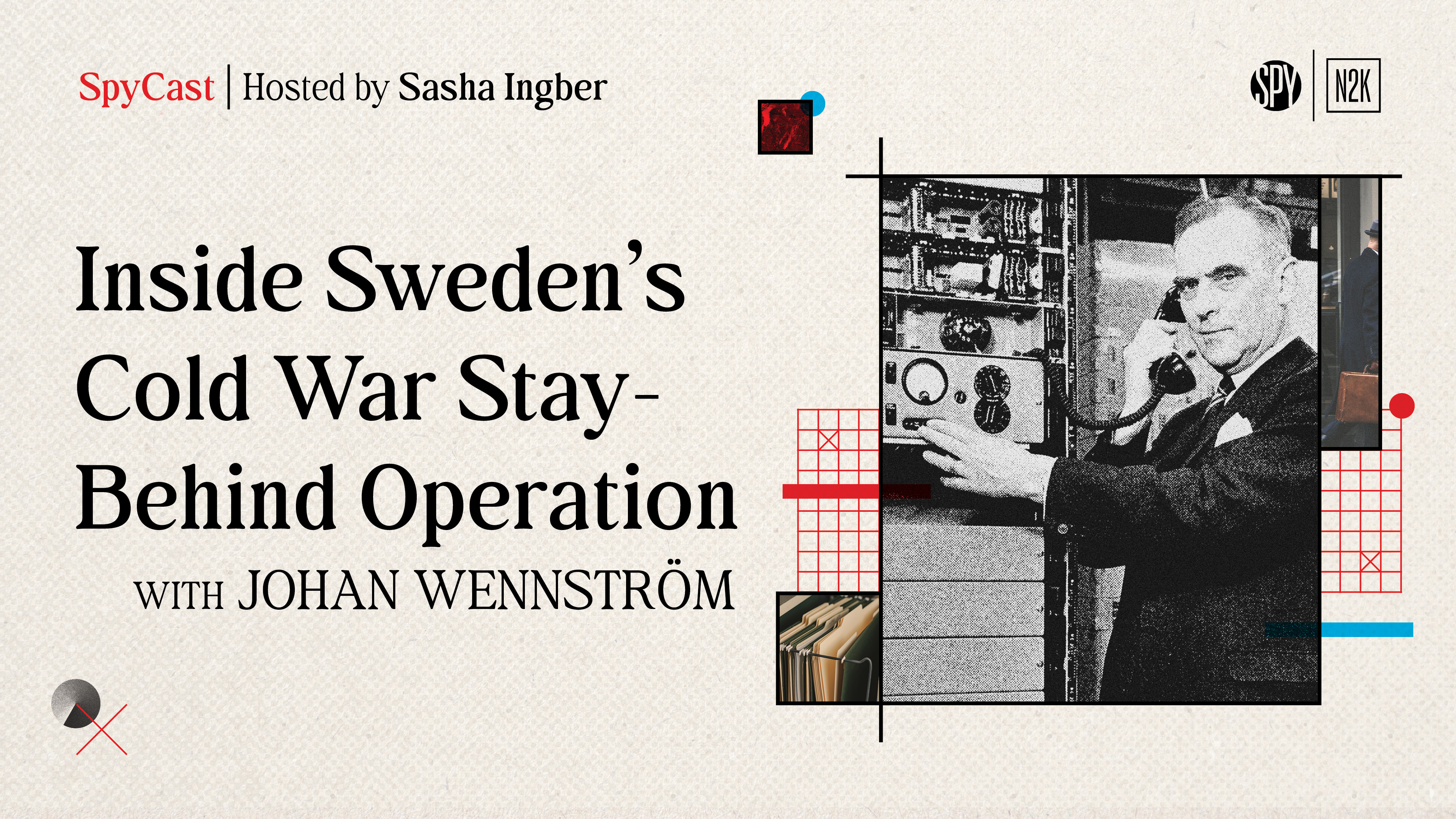


Inside Sweden's Cold War Stay-Behind Operation










Mark Jacobson: Welcome to SpyCast, the official podcast of the International Spy Museum. I'm Dr. Mark Jacobson, filling in for Sasha Ingber today. We're stepping into the hidden world of spies shaping events around the world.
It was a preparation for an invasion that might never come, and never did. Across Cold War Europe, stay-behind networks were established on the premise that Soviet forces might successfully invade and occupy sovereign territory.These clandestine organizations consisted of carefully vetted soldiers, intelligence officers, and everyday citizens tasked with remaining behind enemy lines to gather intelligence, conduct sabotage, and support resistance movements if their country were overrun. In neutral Sweden, the prime minister secretly authorized one such covert network in 1949 to mount guerrilla warfare against a potential Red Army occupation.
Today, I speak with Johan Wennström, author of The Stay-Behinds: Sweden's Cold War Guardians, about this long classified operation.
Johan, welcome to SpyCast.
Johan Wennström: Thank you very much.
Mark Jacobson: Johan, before we get into the Swedish case, what is a stay-behind organization?
Johan Wennström: Well, stay-behind is really an adjective. It describes, uh, you know, an organization, a military or civilian, that operates behind enemy lines in occupied territory.
In this particular case, we're talking about a civilian stay-behind structure in Sweden during the Cold War.
Mark Jacobson: It's very interesting because you write about how difficult it has been for historians to document, uh, the activities of stay-behind organizations or the stay-behind organization. Why is that?
Johan Wennström: Well, yes, you're right. My book is the first qualified book to appear in English on this subject. It has largely been left to journalists and conspiracy theorists. In the case of Sweden, our government and, you know, the, the qualified research community have not really been interested in pursuing this line of, uh, research because, um, you know, the, the, there was a fear of what might turn up.
You know, there was uncertainty regarding, you know, whether or not this was a, a legal organization or not, you know, uncertainty regarding what, what they really did during the Cold War. So it, it was seen as something that was better sort of left alone and, and, and for a long time, um, you know, was considered almost like, um, UFO research or something.
And I am, I'm the first qualified researcher in my own country to, to really document this history in detail.
Mark Jacobson: Well, you note that there was concern at the time about the legal basis for, uh, standing up such an organization, but there's also a very clear political risk, too. The ent- entire concept demands that a political leader says, "We are going to lose this war. And therefore, I need to set up an organization to deal with the aftermath.”
How difficult is that or was that to do?
Johan Wennström: Well, I think g- I, I think that was the main lesson of World War II for Western European societies, that you have to establish already in peacetime resistance networks because the, um, you know, the, uh, heroic resistance networks in, in Denmark, uh, Norway, France, and, and Czechoslovakia, you know, they really had to spend a few years improvising their enterprise.
And so when Sweden and by extension the wh- whole of Western Europe switched enemy in 1945 from National Socialist Germany to the Soviet Union, most countries, Sweden included, reasoned that we need to set up these networks already in peacetime so that everything is, is established for the next invasion really, because this was something that was really counted on, especially in the, in the 1950s and early 1960s.
Mark Jacobson: Could we talk about for a second what sort of infrastructure needs to be considered in advance? I mean, obviously, uh, you have things such as safe houses, covert communications network, but what was on the mind of those, uh, trying to set these things up with, uh, facing a, a potential Soviet invasion?
Johan Wennström: Yeah. Th- the most important factor is really the people in a resistance organization. Finding trustworthy individuals with the right character traits, that takes some time, you know, and that is really a precondition for everything else that a, a resistance organization does.
Mark Jacobson: So you're asking people to set aside part of their lives to spend years preparing for a hypothetical invasion that may never happen. How do you maintain that sort of devotion and, and adherence to s- the secrecy required to make that, uh, planning successful?
Johan Wennström: Yeah, yeah.
It's really interesting. A lot of the people that I write about in the book, they spent, as you say, years, sometimes even decades, you know, preparing for an event that never materialized, and they did sacrifice a lot, not only, you know, career advancement in some cases.
It, it put strains on their families. But perhaps m- most importantly, they carried the psychological burden of knowing that it was partly up to them whether or not a Soviet occupation would be successful in their part of Sweden. And why did they do this, you know, year after year? They never, never received any, you know, material compensation for their assignment.
It was really out of a sense of, you know, love of country, national sentiment. Which is, I think, not only, you know, touching, but also a very important lesson for our moment, that a will to defend your country is really fueled by national sentiment and not, not these sort of abstract notions about, you know, democracy or our parliamentary system or whatever.
It's really about, you know, uh, national love.
Mark Jacobson: Well, let's look at Sweden in 1949. Sweden is formally non-aligned, not part of the NATO alliance, of course, unlike today. But the Soviet Union's right across the Baltic. Uh, you have, uh, a coup in Prague that's just taken place. Mm. Uh, Finland's been pressured into a security arrangement with, with Moscow. What convinces Prime Minister Erlander that Sweden needs to at least start planning for an underground resistance movement?
Johan Wennström: Mm. Well, it was, um, partly the experiences of World War II. Um, uh Prime Minister Erlander, he, he had been involved with Sweden's secret, uh, support to the Norwegian and Danish resistance movements during the war.
Um, so he had experience, um, in this. But he also, you know, was very motivated by the events that you just mentioned, the stolen elections in Poland in 1947, the Prague coup the fo- following year, and, and, and of course, um, Stalin's offer to Finland merely hours after the Prague coup to join the Soviet Union in a friendship and security pact.
Um, and, you know, uh, Erlander and, and many other people in Sweden's military and, and political establishment at the time, um, reasoned that Sweden may very well be next in line.
Mark Jacobson: So it felt very real at the time. This was-
Johan Wennström: Definitely. Sweden had a ... was, you know, exposed to the threat of Soviet invasion throughout the Cold War really because of Sweden's strategic geographic position in the Baltic Sea.
And if the Western societies drew the lesson from World War II that we need to establish peacetime resistance networks, the Soviet Union learnt that they never again wanted to fight a military campaign in their own territory because of the catastrophic losses on the Eastern Front in, in World War II.
So the Soviets wanted to move the entire scenario westwards of Norway, and to do that, obviously, you have to go through Finland and Sweden. So Sweden might very well have been invaded on, you know, the first day of a wider confrontation between the Soviet Union and NATO.
Mark Jacobson: Well, let's talk about day one.
Johan Wennström: Mm.
Mark Jacobson: What would that have looked like with the Soviet invasion? What might the stay-behind organizations have to do in those first 24 to 48 hours?
Johan Wennström: I provide what I think is a plausible invasion scenario in the book to establish the fact that the stay-behind organization was not, you know, uh, merely the product of someone's paranoia.
Uh, it was a response to a, a, a real and present threat against Sweden. Before day one, we have to think about the days leading up to day one of, of an invasion. Most likely an invasion would have been preceded by a wave of, uh, you know, liquidations and sabotage efforts directed against Swedish infrastructure, fighter pilots, our electrical system, et cetera.
Mark Jacobson: So the Cold War version of a Green Man invasion.
Johan Wennström: Exactly. Exactly. The purpose of which is to hinder Sweden in this case from, um, you know, raising its guard in time, you know? And so when the actual invasion starts, the key fighter pilots have already been assassinated. The invaded country is, is struggling, you know, to keep together because of, you know, electrical failure, et cetera, et cetera.
So it's about really softening up a, uh, a country before the actual invasion. And it would've started probably on day one with bombing campaigns against Swedish military runways, and also the, um, landing of paratroopers close to centrally placed Swedish airports and harbors in order to, uh, you know, facilitate the landing of further troops via sea and air
Mark Jacobson: So let's assume for a minute for purposes of our scenario here: military victory. But there's the political situation as well. How, how were these organizations to determine whether or not the government had survived and, and who still had legitimate authority?
Johan Wennström: So the plan was to have the Swedish government and the royal family, um, along with the leadership of the Swedish stay-behind organization escape to a headquarters in either England or, or America and, um, conduct the struggle for Sweden's survival from there.
It was, for a long time, you know, an informal norm, but it, it, it became part of our constitution that Swedish government is not allowed to make decisions on occupied territory to maintain, you know, its political integrity. So the plan was to have the government escape, and then after the occupation had been, you know, successful and completed, the stay-behinds would spring into action, and they were supposed to listen for, you know, uh, radio transmissions, um, giving them, you know, the signal to start their work basically.
Mark Jacobson: Who was the Swedish stay-behind organization looking for? What types of, of civilians, what types of personalities in, in order to, uh, increase the likelihood that the resistance would be successful?
Johan Wennström: They often had jobs like gamekeepers or farmers or low level white collar workers, you know, sort of insurance salesmen.
And the organization was looking for people who, one, as I said earlier, had the right sort of personality, you know, who were trustworthy, who wanted to do, um, you know, a, a service to their country But who also had a, a, a, a profession that would allow them to, you know, without raising any suspicion, travel around in their local environments
Mark Jacobson: I mean, this sort of operation puts a real premium on leadership.
And, and I'd love to discuss some of the personalities involved. Uh, first, Teodor Palm. Uh, I don't know whether we'd call him our lead spy, but it's certainly a connection here between the stay-behind organizations and the part of government, uh, charged with sort of the overt defense of the realm.
Johan Wennström: Yes. Yes.
So, uh, Teodor Palm was, um, the head of Swedish intelligence for almost 20 years between 1946 and '64, and he was also one of the, uh, operational directors of the stay-behind movement for almost fif- 15 years. He was asked to do this to be a part of the, the tactical staff of the resistance movement because in 1949, there were o- there were only so many people you could ask, you know, to be a part of this who had that particular competence.
But he was not involved in this in, in, in his capacity as head of Swedish intelligence, and he was always very mindful of maintaining a wall between Sweden's in- int- secret intelligence service and the resistance organization. And that continued in later, uh, stages as well. The intelligence s- with- service was never, you know, directly involved in the, uh, resistance organization.
And, you know, other top military people who sat on the board, the chief of the army, Carl August Ehrensvärd, for example, they were there in a more advisory role. This was purely a civilian organization. But Teodor Palm is, is, is a really interesting character, you know, and, and if there's one hero in this book, to me, that's Teodor Palm.
He was a religious historian, um, before he became head of Sweden's, uh, secret intelligence service. Um-
Mark Jacobson: I mean, you've compared him to le Carré's George Smiley. I mean-
Johan Wennström: Oh, yes, yes. He, he looked exactly like, um, you know, Sir Alec Guinness in the Smiley films of the, you know, '70s and '80s, and you know Teodor Palm.
You really see a resemblance in, in terms of their personalities as well. They were actually so so similar that one can suspect that David Cornwell, John le Carré, you know, might have met Teodor Palm in, in Germany, for instance, during his MI6 service there during the Cold War. Who knows? But he's a real interesting figure who really belongs in a, uh, le Carré novel, you know, rather than the sort of prosaic reality of Swedish intelligence bureaucracy.
Mark Jacobson: Well, Johan, that's the next book, right?
Johan Wennström: It might be actually, because I'm now doing a commented edition of his diaries, which he kept during his time as director of the, uh, Secret Intelligence Service. It's really a unique document showing what the Cold War looked like on a, you know, daily basis from the point of view of Swedish intelligence.
And I, I build on that diary in the stay-behinds book, of course. It's one of the most important sources. Uh, but I'm now also, um uh, doing a, a commented version because a lot of it is written in, in code, and I was actually the first person to, to, to, you know, uh, break those codes and who was a- able to read it properly, you know.
So I'm now doing a, a version of the diary that everyone can read. It's a really important document, you know, not only for researchers, but also for the general, uh, you know, audience in order to understand Swedish security and for- foreign policy during the Cold War and, and actually also to, to understand, uh, the actions of, of, um, certain foreign security and intelligence services during the Cold War, including the CIA.
Mark Jacobson: I want to expand on the CIA, but in a bit different way.
Johan Wennström: Mm.
Mark Jacobson: Uh, there have always been some suggestions that the Swedish stay-behind and some of the other national stay-behind organizations were really created by the Americans. But you suggest that, no, that's really far from the truth. You have to understand there were potential relationships, but it didn't guide what was happening.
Johan Wennström: That's true. Yes, yes. Um, I mean, the CIA and, and MI6 were both involved with the various European stay-behind networks, but again, in a more advisory role. I was actually fortunate enough to meet someone who was the MI6 liaison for the Swedish stay-behind organization at one point and, and he confirmed this and said that, you know, he mainly contributed radio batteries and cartons of tax-free cigarettes.
But in Sweden, certainly this was a, an independent organization. There was an attempt by CIA and MI6 in the early 1950s to sort of co-opt this organization into a wider NATO structure. But that was firmly rejected by the Swedes because they wanted to keep it as a national defense organization. Of course, um, you know, utilizing advice and, and other forms of assistance from the Western powers, but it was never a question of, of ownership.
Britain, for instance, uh, you know, gifted the first shortwave radios in the mid-'50s to the Swedish Resistance Organization, for instance. CIA was kept in the loop. Obviously, obviously, Sweden counted on, you know, uh, support from the Western powers in the, in the event of invasion, you know.
Mark Jacobson: Do you think they accurately assessed the level of support they would have needed from the outside if, if the balloon had gone up?
Johan Wennström: No, I think, uh, in the Swedish case, they were very, you know, standoffish towards the Western powers. Teodor Palm particularly preferred dealing with the Brits over the Americans because he felt the CIA was trying to direct too much and try to take over. Nonetheless, I, I do think that maybe they were too standoffish, you know.
I, I think it was wise to keep a, a kind of strategic distance to the Western powers, but maybe they went too far, you know, considering the level of support that Sweden would have needed in case of an invasion and occupation. You know, not only conventional military support, but for instance also, you know, um, hosting a Swedish government in exile and, and the stay-behind leadership.
Mark Jacobson: There certainly is a material and logistical element to all this, but I, I wanna talk a little bit more about the human element. And I, I was hoping you could tell us a little bit about, uh, Alvar, uh, Lindencrona.
Johan Wennström: Yes.
Mark Jacobson: And I ... You know, at one point he even uses his daughter, I'm not clear whether it was wittingly or unwittingly, as, as part of his cover.
Johan Wennström: Unwittingly, yes. Yes. On her part, obviously. So, so this was the, the, the first, uh, national commander of the stay-behind, uh, organization, and he maintained that assignment for three decades, actually. He was the leader of what I call the first generation of the stay-behind movement with a wink to, you know, the, the, uh, Baader-Meinhof Gang and, and other sort of similar structures that shared this, this, you know, cell-like structure with the stay-behind organization.
And he was an insurance executive. And an aristocrat. He, um, was a very unlikely resistance leader in 1950s Sweden, you know, completely dominated by the Social Democrats. But of course, it was, um, the perfect cover, you know. And, um, he did use his eldest daughter, Elizabeth, as a kind of cover when conducting meetings regarding the resistance organization, you know, um, in public or, or abroad, you know.
So he, he often kept Elizabeth close in order to give the impression, you know, that it was just a father-daughter trip or something, uh, rather than something having to do with Sweden's contingency planning in the event of occupation. And she's not the only, uh, child who was used in this way. It was actually not uncommon that stay-behind operatives, uh, used, uh, one of their children in, in, in this way, which might be, you know, motivated from, from a tactical standpoint.
But, um, a lot of, lot of these children have, you know, in adult age, come to realize that they were actually used by their parents, you know, and have, have had to, uh, sort of reinterpret their entire relationship with that parent.
Mark Jacobson: Have they had the reaction one might infer from the, the, the patriotism you described that led civilians to want to be part of this organization, to work to be part of this organization?
Have they had those same feelings?
Johan Wennström: Yes, but very mixed, mixed emotions, I would say. Partly, at least the, the adult stay-behind children that I've encountered have very mixed emotions. You know, partly pride, of course, but also a kind of sorrow because they have had to realize, obviously, that the special attention that they were given in childhood was, you know, not necessarily motivated by, by love, but rather, you know, strategic considerations.
And that is, of course, a hard pill to swallow, you know, for, for anyone. Um, I do, uh, you know, interview Elizabeth, uh, Lindencrona at length in this book. She even has her own, um, chapter in the, in the afterword. And she actually accepts that her father put country above family and above her specifically.
It's so remarkable. It's so touching that she can feel that way, you know, and that she, by extension, also puts, you know, country above herself.
Mark Jacobson: You've spoken eloquently about families that have put their country before themselves, but Sweden as a whole, uh, you described as really punching above its weight in the international arena.
Johan Wennström: Mm.
Mark Jacobson: Does that mean this was successful? Where did this really have a, an impact on security beyond that of, of Sweden?
Johan Wennström: Well, yes, I do think it's emblematic of a wider attitude in Sweden throughout the Cold War, really. We were a, an, a non-aligned country, not just formally non-aligned.
We were non-aligned. Uh, we were never neutral, as you often say here. Um, you know, the doctrine was, uh, m- military non-alignment in peacetime, you know, with the ambition of being neutral in, in wartime, but obviously we we would never have been neutral. We were firmly, you know, uh, philosophically, uh, in the Western camp, but we did project, you know, an image of Sweden, uh, being this vaguely pacifist, uh, left-wing country that couldn't really decide between the West and, and the East.
Um, but that was a cover for a massive military buildup. At the end of the Cold War, we could still mobilize one million men overnight in our conscription army. Today we have two brigades. And we had a very professional intelligence service. Actually, Teodor Palm's intelligence service was the foremost partner service to CIA and MI6 during the early Cold War Partly because of his, I think, um, you know, um, sort of strong integrity.
Uh, the Brits, MI6 said that he was the most difficult person they've ever encountered. And, um, Teodor Palm was also good friends with Allen Dulles. You know, when I went through his personal correspondence, I found, you know, Christmas card from Allen Dulles. And I, I think that was, you know, really a sign of the respect that Teodor Palm enjoyed in the Western intelligence community because he was a nationalist and he didn't want to subjugate himself and the interests of his country, you know, to the interests of, of foreign powers.
And that was actually the leading principle of Sweden's foreign and security policy during the post-war era. You know, we did what was necessary to keep Sweden safe. And if that meant, you know, collaborating clandestinely with NATO powers, you know, so be it. But because of our geographical location, you know, we need, we needed to maintain the illusion that we were the sort of third-way country
Mark Jacobson: When we come back, we look at the conspiracy theories surrounding the Swedish stay-behind network
Now, with the end of the Cold War for Sweden and for the world, we're all fortunate that these operations didn't have to take place. But there's often a darker afterlife to these organizations once they're stood down and they become public. And in, in the case of Sweden, there were some conspiracy theories that developed around this organization, perhaps that it kept on going after the end of the Cold War.
Johan Wennström: Well, it did, did go on after the fall of the Berlin Wall, of course, and it went on well into the 1990s. So apparently some people in our government didn't really believe the sort of end of history hype, but it was always under democratic control, and it was always this kind of compartmentalized organization.
Nonetheless, you know, uh, as you said, um, conspiracy theories abound, particularly concerning a link between the stay-behind organization and the assassination of our then Prime Minister Olof Palme. But in my view, that is sort of part of the disinformation campaign that has been directed towards the Swedish stay-behind organization from the left and from, from Russia even.
It's, it's, it's interesting to note that both Iran and Russia uses Western stay-behind organizations in their contemporary propaganda against the West, you know. So it's important that we really understand what this phenomena was. They couldn't have assassinated Olof Palme for two reasons. One, you know, this was a, an organization set up to defend the Swedish state, and it was personally sanctioned by Olof Palme.
And so it's, it's inconceivable that the leadership of this organization would have ordered a hit on Palme. Which leaves, of course, the, the other option that an individual cell, you know, did this. But how could they plan a prime ministerial assassination if they never met and didn't know each other's identities?
You know, it's hard to plan something like that through a dead drop.
Mark Jacobson: Let's bring this into the present. We have a revanchist Russia. We've seen what's happened in Ukraine. We have wonderful popular series that have come out, such as the Norwegian series Occupied, suggesting what might happen in a, uh, 21st century Russian in- invasion of the West.
What are the lessons that NATO nations can draw from the Swedish experience during the Cold War? What did they get right? What might not have gone as well in, in hindsight? How should we look at th- this operation and the lessons for NATO today?
Johan Wennström: Well, I think there are both tactical and strategic lessons to be drawn from this history, and that is actually a point of the book.
I call it a, you know, um, as historian Niall Ferguson says, applied history. And I think it, it demonstrates, you know, the sort of timeless usefulness of having stay-behind forces. The invasion of Ukraine demonstrated that the sort of Cold War invasion scenario in fact never vanished. And in our highly technological society, it's really useful to have a low tech primitive kind of resistance network set up already in peacetime.
I think the strategic lessons to be drawn, not only for Sweden but for, for all Western NATO members, is that it, it might be wise to have a kind of strategic distance to not only the major powers in, in NATO, but to, to allies generally, you know. In Sweden and I think many other NATO countries, there is a kind of exaggerated belief in the solidarity within NATO.
But you have to understand that you need to maintain the logic of the nation state within a military alliance, and to have the competence and the resources to defend yourself, you know, the mutual defense clause of the North Atlantic Treaty notwithstanding.
Mark Jacobson: Johan Wennström, thank you very much. The book, The Stay Behinds: Sweden's Cold War Guardians.
Johan Wennström: Thank you. It's been a, been a pleasure.
Mark Jacobson: Thanks for listening to this episode of SpyCast. If you like the episode, please give us a follow on Apple, Spotify, or wherever you get your podcasts, and leave us a rating or review. It really helps. And if you have any feedback or want to hear about a particular topic, you can reach us by email at spycast@spymuseum.org.
I'm your guest host, Dr. Mark Jacobson, and this show is brought to you by N2K Networks, Goat Rodeo, and the International Spy Museum in Washington, DC.



