
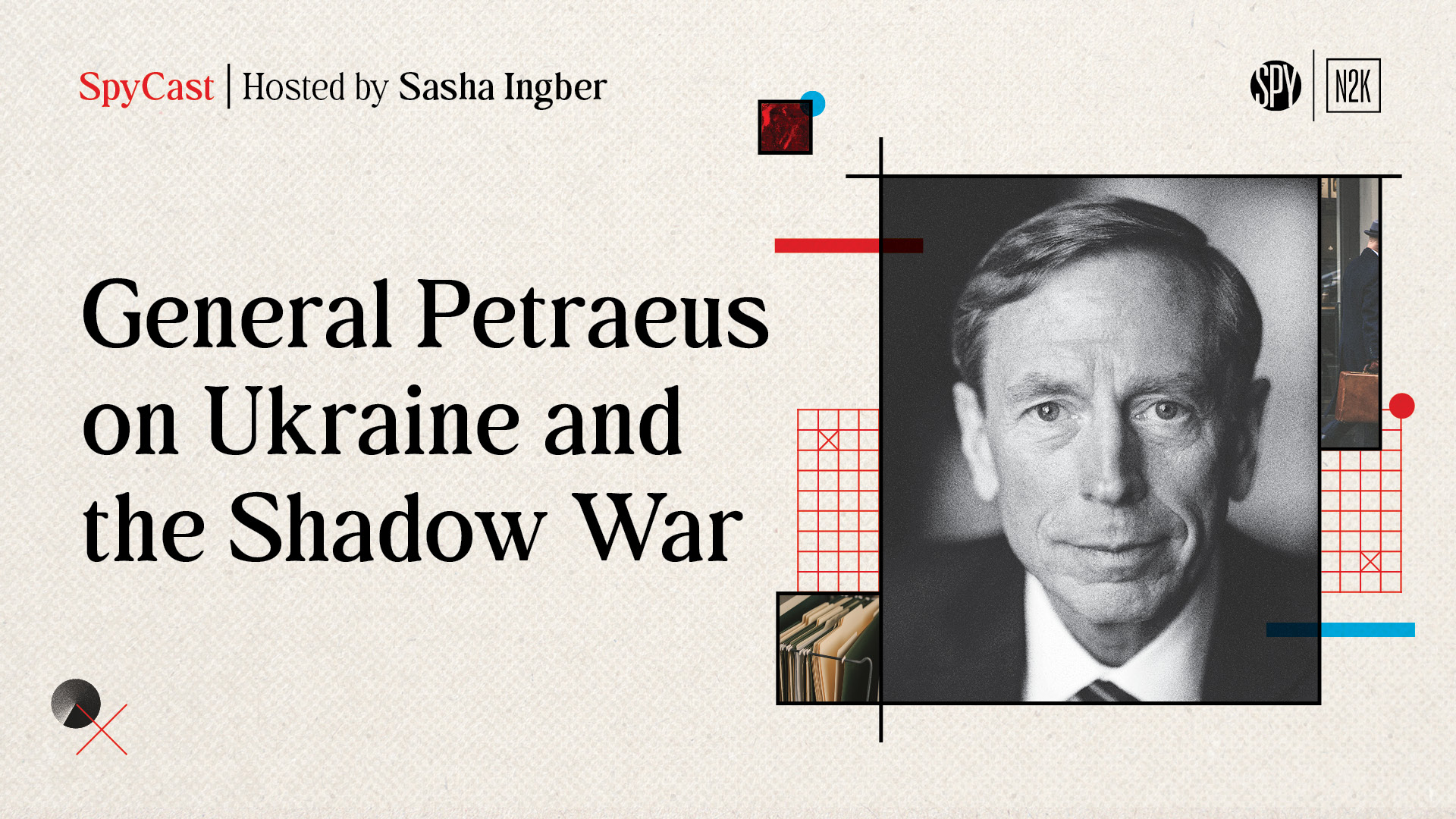


General Petraeus on Ukraine and the Shadow War


Sasha Ingber: Welcome to SpyCast, the official podcast of the International Spy Museum. I'm your host, Sasha Ingber. And each week, I take you into the shadows of espionage, intelligence, and covert operations across the globe.
Winter is coming, and that means Ukraine has to gear up for another brutal season of strikes to its energy infrastructure. Russia's bid to cut off power and heat, making life harder for all Ukrainians. Earlier this year, Ukrainian forces reversed the enemy's territorial gains. And now, Vladimir Putin appears to be stepping up long-range strikes, not just to attack Ukraine's energy system, but water, railways, and bridges. The Ukrainians have responded with their own long-range attacks on Russian energy sites. Since the full-scale invasion of Ukraine began, former CIA director and four-star general, David Petraeus, has taken numerous trips to Ukraine. He sits down with me to discuss not just major developments on the battlefield, but the quieter side of the war, the covert maneuvering behind closed doors and the threats of sabotage troubling the European continent.
Good morning, General Petraeus. Welcome to the show.
Gen. David Petraeus: Good to be with you. Thanks, Sasha.
Sasha Ingber: I know I accosted you on the sidewalk. You said, yes, to coming on the podcast, and I am very appreciative of that.
Gen. David Petraeus: It's what happens when you walk a street in Washington.
Sasha Ingber: That's right. Be careful who you talk to. Now, you were a CIA director two years before Russia first invaded Eastern Ukraine, which happened in 2014. Can we go to the moment when the full scale invasion of Ukraine began in 2022, when you decided that you wanted to go to Ukraine?
Gen. David Petraeus: Well, I had been going to Ukraine for a number of years. In fact, the first time I was actually in Kyiv, it was still part of the Soviet Union. I'd actually been to the front lines in Donetsk province down in the south before the full scale invasion. I'd watched as the Ukrainian military had increased its professionalism, its expertise, its training on NATO standards and so forth. And I thought by the way, that the Russians would have a very, very tough time taking Kyiv. In fact, that Kyiv was very defendable if the Ukrainians did what I thought they would do, and that was exercise a lot of initiative, use their knowledge of the terrain and so forth, which the Russians did not have. And given that, that they would be able to stop the Russians, then go after select targets such as fuel tankers and so on, basically to keep that Russian offensive from continuing beyond the outskirts of a city that because of the wooded areas, because of the limited number of roads and so forth, and ultimately, key bridges, that they would be able to defend Kyiv and they indeed were successful.
And months later, I thought that it would be important to go to Ukraine to assess the situation for myself. I was sanctioned by Vladimir Putin for my support of Ukraine and I've been there, I think it's 10 or 11 times since the full-on invasion, with the last trip being just a couple of months ago.
Sasha Ingber: What has been your most memorable trip since 2022 and among the many times that you've now gone?
Gen. David Petraeus: Well, there have been a number of trips that would compete for that title. I mean, it's a little bit hard to top the last one, where just before we left Ukraine and entered Poland, the locomotive of a train halted next to ours and also evacuated as ours was, was hit by a jet-powered Russian drone, which punctuated again, that particular departure. But no, I think over the years, there were numerous occasions where I came back and realized that Ukraine is defining the very future of warfare, that their adaptation, their innovation, their extraordinary technical skills with software, hardware, and manufacturing coupled with the sheer determination, not just of those on the front lines, but also the sheer relentless determination of the entire citizenry, the entire population has been to date, absolutely unbreakable despite the enormous pressures on them in the past. For example, last winter when the Russians tried to turn out the lights and turn off the heat, which they are trying again to do this winter, with the advantage of having developed jet powered drones for which the Ukrainian interceptors don't have an answer.
Sasha Ingber: The determination of the Ukrainian people to defend their country is truly remarkable. And it is worth remembering that every day, this has been something that they have had to undergo since 2014, didn't start in 2022, specifically on that Russian drone that hit the train station that you were at.
Gen. David Petraeus: It actually hit the locomotive of the train parked next to ours.
Sasha Ingber: There had been speculation that maybe this was targeting officials and former officials. I know that the former UK prime minister, Boris Johnson, had just left. Do you think this was coincidence or was this actually meant to cause damage to foreign officials and former officials like yourself?
Gen. David Petraeus: None of us really know whether this was coincidental or planned. The Russians have been attacking locomotives throughout the country for better part of a year and a half. The railway system is one of the key sinews of the entire society, if you will. They've also been hitting gasoline stations, trying to degrade the trucking capabilities and so forth, so the road system as well. In fact, that particular night, they first hit the locomotive, as I said, of a train that was also halted next to ours and the next track over, and had been evacuated because the air defense centers could see that there were Russian drones circling overhead. And then shortly after that, they hit a gas station, which went up pretty substantial flames as well. So again, it's very hard to truly contend that this is definitely trying to discourage foreigners from coming in and showing their support for Ukraine, or if again, it was just something coincidental. The passengers on these trains leaving Ukraine are essentially women and children, so it was obviously terrifying for them.
Sasha Ingber: This was a terrifying moment for people who do not know war. For you, four-star general who has gone to war zones, was that a harrowing moment for you?
Gen. David Petraeus: I guess less so, frankly. Again, we'd been under volleys of rockets and so forth, and mortars and all kinds of other attacks over the years in Iraq, particularly during some of the key moments of the surge in Iraq, which I was privileged to command. And I guess you get a little bit used to that. And I had personally thought they're just not going to hit passengers. I don't think that they would do that. I think they're going to hit a locomotive if indeed it strikes. And that was what turned out to be the case, albeit the locomotive of the train parked next to ours, not ours thankfully, as we were able to exit shortly after that.
Sasha Ingber: And just briefly, as a former CIA director traveling to Ukraine, what is that like?
Gen. David Petraeus: Well, on one hand, it's wonderful again to be able to see a country full of people who are so determined not to let their much, much larger neighbor succeed in his goals of toppling the regime, basically making them subjects of the Russian Federation in practice, if not entirely territorially. I am sanctioned by Putin. I was cautioned by my old organization that the Russians were trying to go after me in various ways. There was one trip where they knew in advance that I was coming, but we have quite a bit of security. There are a number of former agency senior intelligence officers who go with me each time. At least two of these have been senior station chiefs in Russian-speaking locations. We're provided a police escort, hard car. We have additional security that we take on to ensure that we'll be as safe as you can be. And this is, I wouldn't say business as usual, but it essentially is.
Sasha Ingber: Right now, today, there are Ukrainians who have been panicking over a disruption in the Starlink terminals, but we have also seen the United States reportedly threaten to pause intelligence sharing with the Ukrainians. Last year, President Trump did pause intelligence for about a week. The Ukrainians leaned harder on the British MI6, but the US intelligence has helped with not just early warning on attacks, but also for targeting Russian troops and equipment, infrastructure inside Ukraine. So given where we are right now, how important is the intelligence sharing relationship for the Ukrainians?
Gen. David Petraeus: Well, US intelligence capabilities are far greater than those of any of our intelligence partners, noting that yes, MI6 is an extraordinary partner, one of the Five Eyes as well, of course, share just about everything that we have with each other. That's not just the US and UK, it's also Australia, New Zealand, and Canada. But at the end of the day, there are capabilities that are much, much greater, and the Ukrainians prize these capabilities and put an enormous value on the intelligence sharing that does take place.
I typically, in each of my visits while we're in Kyiv, will meet with the foreign intelligence director, essentially the counterpart of the CI director, and also typically, the internal intelligence as well. They do have, by the way, extraordinary intelligence of their own, keeping in mind that of course, Ukraine was part of the Soviet Union until the collapse of that USSR. And so you have some advantages in terms of individuals that literally went to school in Moscow or other Russian cities still serving in the ranks with obviously, very fluent Russian capability and knowledge of the elements within the Russian intelligence and paramilitary, and also, military organizations.
But at the end of the day, there are certain capabilities that the United States has both in terms of early warning and in terms of truly strategic intelligence that is just not replaceable. I should note that I was talking with some individuals last night who are very knowledgeable about what's going on, and they actually assured me that whatever the rumors were, there was not a policy change with respect to intelligence sharing, and also frankly, with respect to the access to Starshield, which is a military version of Starlink, that is so important to Ukrainian operations all the way from the tactical to the higher levels. There is no question that the access to Starlink was degraded yesterday for a period of time. In fact, I was flying home from the Warsaw Security Forum and getting texts both directly and indirectly from people who were noting that the lack of access to it during a particular period was causing difficulty for controlling forces on the ground in response to Russian efforts to take advantage of that particular development.
And then that later, well, it was back, but it was limited to objects traveling less than 160 kilometers an hour, which means that the top speed of the critical interceptor drones would not be enabled communication. The command and control link would not be enabled if they use their top speed in pursuit of the Russian piston-powered drones, and perhaps even in some cases, the jet-powered ones. I was assured today that everything is back the way it was. And frankly, there's finger pointing in every which way that does not offer clarity about who made the decision, why they made it, and the rest of that. It's obviously a crucial capability for the Ukrainians to have, and without it, needless to say, it'd be at an enormous disadvantage.
Sasha Ingber: We have seen the movement of Ukrainian officials, and one of them is General Kyrylo Budanov, who was the head of military intelligence. He's now President Volodymyr Zelenskyy's chief of staff. How has that switch affected the way Ukraine operates both offensively and defensively?
Gen. David Petraeus: I know General Budanov quite well. I typically have met with him every time I've been in the country and valued his assessments. He's quite blunt and quite forthright. And you need that kind of analysis and assessment if you're trying to understand the dynamics in a situation like this. It's a sign obviously, that President Zelenskyy puts a great deal of trust in him to make him his chief of staff, but I don't think that has a particularly profound operational or strategic effect. What you do have is a person right next to President Zelenskyy who certainly has a deep understanding of the military situation, military operations. In fact, I should note, the first time that I met General Budanov was actually over a video link. He was not in the office, to our surprise. He was out actually near the border with Russia overseeing one of the early operations that went into the Russian Federation from Ukraine with some very dedicated individuals with enormous skill and expertise.
Sasha Ingber: Yeah. He has a reputation for bending the rules and marching to his own drum, and I could probably come up with a few more cliches to describe him.
Gen. David Petraeus: Well, a number of people who have worn the uniform have had those distinguishing features.
Sasha Ingber: That's true.
Gen. David Petraeus: Including the great leader of the Spy Museum and perhaps also, the individual you're interviewing.
Sasha Ingber: Yes. So speaking of the military intelligence agency known as HUR, in September, we saw a shootout between HUR and the domestic intelligence service known as the SBU. This is almost like something that you would expect in a spy movie, where different agencies are really duking it out in the street, but per Reuters, this had to do with a Russian activist who was fighting alongside Ukrainian forces. And the SBU detained him, they searched his home, they accused him of actually working with Russian intelligence. What do you make of this?
Gen. David Petraeus: Well, when you are in a country at war, particularly one where the aggressors look like you do, speak the same language. Because keep in mind, there's still an awful lot of Russian use in Ukraine, even though they are transitioning to Ukrainian from Russia. It's very close, but not by no means the same. But you have a serious problem when it comes to your counterintelligence operations because there are spies everywhere within Ukraine. It's very well known that there were dozens of them inside Kyiv when the Russians launched the operation, planning to take Kyiv within three days, and then to go home to a victory parade. But the challenge of, again, individuals inside your country who seem to be working for your side, but could actually be doubling, in other words, really working for the Russians, that's a big, big issue. And I talk to the SBU every time I go, and the SBU has repeatedly picked up individuals who have had various covers, some of which were quite clever and seemed quite real, and that's a case in this particular circumstance, noting that they have had a very high success rate in identifying such individuals, and then in detaining them as well.
I should note that I also talked to essentially, the deputy head of the state police, another internal security entity, and they're also confronting a very serious challenge of individuals that are essentially recruited over social media, eventually perhaps telegram as well, to carry out actions for small amounts of money. And these individuals are in some cases, operating out of Russian prisons, carrying this kind of elicitation and recruitment, again, via social media to snag someone, and then recruit that individual and move on to more and more and more serious actions, to the point that they've got their hooks into them, and now, they're going to carry out something that could be, for example, kinetic in nature. So this is the kind of circumstance in which the SBU finds itself carrying out its operations again, together with national police and sometimes local police also, and it's a very, very serious challenge for them.
Sasha Ingber: And Zelenskyy has fired people inside the intelligence services who he has accused of secretly being loyal to the Russians. It is a problem, but speaking of kinetic, what about when a Russian drone struck the SBU headquarters also in September? This seemed like a marked escalation to hit the security services headquarters.
Gen. David Petraeus: Well, the Russians have been escalating their use of force. They've also been hitting a number of very, very clearly civilian targets, for which there's just no military justification. Again, they've been doing this for quite some time, but it seems as if they've been doing more of that recently reflecting, I think, a degree of frustration on the part, I'm sure of Vladimir Putin and the senior leaders of Russia who are saying, "Take the gloves off. They're going after our refineries, our logistical distribution centers. It's getting really serious for us. We need to show that we're willing to take it further." And again, noting the Ukrainian targets are legitimate military targets. They would hold up in any test against of the Geneva Convention or the laws of land warfare. Russia certainly cannot make that claim. Beyond that, of course, Russia has been engaged in absolutely barbaric activities, whether it's the massacres in Bucha, killings of prisoners, torture, taking children into the Russian Federation from occupied areas of Ukraine. The list of their violations of the Geneva Convention is very, very long indeed.
Sasha Ingber: Right. And this from a Financial Times report, "Speaking in a bomb shelter inside a school that had just been hit by a Russian jet-powered drone, President Volodymyr Zelenskyy told the FT that Ukrainian spy agencies had obtained information that the Russian president had scrapped the constraints that governed earlier air campaigns." He said, "There are no rules now." Now, didn't seem like there really ever were rules. I remember the targeting of schools up until that moment. There was that children's theater in the early days. They seemed to have been indiscriminate. But while Russian commanders have been exaggerating their territorial gains in Ukraine, Ukrainian commanders seem to have stayed very quiet about their actual gains. And I'm speaking specifically about Operation Vivaldi, what is being called Ukraine's robot offensive. Can you explain what that is and why it's been so effective?
Gen. David Petraeus: Well, first and foremost, I should note that General Biletsky, whose core carried out Operation Vivaldi, just posted in the last 24 hours that this operation is over. And it gains somewhere more than 250 square kilometers from Russian occupation. So this is quite a significant operation in a war in which the gains on either side have become increasingly incremental. But this particular offensive of the robots, as it has been termed to a degree, is called that because of the extraordinary use of unmanned systems by the Ukrainian forces of General Biletsky's third core, including even aerial drones lifting ground drones, remotely piloted ground systems, into the rear of the enemy to sow mayhem and disorder and confusion and fear. These drones moving around until they find a target, then blowing up. There are other drones that have the capability of remote controlled machine guns. They have mine lane remote controlled drones, others with optics, et cetera, et cetera, in addition to all of those in the air of various types, everything from suicide drones to bomber drones to surveillance drones, and so on.
And so this has been the key in a way to blanketing the Russian unmanned systems capabilities and to enable a degree of maneuver to return to the battlefield. We're not talking now about major combined arms operations the way we saw in the first year and a half or so of this war, where you'd have tanks with infantry fighting vehicles and air defense and electronic warfare and combat engineers, logistics pushed right up command and control, closed air support or artillery and mortar support. That was not what was seen, but there was an ability to use a limited number of armored systems in ways that had not been possible in the past year or more, because of the ubiquitous surveillance everywhere all along the front lines of this 1,500 kilometer line of contact between the two forces. And so they were able to advance impressively, and as I said, to liberate well over 250 square kilometers, which in a war in which the lines have barely moved in recent months, that was really quite a substantial accomplishment.
And it also really threw the entire Russian offensive off schedule, setting it back very considerably. So a very important achievement, and at a time when there's a bit of real concern about what Russia is doing through the air with the jet powered drones and increased numbers of ballistic missiles, and the Russians trying to attack Kyiv, for example, every two hours or so, so that people never really get a break.
Sasha Ingber: The targeting of civilian infrastructure, just the everyday way of life, has deep psychological warfare tactics. There's no doubt about that. Now, Zelenskyy has said that he has gotten the green light from President Trump to grant a license for Ukraine to produce patriot missile interceptors. That will take time. The Ukrainians are working on their own interceptors. Anything that you can share on that front?
Gen. David Petraeus: Well, the challenge has been that Ukraine does not have domestically produced missile interceptors. We have provided a certain number of patriot missile systems and interceptors for them. It's well known though that we have used up half or so of our stockpile of those in the Middle East, along with some of the other types of interceptors that we have. And that limits our ability to share more of our own interceptors, although there are some in stockpiles of other countries that I think still probably will be provided to the Ukrainians, with the promise that when the Ukrainians get the more advanced ones that they've ordered, they will replenish those that were provided to them.
But it's a huge challenge for Ukraine. They have tried domestically to produce something. It is probably likely that they will develop something perhaps not quite as exquisitely capable as a patriot missile interceptor, but undoubtedly much cheaper and still perhaps effective. Because the idea that they would from scratch, even with a license to manufacture interceptors, could do something in less than a year probably defies reality, noting that it takes our established defense manufacturing companies well over a year to produce the kinds of missile interceptors that are being manufactured now.
Sasha Ingber: When we come back, General Petraeus discusses Russia's domestic intelligence service restructuring and whether Putin can be forced to make any concessions.
We've also learned that the FSB, Russia's domestic intelligence service, has reportedly been set to restructure as early as October. And we both know that the FSB told their boss, Vladimir Putin, "We can take Kyiv in a few days and the Ukrainians will welcome us." What do you make of the fact that the FSB is set to have an overhaul? Will that have any significant effect on the way they conduct their war?
Gen. David Petraeus: I'm not sure that it will, frankly. Again, the FSB is well known, and of course, it orchestrates operations outside the Russian Federation as well. It may be that they're seeking to improve that particular component of their capabilities, but they've already been very, very active. They've already been pulling out all the stops that they can in supporting the special military operation as President Putin likes to term the war in Ukraine. And I'm a little bit skeptical that they are going to come up with something that can materially change the possibilities for Russian forces on the ground, noting that those forces right now are sustaining far more losses killed and wounded each month than they are recruiting. Last month alone, for example, the Ukrainians estimated that they killed or wounded about 46,000 Russian soldiers. And we know that the recruiting is roughly somewhere around 30,000-ish.
Now, it's very possible that President Putin will recruit additional forces, that there will be an additional mobilization, could be as many as several tens of thousands or more forces. I'm not sure that even that though would dramatically change the situation on the front lines, given the extraordinary capabilities that the Ukrainians have with aerial and ground drones in particular. By the way, they also have a phenomenal maritime drone capability, which is what enabled them, a country without a Navy, as we would think of the Navy surface ships. They have sunk over one third of the Russian Black Sea fleet. Aerial drones pinpoint the ship's maritime drones sink them, and the whole fleet is now tied up in a port and overseas about as far from Ukraine and the Black Sea as they can get.
Sasha Ingber: Let's think about the broader threat to Europe and potentially, the United States. We have seen drone incursions seem to be normalized. So many drones have crossed outside of Russia and Ukraine into places like Poland and Romania, Moldova. There have been escalations in sabotage, the weaponized drones hidden at airports, Leipzig, warning that drones might be launched from shipping containers in the Mediterranean. The FBI has identified a global assassination network. The CIA warned that Russia could target under sea telecommunications. There have been arson attacks. What concerns you most?
Gen. David Petraeus: Well, what concerns me is that one of these incidents could spark a bigger conflict. I don't actually think that Vladimir Putin wants a war with NATO. I think what he's doing is feeling the edges of individual countries and of the alliance collectively, to try to go as far as he can to sow a degree of mayhem, to try to undermine the support of European countries for Ukraine in its war with Russia, perhaps to put wedges in between countries within the European Union, maybe between Europe and the United States. Again, this is so-called gray zone warfare, and you gave a wonderful list of what is going on by Russian elements and those that they recruit and so on. And many of these, by the way, they're recruiting essentially criminals to carry out activity that is in a way, on behalf of the Russian Federation.
Sasha Ingber: And yet, I am told that the Russians have started to turn to proxies who were no longer amateurs, as we saw in the early days of the full scale invasion, that they are recruiting Colombians who have experience in drone surveillance attacks. These are post FARC factions, guerrilla groups. Then there's this advanced middle layer of former intelligence officers who manage them.
Gen. David Petraeus: Well, the Russians are doing anything that they can. And of course, keep in mind by the way, they're bringing in North Koreans, individuals from other countries as well, to try to augment their workforce, as well as their domestic security operations. If you're losing 40 some odd thousand killed and wounded per month, you're going to have to find some additional manpower somewhere, and they're doing that in this case as well. Again, there is a long history of Russia carrying out espionage activities, assassinations. They have long been active in also, misinformation and disinformation to try to inflame, to try to expand the differences that exist in our society. They have done this before elections in the past in the US, France, and various other European countries.
Sasha Ingber: So what's happening faster? Is it the escalations that we've seen from the Russians or NATO preparedness?
Gen. David Petraeus: Well, it's not either or. What you're seeing is an escalation in so-called gray zone activities that you again, enumerated very nicely. But you're also seeing enormous effort by NATO countries to improve their readiness, to spend much, much more on defense than they ever have before, and to strengthen deterrence by ensuring that their forces are ready for anything that Russian might bring their way. That said, I don't think Russia does want an additional front. They can't even deal with the front in Ukraine as it is, but NATO is working very hard to again, to try to learn what they should from Ukraine. Although I'll note here that I don't think that any Western country is as aggressively as we should, be carrying out the overall institutional change that should be taking place in each of our military services and in each of the countries' militaries of NATO and other Western powers.
That would be a revolutionary change to recognize that many of the manned systems, the legacy systems that we have and in which we have trained and which we've operated in wars over the years, can no longer survive on this particular battlefield. We see some very commendable initiatives, the autonomous warfare command announced by the Secretary of War a week or two ago. A lot of this is very good, but it should go even farther and it should go faster. Again, true revolutionary urgent change pursued on an urgent basis is what the moment calls for.
Sasha Ingber: When it comes to Putin himself, yes, he has seen losses on the battlefield, slow incremental gains that are impermanent as we talked about with Operation Vivaldi. Is there anything that will force him to make concessions when we see the lifting of sanctions with the diesel fuel agreement right now, and this man doesn't seem to want to stop this war?
Gen. David Petraeus: Well, what will bring him to look in the mirror and acknowledge that he cannot continue the war further is additional pressure. Keep in mind that the Russians have now sustained 1.5 million killed and wounded. That's more than the United States sustained in all of World War II. And there is a point at which he cannot recruit the additional soldiers that would be needed. And by the way, they don't train these soldiers very well in any event. They really are almost human cannon fodder. The Ukrainians have reported capturing Russian soldiers who have actually been in the Russian army, not just in their unit, but the Russian army less than two weeks. That is not something that would lead you to believe that there is extensive individual and collective training going on before these soldiers and their units are committed to combat.
So I think he's in a very difficult position in that regard. His economy is feeling the pressure enormously. I think it's in question whether he can even export refined fuel products on the order of apparently, what has been agreed here in the realm of diesel. Russian citizens inside the federation right now have to use an app on their phone to find which gas stations actually have gasoline and/or diesel. The Ukrainians have hit every single refinery within 3,000 kilometers of their border inside the federation at least once, and many of them multiple times. Russian oil production is also down below nine million barrels for the first time since 2009. Their economy is stumbling, struggling because of the war footing they've been placed on. The National Welfare Fund has been diverted to the military industrial complex, but it will run out of money by the end of this year.
So all this pressure is what is required and the pressure should be increased. In fact, it's time that European countries and the United States take the frozen Russian reserves and provide them to Ukraine. When President Putin sees that being done, I think he's going to realize that Ukraine just might be able to outlast Russia, instead of Russia being able to out suffer Ukraine as Russians have in many wars over the years.
Sasha Ingber: It would be nice to see that happen someday. How do you see this war ending whenever that day does come?
Gen. David Petraeus: The base case for that eventuality when Vladimir Putin realizes he cannot continue the war any longer, and again, keep in mind, as you noted earlier, he actually feels that he has to continue this war. But there could come a moment where he recognizes that this is just not sustainable any farther, and he essentially declares victory, announces to his people the great news that the special military operation has achieved its objectives and that they're going to reduce their forces and cease hostilities. That would be though just a cessation of hostilities, but a cessation of hostilities in and of itself would be welcomed I'm sure, by Ukrainian leaders and the Ukrainian people, noting that obviously, they will be very disappointed not to have been able to liberate all of the territory that Russia occupies, including still the Crimea Peninsula, which by the way, is also being rendered almost unlivable by the Ukrainians who have sunk over 300 of the vessels that usually supply Crimea with everything from refined fuel products and various goods.
And they also are interdicting much of the road traffic that goes into Crimea. They've hit all the electrical generating stations, transmission controls and so forth. They'd like to get Crimea back. Needless to say, they should never agree that it should actually be Russian, but a cessation of hostilities is I think what might be attainable, assuming that Ukraine can continue to hold out in the way that they have, and I think that they will, noting that it's going to be a really tough winter once again this year. And that the Ukrainians, while being absolutely unbreakable as a people, are nonetheless also very, very weary as a people as well.
Sasha Ingber: If Vladimir Putin wanted to say, "We won and everything's going great, but Ukraine got to keep its land," that would be a disinformation campaign I could get behind personally, but I digress. I wanted to speak with you about the secondary effects of this war and where your greatest concerns lie. Because it has been reported that Russian forces taught Chinese military contingent how to combine drone and counter drone systems into land warfare at a recent exercise. The Russians have been relying on the North Koreans to operate drones in Kursk, giving them those skills. So the world is getting more dangerous by the fact that Russia has allies who are benefiting from their combat operations. Where is your eye when it comes to this right now?
Gen. David Petraeus: Well, it's in many places actually, and of course, it's also still the mutual support of Iran, keeping in mind that Iran provided the Shahed drones to Russia. In the beginning, Russia then took them, made product improvements to them, mass-produced them, and that was the early model, the most ubiquitous drone in their operations against Ukraine, particularly in these night operations. I went out on a drone intercept mission on a night, a frigid actually, early February night earlier this year.
Sasha Ingber: What was that night like?
Gen. David Petraeus: Cold, in a word. Actually, of all things, I was surprised to find that there was actually some kind of press entity out there that night as well. And they wanted an interview and it's the only time in an interview, I think I still had a balaclava around my hood over my head, big gloves and everything else.
Sasha Ingber: Thank you for not wearing the balaclava to this podcast episode.
Gen. David Petraeus: Yeah, not normally part of my sartorial outfit. But I think we should be aware that our potential adversaries and real adversaries in some cases, are going to school and what's going on in Ukraine. And that in fact, we should be going to school much more rapidly than we are, noting again the very commendable recent initiatives being launched by the Secretary of War and noting commendably the actions in many of the European militaries. But this has to be overall. It's not just buying drones for existing tank units. It's reexamining your entire force structure and realizing that many of the legacy systems are just not survivable on a Ukrainian battlefield, which by the way, is going to get even more challenging when you see the introduction of large numbers of autonomous systems. Right now, these unmanned systems are largely remotely piloted, remotely driven, and so forth.
In the near future, I think in the months that lie ahead, we're going to see the gradual introduction of numbers of autonomous systems where you no longer need a pilot or a remote driver. It will pilot itself based on the algorithm that is on board and the instructions in it for all of the conceivable contingencies that it could meet, and of course, with a mission, a task that it is supposed to carry out. That will enable drone swarms because again, you're not limited by the number of pilots. Keep in mind that Ukraine is using about 10,000 drones per day.
I don't think Iran has even used 10,000 overall, certainly not many more than that if that's the case, but the limit is the number of pilots. And when that is no longer a limiting factor, you're going to see the number of drones dramatically escalate and they will present drone swarms for which we don't have a solution right now. But again, what we should be doing is coming up with an entirely new concept of warfare, which should then drive a complete overhaul of our force structure, change how we train, how we educate our commissioned, non-commissioned officer and warrant officer leaders, what we buy and how we buy it, and even personnel policies and facilities and the rest of this.
This is what's called institutional change. We did this during the counterinsurgency era in 2006. I was privileged to lead it for the US Army, empowered by the chief of staff as a three-star with Jim Mattis as my counterpart in the Marine Corps doing likewise. The Counterinsurgency Field Manual was the new concept of war that we developed in less than 10 months, the first time a manual has been produced in anything under a number of years. And then that drove the institutional change that we carried out.
As dramatic as that seemed at the time, and it was, that was modest compared with what needs to be done now. And we should do this again with a considerable degree of urgency, noting what you explained, that the Chinese, that the North Koreans, even to a degree, the Iranians are watching very carefully what is going on inside Ukraine, how Russia is innovating, and they are innovating too. We tend to believe that the Ukrainians are way ahead in this innovation in the way that we believe that we are ahead in AI. But when you examine it, you find out that that lead is not as long as you think it is. And in some cases, in the war in Ukraine, the Russians actually have jumped to a capability before the Ukrainians have had it.
Sasha Ingber: As you say, has to be major adaptations for the future of warfare, but right now, Ukraine largely does possess the brain trust for drones, AI in warfare. Will they hold onto that, and is that going to benefit the United States when we've seen some of these bumps in the road?
Gen. David Petraeus: Well, Ukraine is far and away the biggest, most capable and really, most innovative military force in Europe. Noting that to be fair again, the Russians are carrying out quite a considerable degree of innovation. Theirs tends to be a bit more top-down. The Ukrainians tend to be a bit more bottom-up, which is a bit more of what our system is as well. At the end of the day, when this is all said and done, Ukraine's military will have done for NATO what NATO armies would otherwise have to do if Ukraine was ever to fall to the Russians, if the Russians were ever to achieve their objectives in Ukraine, after which they'd immediately do Moldova, and then perhaps Lithuania, which they've talked about a great deal as well.
So again, we need to learn from this. We need to do it more rapidly and urgently. And if we do do that, then I think we will have made enormous progress in improving the readiness of our forces for possible missions, which therefore enables them to deter would-be aggressors far more effectively than would be the case if we don't learn this and actually, institutionalize it in all the different areas that I described.
Sasha Ingber: As a last question, how long do you intend to keep visiting Ukraine?
Gen. David Petraeus: Well, I think as long as the war continues and frankly, beyond. I mean, I'd like to see Ukraine rebuilt in the wake of this. I'd like to see Ukraine capitalize on the extraordinary skill that they've demonstrated in design and manufacture and employment of unmanned systems of all types. So again, I've been fascinated by Ukraine in the past, as I noted the first time visiting it when it was still part of the Soviet Union, and fascinated by it ever since. And its people are truly admirable. They're also very, very welcoming and hospitable. And they're also very, very grateful for all that the United States and other Western countries have done for them to enable them to achieve what they have in this war against this truly barbaric and brutal invasion by their neighbor, Russia.
Sasha Ingber: General Petraeus, thank you so much for coming in and I appreciate your time.
Gen. David Petraeus: Great to be with you, Sasha. Thank you.
Sasha Ingber: Thanks for listening to this episode of SpyCast. If you liked the episode, give us a follow on Apple, Spotify, or wherever you get your podcasts and leave us a rating or a review. It really helps. If you have any feedback or you want to hear about a particular topic, you can reach us by email at spycast@spymuseum.org. I'm your host, Sasha Ingber, and this show is brought to you by N2K Networks, Podville Media, and the International Spy Museum in Washington, DC.


